
17185478


| Question | Answer |
| As light enters a medium that is more optically dense...... | It slows down and bends towards the normal |
| As light enters a medium that is less optically dense..... | It speeds up and bends away from the normal |
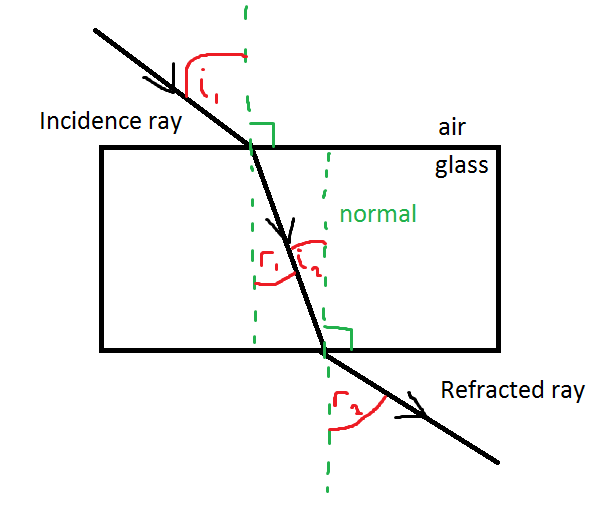
| Refraction diagram: | |
| Things we need to remember about diagram: | i1 > r1 i2 < r2 i2 = r1 r2 = i1 Incident ray and refracted ray are parallel |
| What is the speed of light in a vacuum or in air? | 3.00 x 10^8 ms-1 (3sf) |
| What does the refraction index (n) tell us? | How will it will refract light (note it has no units) |
| How do we work out refraction index? | Speed of light (c) ms-1 / speed of light in substance (cs) ms-1 |
| What is the refraction index of air? | n = 1.00 |
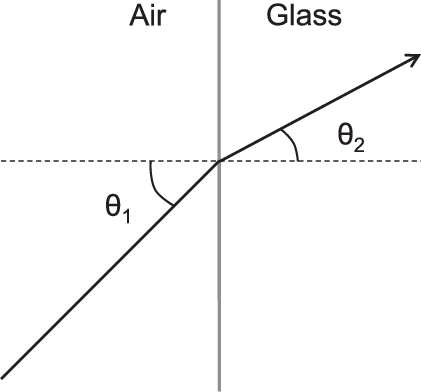
| What is Snells law of diffraction? | n1 x sinθ1 = n2 x sinθ2 |
| if n1>n2 , this means light will bend.... | Away from the normal |
| If n2>n1 , this means light will bend.... | Towards the normal |
| Diagram to show locations of θ1 and θ2: | |
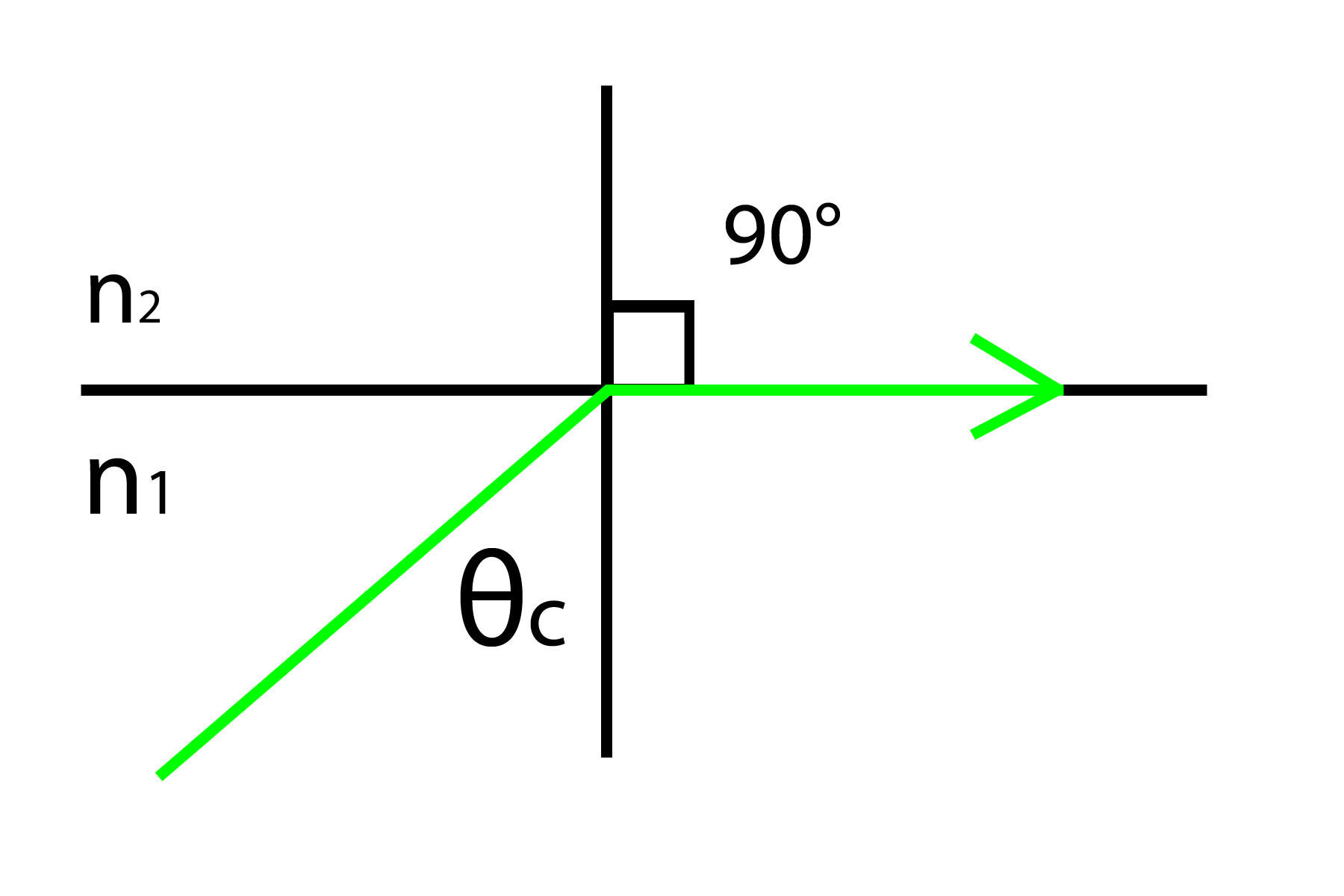
| What is the critical angle? | Where the light ray is refracted along the boundary of the object (θc) |
| If the angle of incidence is smaller than the critical angle then.... | Refraction occurs as normal (may also be a partially reflected ray) (θ1 < θc) |
| If the angle of incidence is equal to the critical angle then..... | The refracted ray runs along the boundary (θ1 = θc) |
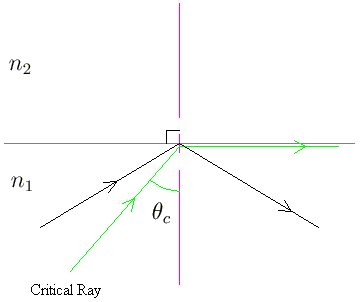
| If the angle of incidence is larger than the critical angle then.... | Total internal reflection occurs (TIR) (θ1 > θc) |
| Critical angle diagram (θ1 = θc) : |
Image:
90deg A (image/jpeg)
|
| Total internal reflection diagram (θ1 > θc) : |
Image:
Internal01 (image/gif)
|
| How do we work out the critical angle? | sinθc = n2/n1 |
| What are the conditions of total internal reflection? | 1. n1 > n2 2. Incident angle > θc |
| What other law applies to total internal reflection? | Law of reflection (angle of incidence = angle of reflection) |
| If n1 = 1.33 and n2 = 1.00 , find θc | sin-1(1.00/1.33) = 48.8 degrees |
Want to create your own Flashcards for free with GoConqr? Learn more.