
18483882


| Question | Answer |
| When does damping occur? | When resistance is added to the motion of an oscillator |
| When damping occurs, what is taken out of the system? | Energy |
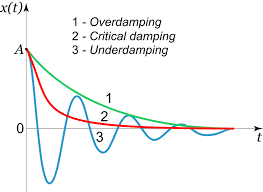
| What does underdamped mean? | System oscillates before coming to a stop |
| What does critically damped mean? | The smallest amount of damping required for a system not to oscillate |
| What does overdamped mean? | Any more damping that critically damped |
| Graph of underdamping, critical damping and overdamping: | |
| How to check if damping graph is exponential: | 1. Decide on value for "change in x-axis quantity." Pick 4 x-values (they should take up a large portion of the graph). They should also change equally 2. Find the y-values at these x-values 3. Check if y1/y2 = y2/y3 = y3/y4 , and if so it's exponential (note doesn't have to be exact) |
| What is free oscillation? | No force acting except internal forces No energy input (following initial displacement) : Oscillates at it's natural frequency |
| What is forced oscillation? | Oscillator is acted on by periodic external force Energy given periodically by an external force : Provides driving frequency |
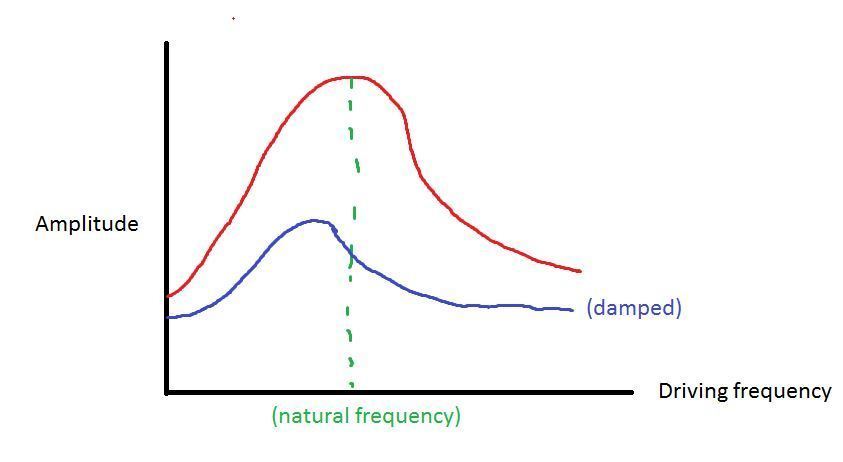
| What is Resonance? | Where the natural frequency = the driving frequency (or approximately) |
| What does resonance cause? | Amplitude of vibration to rapidly increases to a maximum value |
| How do we answer a question on resonance? | State whats providing the driving frequency and the object whose natural frequency is being matched (e.g. washing machine: frequency of drum spinning (driving) = frequency of whole washing machine (natural)) |
| Amplitude against driving frequency graph: | |
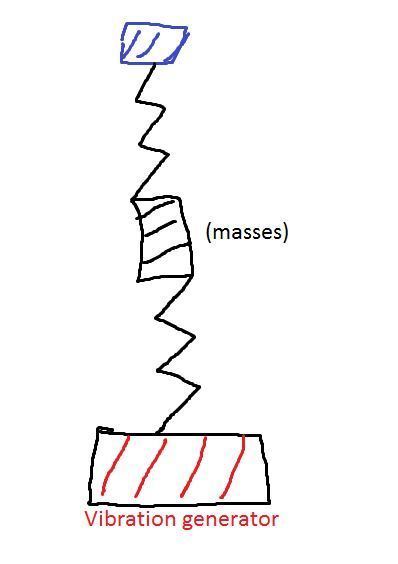
| Set up used for graph above: | |
| On the graph, we need to know the damped line is.... | Lower and the peak is more to the left |
| If the masses bang when oscillating, it means..... | a=g (at top = a(max)) |
Want to create your own Flashcards for free with GoConqr? Learn more.