
19795615
Description

Flashcards by Brandi Hull, updated more than 1 year ago

|
Created by Brandi Hull
about 6 years ago
|
|
| Question | Answer |
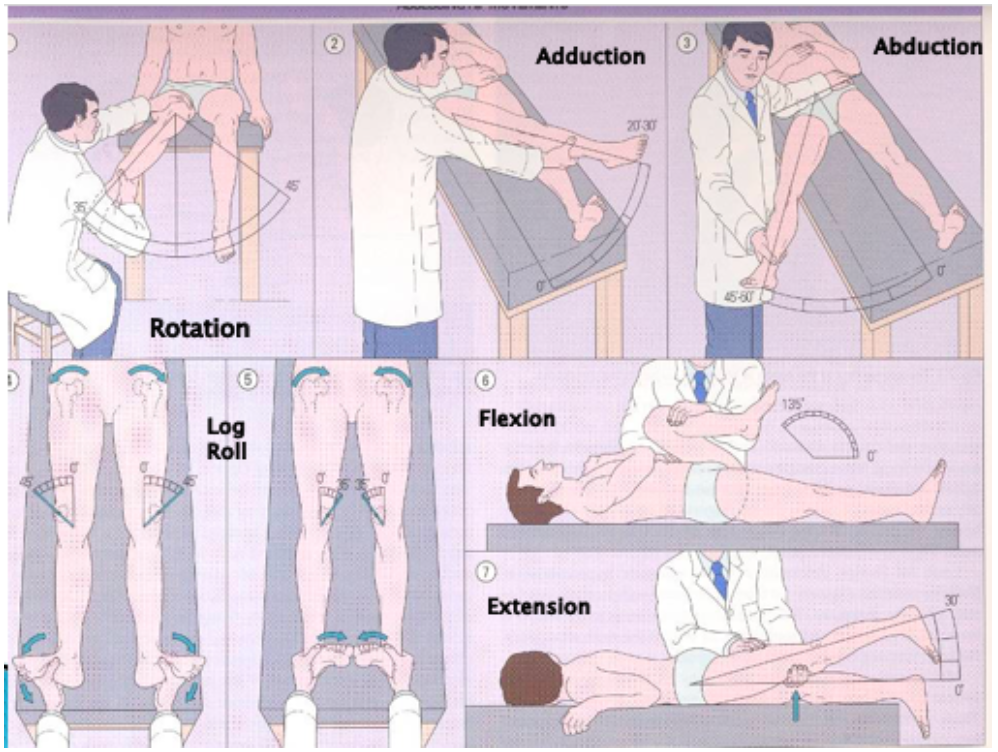
| Hip & Knee | Hip: inspect gross deformity, symmetry of ASIS Palpation (ASIS, SI joints, greater trochanter, lumbar spinous processes, gluteal m.'s, anything indicated by history) ROM: restriction in int. rotation suggestive of hip joint pathology |
| Strength Grade ROM | |
| Neurovascular Test | Sensation over Ant., Post., Medial & Lateral Leg Check femoral & distal pulses |
| Ober's Test | Patient in lateral decubitus position with knees and hips flexed to 90˚, top leg is passively further flexed followed by abduction and extension. Leg is allowed to gently fall toward the exam table. Test is positive if the top knee does not adduct to the table or if passive knee extension occurs. Test is for IT band inflexibility. (Common cause of runner’s knee) https://www.youtube.com/watch?v=Amjv6FzDeLE |
| Modified Thomas Test | Patient sits on edge of exam table, pulls opposite knee to chest, and then lies supine. Exam positive if the thigh rises off of the exam table, or the knee passively extends past 90 degrees. Suggestive of iliopsoas contracture, rectus femoris contracture or quadriceps inflexibility. https://www.youtube.com/watch?v=-c0albG73po |
| FABER Test (Flexion, Abduction, External Rotation) | With patient supine, the hip is passively flexed, abducted and externally rotated. An Axial load can be transmitted by the examiner down the femur. Test is positive if the ipsilateral SI joint hurts. Test is for SI joint dysfunction. Reduced ROM (Hip arthritis, Femoral acetabular impingement, Other hip pathology) Groin or side of hip pain (Hip pathology) Low back pain (SI dysfunction) https://www.youtube.com/watch?v=V1a0E0ssTqA |
| Trochanteric Bursitis | Irritation of the bursa (by trauma/ hip surgery/ movement) between the femoral trochanteric process and Gluteus Medius / iliotibial tract |
| Meralgia Paresthetic | Lateral femoral cutaneous is entrapped between the ASIS and the inguinal ligament |
| Knee Exam | Inspect: asymmetry, effusion, redness, deformity |
| Knee Positions | |
| Knee Palpation 1 | Subtle effusion, Suprapatellar Bursa, Pre-patellar Bursa, Patella Bulge sign: Medial or lateral side compression to move fluid away from medial or lateral compartment |
| Knee Palpation 2 | MCL/ LCL of 90 degree flexed knee Patellar tendon and insertion Posterior knee ( bogginess) Baker cyst Pes Anserine Fibular Head/ Proximal Tibia |
| Knee ROM & Strength | Measure flexion and extension, has minimal appreciable rotation or adductive or abductive ROM Strength: Flexion and Extension- grade X/5 Injured Knee (no extension): Consider quadriceps rupture (needs immediate surgery) Patient supine: have patient perform a straight leg raise with foot neutral or slightly externally rotated. If the patient internally rotates, the patient can still raise the leg using the Tensor fascia lata and Sartorius muscles |
| Knee Neurovascular | Sensation over medial and lateral knee Check Proximal and Distal Pulses |
| Patellar J Sign | With the patient’s leg strait, apply resistance to the superior pole of the patella with the Thenar Space, ask the patient to flex their quadriceps Positive Test if the patella moves medially or laterally before moving caudally, or if pain occurs with this maneuver Suggestive of Patellar Femoral Pain Syndrome https://www.youtube.com/watch?v=4dHF6LxhAMw |
| Patellar Grind Test | With the leg in extension, compress the patella against the femur longitudinally and transversely Positive test if pain or crepitus Suggestive of Patellar Femoral Pain Syndrome https://www.youtube.com/watch?v=4AO_VtrU3yE |
| Patellar Apprehension Test | Patient supine, relaxed quadriceps, knee flexed 30˚-45˚, press against the medial border of the patella. Test positive if the patella begins to sublux, the patient will ask you to STOP! and feel as if their patella is about to dislocate. Suggestive of a patellar retinaculum disruption/ patellar instability https://www.youtube.com/watch?v=4TnCQppTy1g |
| Lachman's Test | Knee flexed to 30˚, hands placed around distal thigh and proximal tibia with the thumb on the tibial crest, attempt anterior translation with the distal hand. Test is positive if endpoint is not detected, or excessive anterior translation occurs Suggestive of ACL injury |
| Posterior & Anterior Drawer Test | With the knee flexed at 90˚, with both hands placed on the tibia, anterior and posterior translation is transmitted through the joint Test is positive if endpoints are not detected or if excessive anterior translation occur Anterior drawer tests for ACL, Posterior drawer tests for PCL |
| Varus & Valgus Stress | With the knee flexed to 30˚ stabilize the femur, and apply varus and valgus stress to the knee Test is positive if there is pain or laxity Valgus Stress tests the MCL Varus Stress tests the LCL |
| Apley's Grind | Patient is prone with knee flexed to 90˚, examiner pushes straight down on the foot while rotating the tibia and partially flexing and extending the knee Test is positive if there is pain over the medial joint line during external tibial rotation, or over the lateral joint line during internal tibial rotation Suggestive of Medial or Lateral Meniscal injury https://www.youtube.com/watch?v=6Z_9lfX_Pc8 |
| Thessaly's Test | Patient standing on the affected limb, flexed 20˚-30˚, patient rotates their body weight on the knee Test is positive if there is pain with rotational movement on the medial or lateral joint line Suggestive of Medial or Lateral Meniscal injury https://www.youtube.com/watch?v=ebraZ4jM36A |
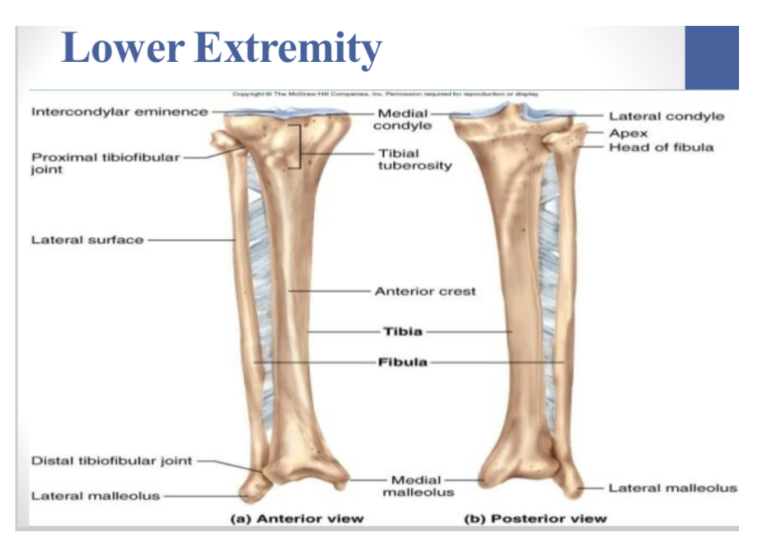
| Leg Bones | |
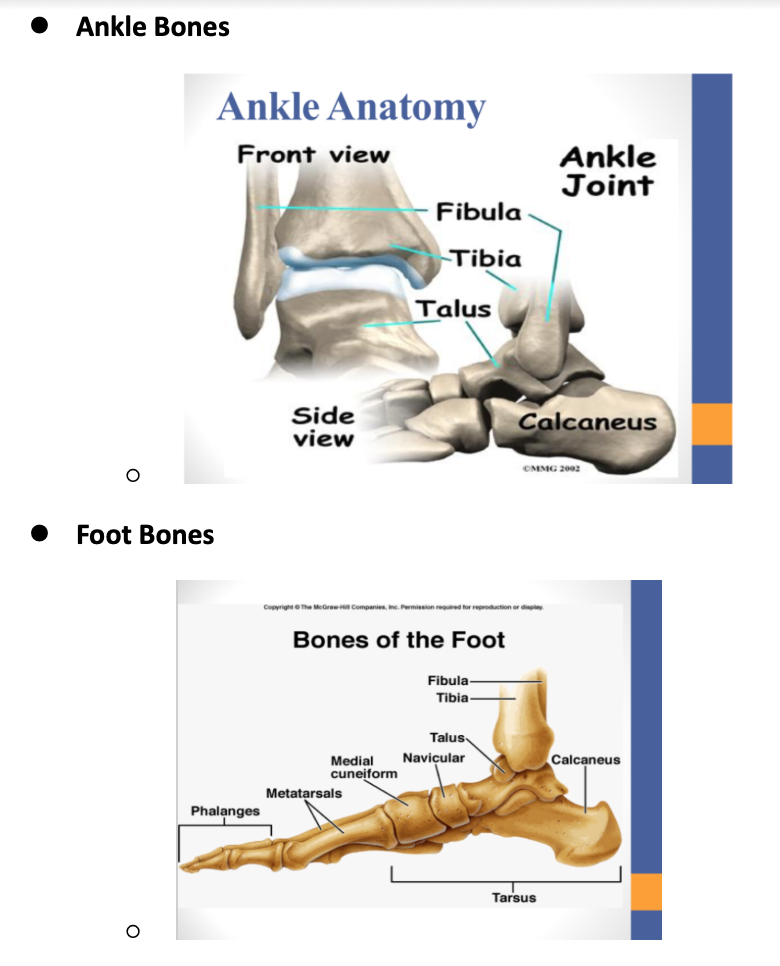
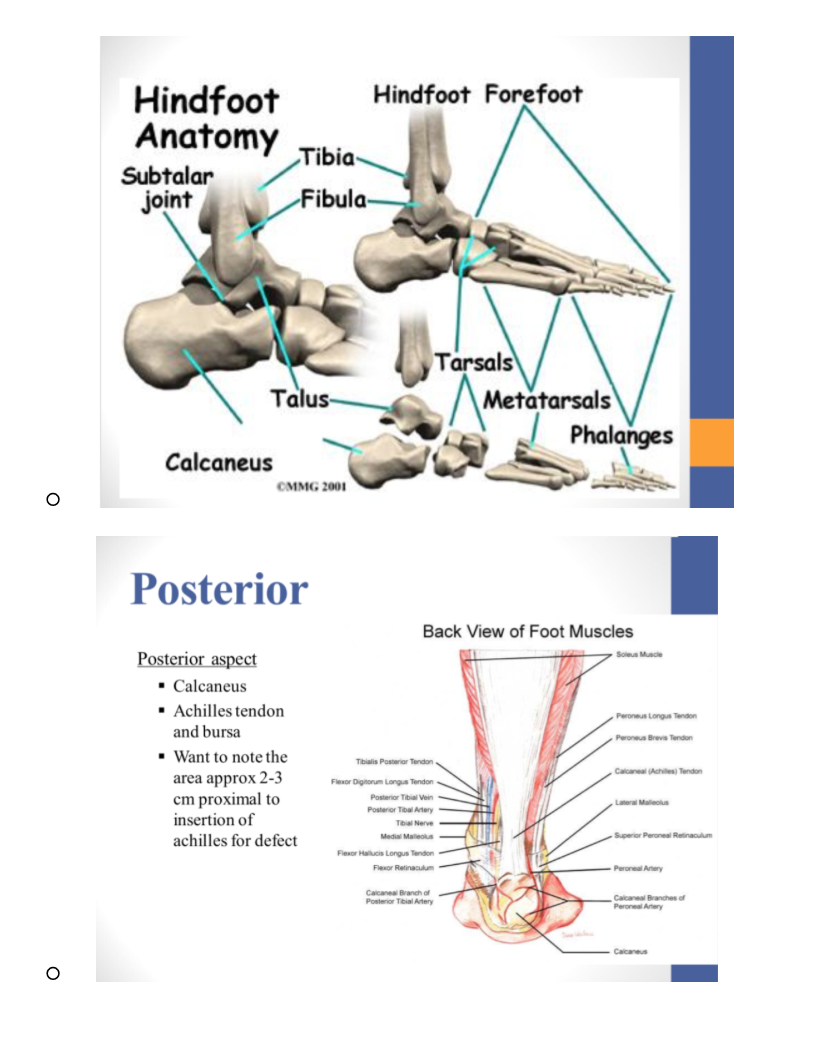
| Foot & Ankle Bones | |
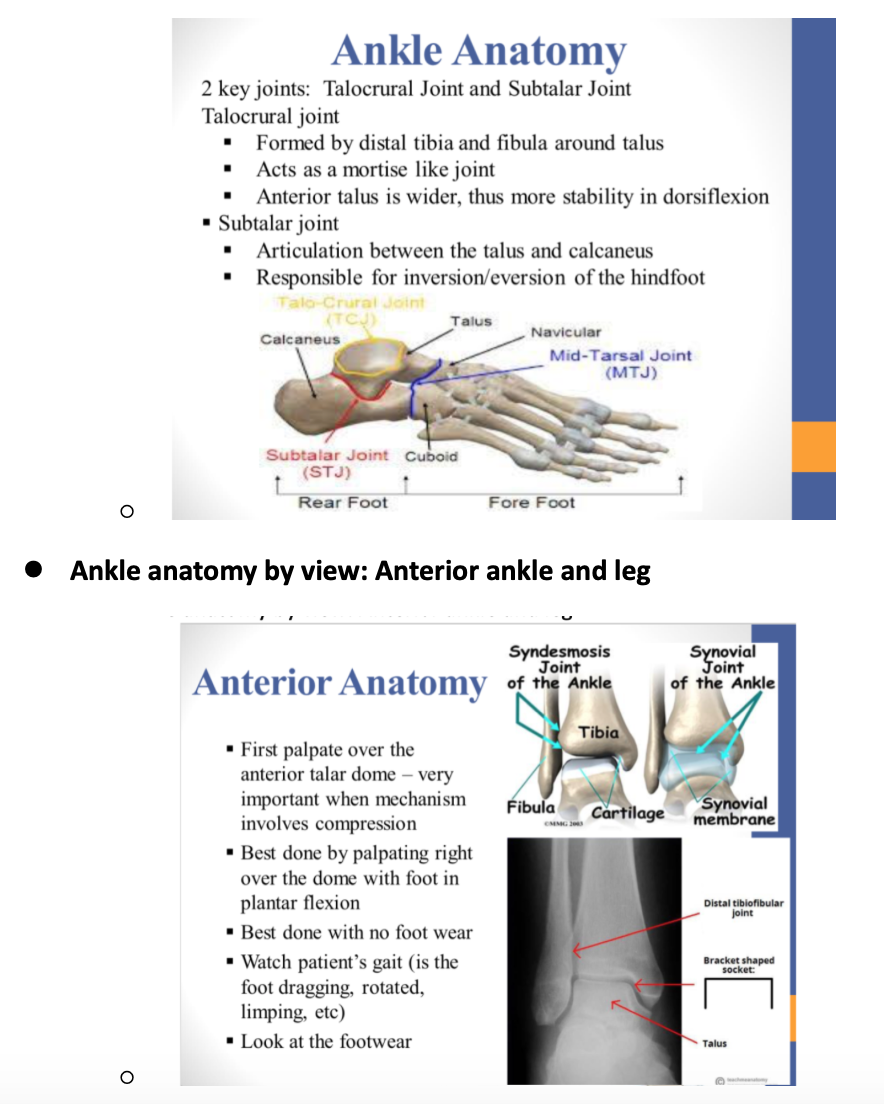
| Ankle Joints | |
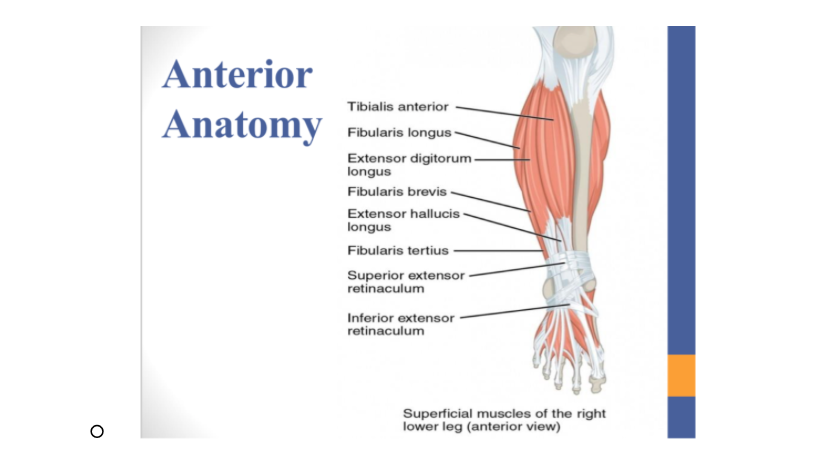
| Anterior Leg Anatomy | |
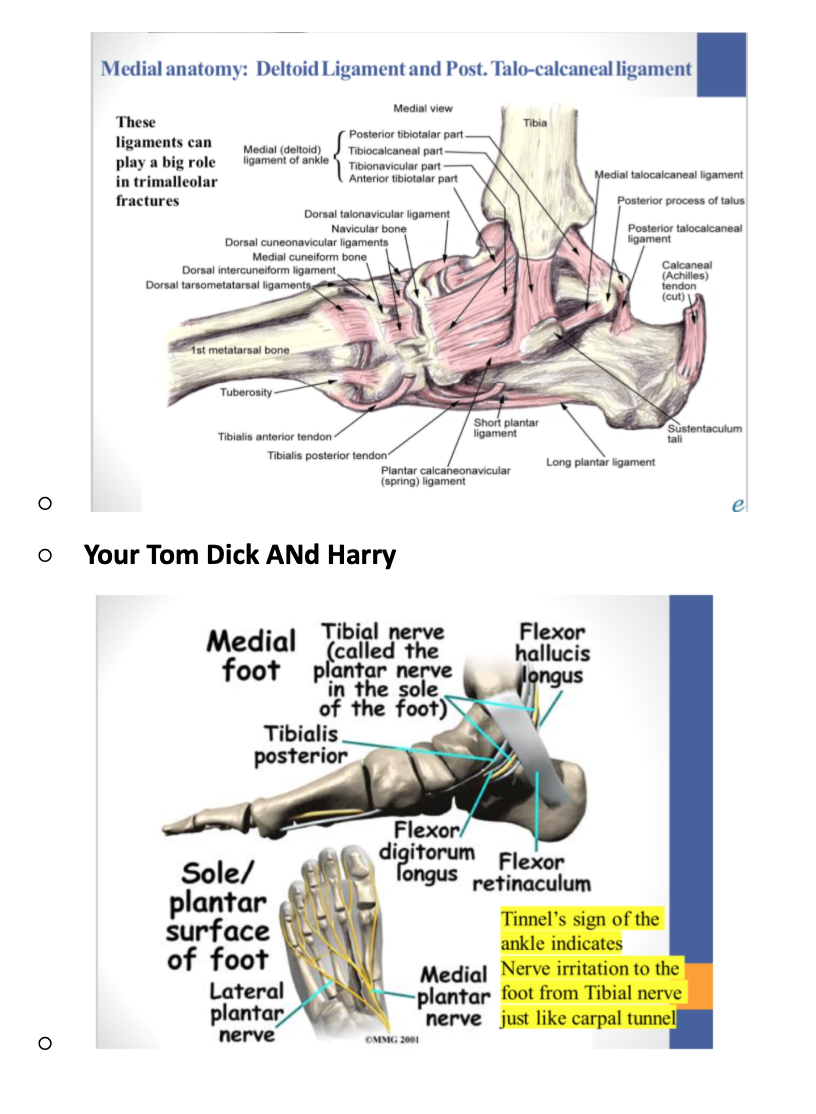
| Posterior Leg Anatomy | |
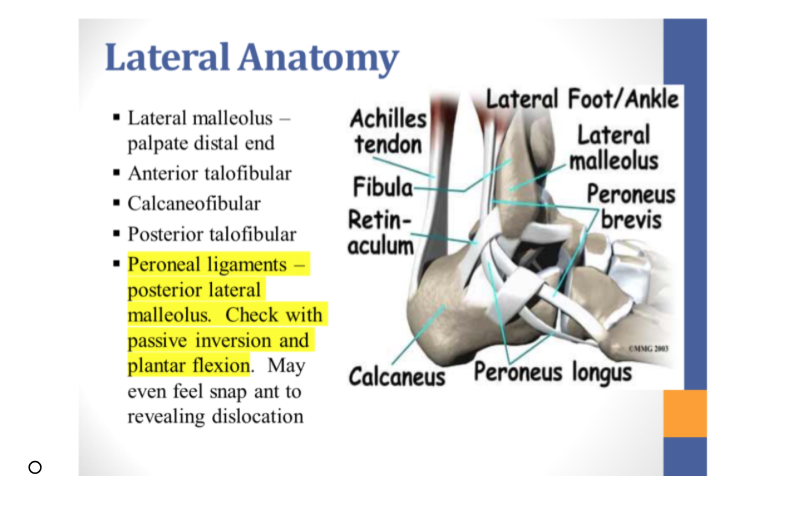
| Medial Ankle Anatomy | |
| Medial Ankle | |
| Lateral Ankle | |
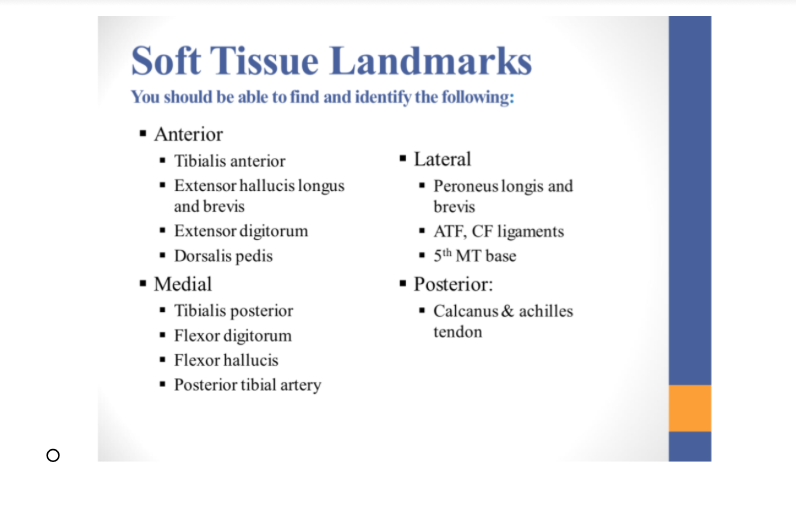
| Ankle Soft Tissue Landmarks | |
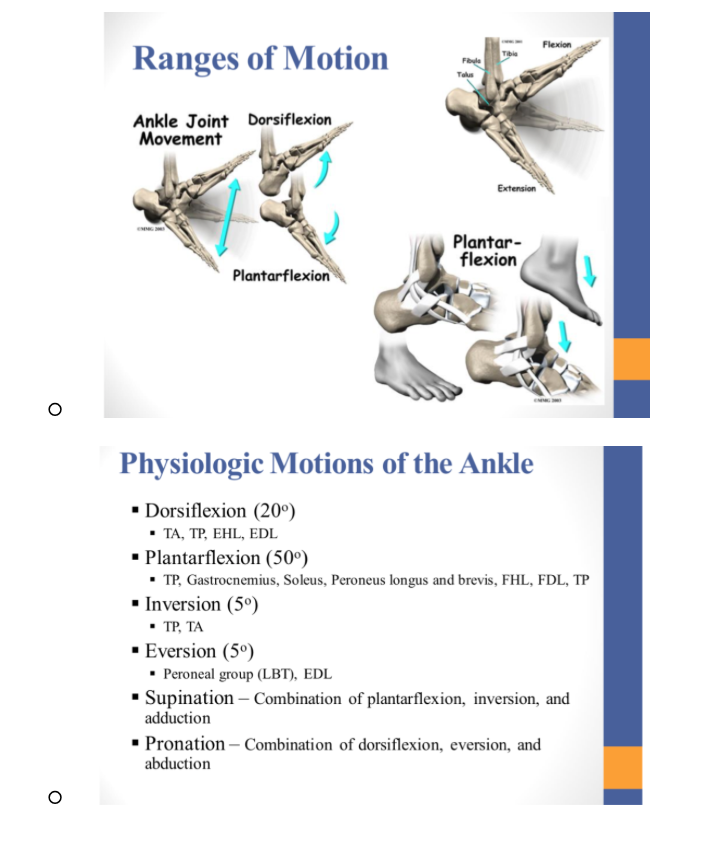
| ROM of Ankle | |
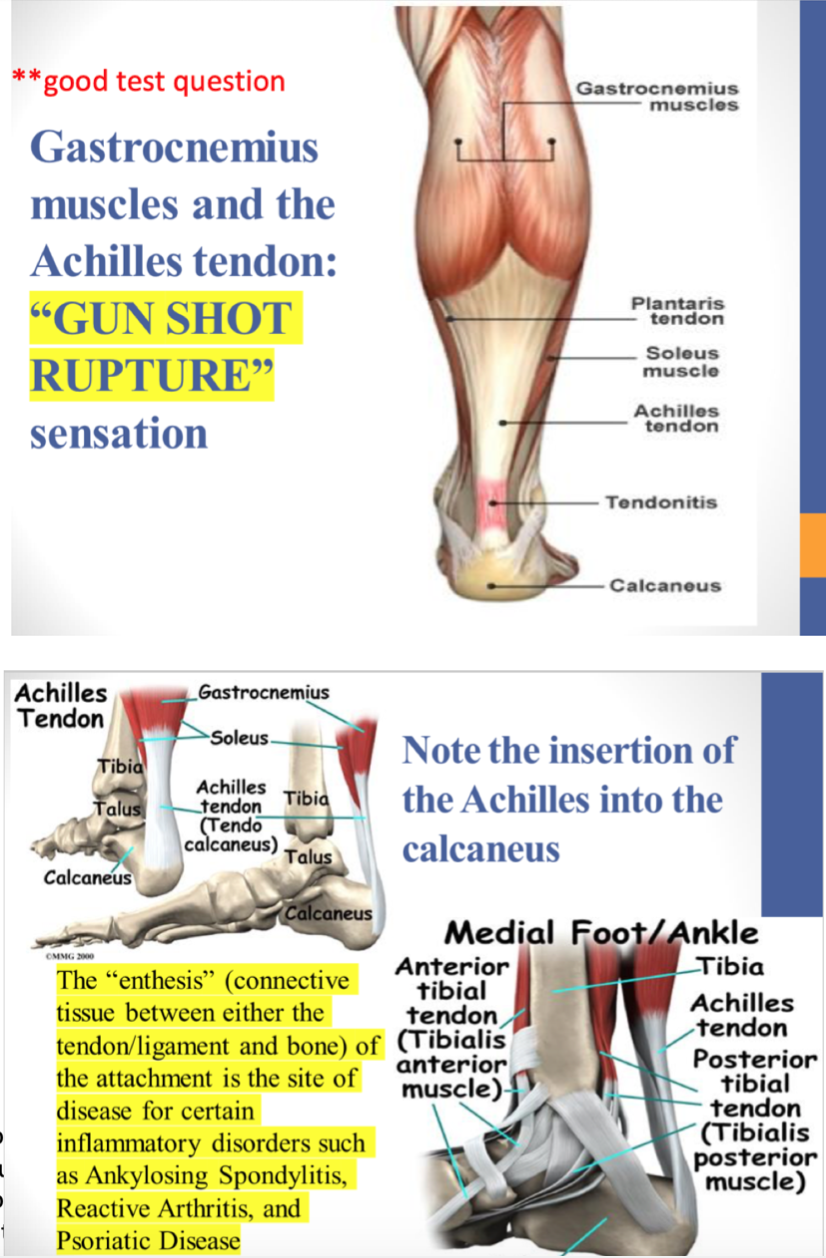
| Achilles Tendon | |
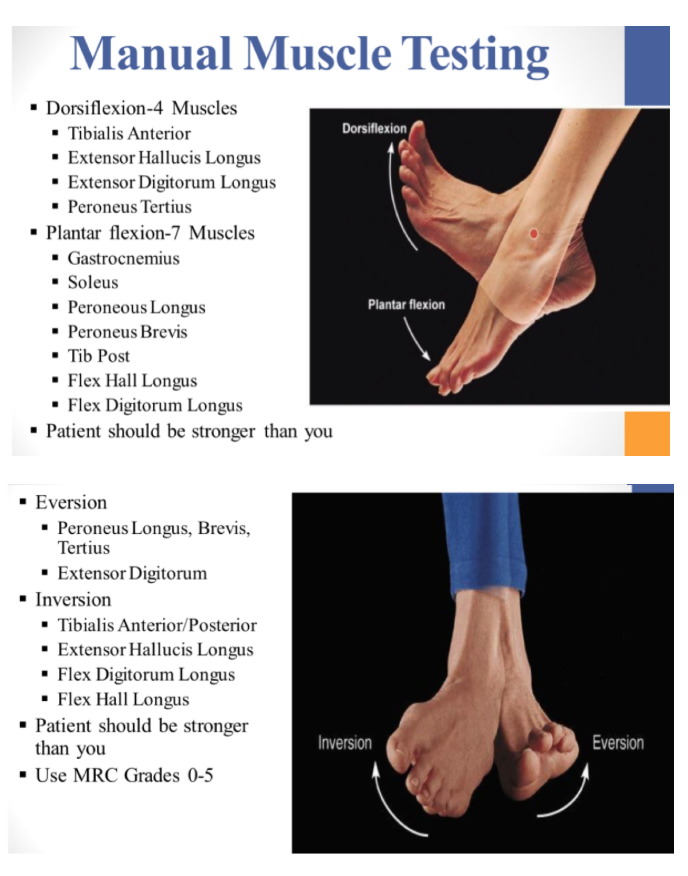
| Manual Muscle Testing of Ankle |


Want to create your own Flashcards for free with GoConqr? Learn more.