
21346254
Description

Flashcards by Albin Jonsson, updated more than 1 year ago

|
Created by Albin Jonsson
almost 6 years ago
|
|
| Question | Answer |
| What is the purpose of organizing an operation, regardless of whether the organization is a private company, a public authority or a non-profit organization? | The purpose of organizing an operation is to achieve efficiency. The goal is to optimize the usage of resources available in the organization. Resources are always limited in an organization, no matter what size the organization is. |
| In the organizational theory, what does the structure of an organization include? Give 2 examples of what it can include. | Research within Organizational Theory focuses on three main topics: structure, processes and culture. The structure of an organization encompasses visible components such as functions, positions, hierarchies, titles and ranks. The structure and culture determine how members of the organization work, collaborate and obstruct one another, how the system is built up or broken down and how decision levels and areas of responsibility are allocated (page 14). |
| What do we mean when we talk about “the culture of the organization”? Give two examples of organizational culture elements and explain. | The culture of an organization relates to values, norms, language, symbols, leadership and motivation. |
| What is lean? | A focus on streamlining workflows and minimizing waste is central to lean. Lean mainly relates to optimization of workflow efficiency, which requires to be unallocated capacity in each step of a process to handle the unexpected. (example Toyota). |
| What is/are the risk/s associated with traditional resource allocation? | Traditional resource allocation is based on each resource being used maximally. Queues are often created, causing delays, and in the worst case scenario giving rise to new needs that must in turn be handled through activities that are not value-generating. |
| In which type of business activity is it easier to achieve high workflow efficiency? | It is easier to achieve high work flow efficiency if you produce similar products and the variation in customer demand is low. |
| Describe the four levels that can describe Lean. | Lean can be described based on four levels: Values: how the organization should act. Principles: how the organization should think. Methods: what the organization should do. Tools: what the organization should use. |
| What does the Japanese concept “Kaizen” mean? | Toyota’s values are constant improvement, Kaizen. In Sweden the word is usually used as a way of keeping quality within the organization, where the activities all the time is developing through small changes. |
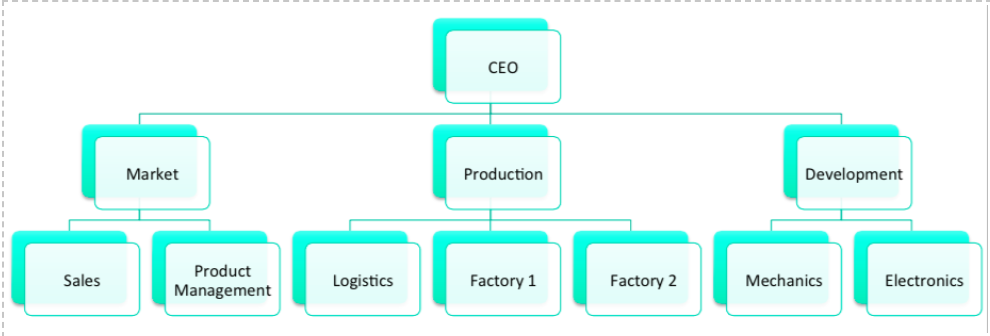
| What is an organizational plan? | The most common way of depicting a company’s formal organization is as a hierarchy with superior and subordinate units. This is called an organization chart/plan. With the organizational plan as a starting point, it is easy for employees to see their roles in the organization. It is easy to follow decision paths and see who your superiors and subordinates are. The division of responsibilities is clear and obvious. |
| Give 2 limitations of organizational plans. | The organization plan does not depict the informal links between different individuals within different units. This can be a problem nowadays, as tasks are increasingly executed in cross-functional project groups, with members from different parts of the organization. Traditional decision paths and delegation methods does not work in networks, which make up an increasingly common way of conducting business in a flexible manner. |
| When is a project a suitable work form? | The project is a suitable work form when there is a need to temporarily coordinate different parts of an organization or link resources from different companies and organizations. A strong focus can be placed on client benefits through goal governance down an an individual level. |
| Draw a hierarchical structure. |
Image:
1 (binary/octet-stream)
|
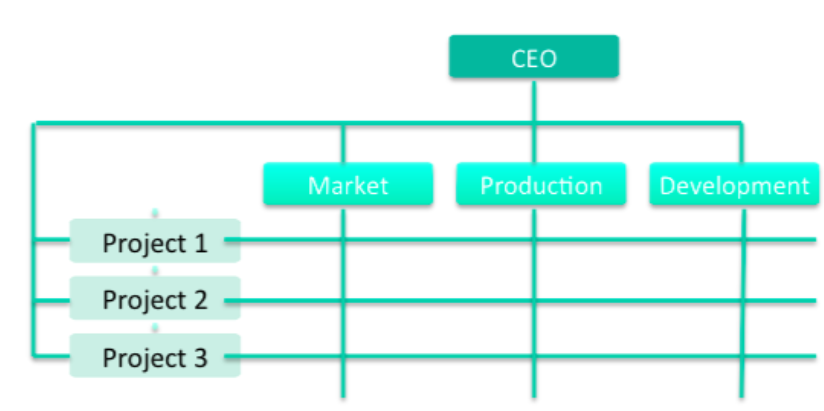
| Draw a matrix structure |
Image:
2 (binary/octet-stream)
|
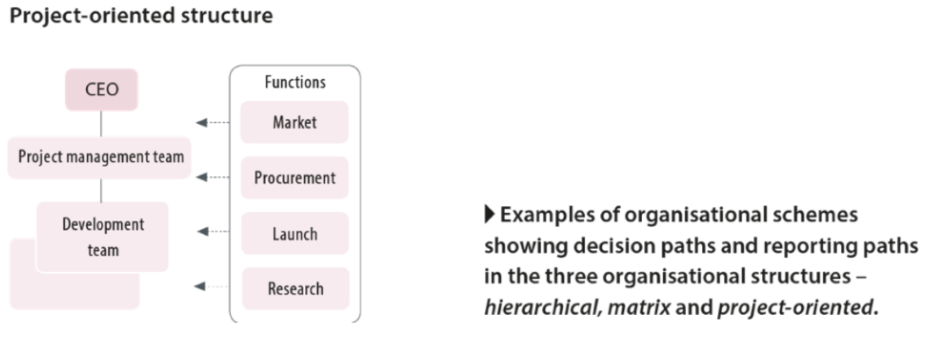
| Draw a project-oriented structure |
Image:
3 (binary/octet-stream)
|
| How is work organized in a hierarchical organization? | Top to bottom. The higher up in the organization the more power and authority. |
| What are the 2 weaknesses of a hierarchical organization? | The space for the individual is small and hard to adapt to altered external conditions. |
| How is work organized in a matrix organization? | Flexible structure. Employees work vertically in the line, while the operations are conducted cross-functionally. It is a managerial task to put together work groups to solve specific tasks. |
| What are the 2 main weaknesses of a matrix organization? | The weakness of the organizational form is the dual decision paths, which demands more from managers in regards to formulating goals and prioritizing tasks. Usually the line organization and projects exist in parallel and the boundary between the different forms of organizations and tasks is diffuse. |
| What are the 2 main differences between a weak matrix and a strong matrix? | In organizations where the hierarchical decision paths dominate, we can talk about a weak matrix. In a weak matrix a small proportion of employees work in projects. Most have positions on the line, where the majority of the work in the operations is conducted. As a consequence, line managers make most decisions, even those related to the projects. The project manager has a low status in this type of organization. In an organizational structure where more people work in projects, the project manager’s ability to make decisions relating to his/her project increases. In a strong matrix line managers only make overall decisions regarding goals, framework and resources. The details are left to the project manager. The majority of the operations are conducted within projects. |
| In the project methodology, what are the three main characteristics that define a process? | The aim of describing a project as a process is to ensure that governance and management of each project is executed in a manner specified in advance. This creates the conditions for developing common methods and work routines and facilitating communication within projects and with external parties. Process definition: A process is a sequence of interconnected activities. A process refines a product or service to fulfill a need. A process has at least one supplier of input and one customer who is the recipient of the outputs. |
| What is the difference between the core process and the support process/es? | The core process constitutes the main workflow of the project and encompasses the tasks that lead to the result of the project. The support process deliver output necessary for executing the work within the core process, e.g. recruitment. |
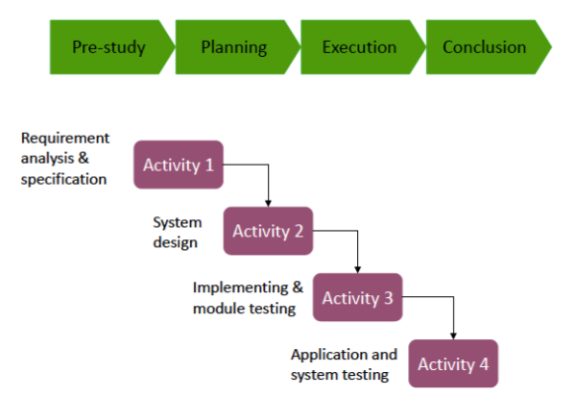
| Draw a typical project lifecycle | Pre-study - Planning - Execution - closure |
| What are the phases of a project life cycle? Explain each of them. | Pre-study: the purpose is to decrease uncertainties by analyzing the bases for executing the project. Requirements must be documented, the scope of the project must be defined, a solution must be selected, stakeholders must be identified and the business benefits must be assessed against costs and risks. Planning: the purpose is to select a method for realization and draw up a plan for how the project goal will be achieved. Activities must be defined, estimated and synchronized, resources must be organized, cost calculated and risk handled. Execution: the results are created and handed over. Activities and costs are followed up regularly, deviations are analyzed and any changes are handled. Closure: The purpose is to evaluate the project, take advantages of lesson learned and phase out the project group. |
| What is a decision point in the project model? | A decision point is a tollgate that can only be passed when the result of the previous phase has been approved. |
| What are the four alternative decisions that can be taken at a decision point in the project model? | At each decision point, a decision meeting is held, which can result in one of four different decisions: Continuing the project as planned. Going back making changes or supplements. Putting the project on hold temporarily. Ending the project. |
| In the traditional project organization, what are the tasks of the project owner? | The owner of the project. Is in charge of business impact goals and project goals. Selects a project manager and allocates resources. Is chairperson of the steering committee. Initiates, follows up and terminates the project. Appoints and chairs the steering committee. Is in charge of the pre-study. Is in charge of business impact realization. |
| In the traditional project organization, what are the tasks of the steering committee? | Ensuring that project is in line with the overall goals of the operations. Determining the project plan and approving the results. Reviewing results and deciding on changes. Handling business opportunities/changes. |
| In the traditional project organization, what are the tasks of the project manager? | Ensuring that delegated tasks are performed. Planning and organizing its own activities. Reporting performance and hours worked. Complying with routines, methods and quality systems. Proposing improvements. Participating in project meetings. |
| In the traditional project organization, what are the tasks of the project group? | Ensuring that delegated tasks are performed. Planning and organizing its own activities. Reporting performance and hours worked. Complying with routines, methods and quality systems. Proposing improvements. Participating in project meetings. |
| What are the similarities between agile methods and LEAN? Name 3 similarities. | Agile methods are based on a set of values, attitudes and principles that describe how work should be organized in a complex, changeable world. The method has much in common with LEAN, including focus on collaborative teams, avoiding unnecessary work and visualizing progress on boards (page 43). |
| What are four pillars of the agile manifesto? | Value individuals and interactions over processes and tools. Value working software over comprehensive documentation. Value customer collaboration over contract negotiation. Value responding to change over following a plan. |
| The 12 agile principles. Name 5 of them. | Our highest priority is to satisfy the customer. Welcome changing requirements, even late in development. Deliver frequently. Business people and developers must work close together. Build teams around motivated individuals and give them the support they need. Communicate face to face. Functional results are the primary measure of progress. Strive for sustainable development. Continuous attention to technical excellence and good design enhances agility. Simplicity and minimizing waste are essential. The best solutions, requirements and designs emerge from self-organizing teams. At regular intervals, reflect on how work can become even more effective and adjust your behavior accordingly. |
| What are agile methods particularly good at in complex and uncertain projects? | Agile methods are based of work in short cycles, with frequent deliveries and continuous feedback loops. This makes it possible to react quickly to changes and apply lessons learned during the course of the project. |
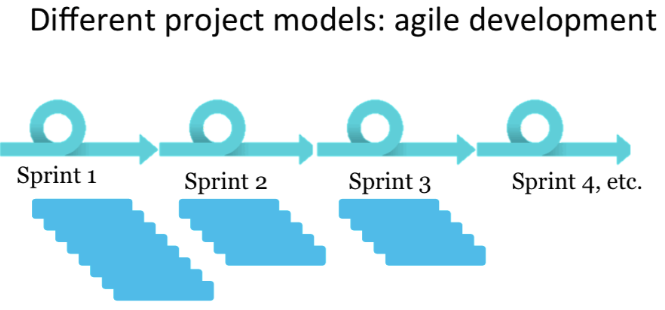
| What is Scrum and what does it mean in practice? | Scrum is method for developing and administering complex products. Is primarily focused on software development and system administration. The central aspect of scrum is an interactive work method that means dividing the task into stages of equal length, usually two or four weeks, called sprints. |
| What are daily scrum meetings organized and what is done during these meetings? | Results are followed up through short meetings where the entire team participates. Each member reports what he/she is doing by answering three questions. What did I do yesterday? What am I doing today? Are there any obstacles? Within the agile development method Scrum, these meetings are called Daily Scrums and should take at most 15 minutes. |
| What are the five conditions needed for a cohesive self-organizing team? | To achieve a cohesive, certain conditions are needed. The group should not be too small or too large. Practical experience has showed that between three and nine people is optimal. The group must have a clear, common goal. The group must have the competence necessary to carry out the task. Everyone should spend most of their time working on the task. The staffing should be fixed and not changed. (Page 46) |
| What are three components of Kanban Board? | Visualization using Kanban boards is a common element in the agile methods. The simplest form of Kanban board has three columns – planned work tasks, work-in-progress and finished. The tasks are written on notes that are moved from left to right as they are initiated, executed and completed. The goal is to visualize tasks that are initiated, executed and completed. |
| In agile project management, what are the tasks of the product owner? | The product owner is responsible for handling the product backlog. His/hers main task is to ensure that the team delivers benefits by taking charge of the requirements and prioritizing what should be done. The product owner also approves the result that each sprint delivers, as well as product releases (page 52). |
| In Agile project management, what are the tasks of the Scrum master? | The Scrum Master’s task is to coach the team and ensure that the agile methodology is used. The Scrum Master has more limited mandate than a project manager. He or she must facilitate collaboration, clear obstacles and help the team so that work is efficient. A Scrum Master should strive to ensure that scrum is implemented in the organization and help employees and stakeholders understand and execute Scrum. |
| If you compare the traditional project management and the Agile project management, what are the main differences with regard to the roles present in the project organization? | Those included in a permanent agile team seldom encounter a project manager, instead, they have a product owner or their closest superior as their manager. In agile project management there is no project owner or project manager, instead there is a product owner and a scrum master. |
| According to the course book, what is the definition of a project? | Specific goal: a unique assignment. The goal must be limited in both scope and time and resources must be available. Specified time period: timed. Specific resources: an independent budget. Unique work arrangements: a temporary organization (page 55). |
| Use the definition of a project to figure out if a ski trip to cervinia for you and your friends week 17 this year with a budget of 15 00 sek is a project? | Specific goal: the goal is to go on the ski trip. Specific time period: the project should be during week 17. Specific resources: we have 150000 sek for hotel and equipment. Unique work arrangement: we are temporarily working together with different tasks in order to go on our vacation (page 55). |
| What is the purpose of forming a business case? | Projects should be business-oriented and a profitable investment for the organization that purchase them. A business case is the basis for investment, showing if a project is profitable and feasible. It describes the project on an overall level, as well as the benefits that the project is expected to create. You can say that the foundation that provides the basis for the initiation decision is a rough Business Case that is analyzed and clarified through the pre-study (page 61). |
| A project has different kinds of goals. Which of the following goals are business impacts goals, product goals and project goals? The project should provide a NPV of 200000 sek By the 5th of May there should be a working prototype The cost of warranty claims is not to exceed 100 000 sek Maximum energy consumption of the product is 500 kWh per 98 % of the users should be satisfied or very satisfied | The project should provide a NPV of 200 000 sek – project goals. By the 5th of May there should be a working prototype – product goals. The cost of warranty claims is not to exceed 100 000 sek – project goals. Maximum energy consumption of the product is 500 kWh per – product goals. 98 % of the users should be satisfied or very satisfied – impact goals. |
| What does SMART mean in a project setting? | Specific: the goal must be clearly formulated and pertain only to this project. Measurable: you should be able to answer YES or NO to the question if the goal has been achieved. Achievable: the goal should be supported by both project members and users. Realistic: the goal should be achievable with the resources that may be used. Timed: the goal should be achieved at a given point of time. |
| What needs to be specified in a project charter? | Usually, what the project owner wants is described in a project charter. There, the background, purpose and goals are presented, along with the name of the project owner and client and the timeframe for the delivery. In internal projects it is also common to specify the project cost. Background Purpose Goals Name of project owner Timeframe for delivery Project cost |
| What is the purpose of a requirement specification and why is it sometimes difficult to make such a document? | A requirement specification defines what the project should deliver. It can be hard to make a requirement specification since it is seldom the case that the requirements are documented in the initiation phase. A requirement specification contains product and project requirements. |
| What does the abbreviation WBS stand for? | WBS= Work Breakdown Structure |
| What are the benefits from making a WBS? | A well-executed WBS facilitates the work of identifying activities and milestones or planning product backlog. It also makes later stages of the project preparations easier. The work structure is also an excellent starting point when responsibilities are allocated in a project or to create the basis for realistic assessments of resource needs and costs. |
| What information is preferably (can be) given in work package? | A work package shows what must be done, but can also contain information about: The time it takes to execute a work package. The cost of executing a work package. The resource required for executing a work package. |
| What does the 100% rule describe? | A WBS should contain all the work included in the project. The sum of the work at the lowest level should be the same as the sum of the work in the entire project. |
| What is the purpose of the asking “why” several times method? | The quality system TQM – Total Quality Management uses a method based on asking the questions “why?”. A number of times. This helps you get to the root of the perceived problem, rather than dealing with something that is just a symptom. The method saves a lot of time and money. With this method, not only goals but also the purpose is reviewed. This result will more likely be a solution that satisfies the project owner even in the long run. |
| What is the label of each corner of the project triangle? | Product quality (Q), calendar time/lead time (T), resources (R). |
| What is the label of each corner of the project triangle? | All projects are limited by a deadline and a budget, which means that the quality – what can be done and at what level of quality – must be adapted. Time, Resources and Quality are the governing parameters of the project. One is always more important than the others. |
| On the project triangle, where is it suitable to situate the opening ceremony of the 2020 Olympic games in Tokyo? Motivate. | Largest focus on time since it is essential that the project is finished and ready to be carried out at the opening ceremony, second biggest priority is the quality since there should be a certain standard on the Olympic games. |
| What is a SWOT-analysis and how is it used in a pre-study setting? | Strengths, weaknesses, opportunities and threats, a clear distinction is made between internal and external factors. The strength of the SWOT-analysis is that it indicates internal strengths that can eliminate weaknesses and deal with external opportunities and threats. The conclusion of the business-oriented SWOT-analysis provide a good decision support in choosing a solution or in stopping the project before it has been initiated. The situational analysis is an important link in the planning chain and, along with the WBS, provides the basis for activity and resource planning, organization and staffing, information and risk analysis. |
| What different groups of stakeholders exist? What is the basis for the classification? | Core stakeholders: stakeholders who prime movers and/or decision makers in the project. Are usually identical with the project’s governance and organization. Primary stakeholders: stakeholders that are highly affected by the project and therefore want to influence it. Secondary stakeholders: stakeholders with relatively low interest in the project, who will likely not actively influence it. Not all stakeholders must be handled in the same way; nor are they of equal importance to the project. For this reason, it can be useful to divide stakeholders into different groups. |
| What is a PENG analysis and how should it be used? | PENG is a method for forecasting beneficial impacts of investments. Performing a PENG analysis as part of the pre-study make it possible to influence the results at an early stage and formulate accurate requirements. With an early focus on benefits it is easier to get managers and employees involved. The total value of all identified benefits, the gross benefit, corresponds to the created client benefits. In order for the project to be profitable, the benefits that are hard to assess + indirect result-impacting benefits + direct result impacting benefits – project costs. |
| What are the three types of benefits that the result of a project creates? | Benefits hard to assess. Indirect benefits. Direct benefits |
| Give examples of the different categories of benefits that the bridge between Malmö and Copenhagen can create. Motivate. | Direct benefits: Faster way for commute between Malmö and Copenhagen, a cheaper alternative to commute for people living in Copenhagen and working in Malmö or vice versa. Indirect benefits: more tourism due to people from Denmark or northern Europe travel to Sweden. Benefits hard to assess: More career opportunities due to faster commute, higher satisfaction for people who prefer to travel by car. |
| What dos the MOSCOW stand for in a project setting? Explain. | Moscow: stands for Must, Should, Could and Won’t which mean. Must: necessary resources, must be fulfilled for the results to be usable. Should: Nice to have requirements, that should be fulfilled to realize the business case. Could: non-obligatory requirements, that could further increase the value of the delivery. Won’t: Requirements that are postponed until coming projects. |
| Why and how should MoSCoW be used? | MoSCoW is a method for evaluating requirements from the agile development method DSDM, where it is used to prioritize what should be done in each sprint. In agile work methods, like Scrum, you break down what must be done into tasks and requirements, which are entered into a list called a product backlog. The product backlog encompasses the entire project and is divided into spring backlogs, which govern what should be done in each stage – or sprint. |
| What is a milestone plan and how is it used? | The milestone plan is a special version of the logical network, showing only the milestones of the project. A milestone is a sub-goal on the course from the project’s beginning to its end. These are checkpoints that help the project manager follow the project during execution. A milestone is something that must be achieved. A milestone plan should be simple to give an overview of the project. The milestone plan is an excellent basis for communication how the project will be executed. |
| Two persons ride in a car. Person A says “there is a coffee shop over there, do you think they have coffee” person B says “yes” and drives by the coffee shop. Person A gets irritated. Use the Shannon and Weaver communication model to explain what went wrong. | A message must be formulated and designed so that the recipient interprets in the manner intended. This is called encoding and decoding. If this processes don’t work, misunderstanding can arise. It is important that the sender and recipient use the same key, i.e. that they communicate in a way that both parties understand. |
| What are the different learning styles (Kolb) and why is it fruitful to mix them in a project? | In order for communication within a project group to work, it is helpful to know what learning style each participant has. If the project manager knows how each member takes in information, he or she can tailor messages and use the correct channels. CE concrete experiences: learns through experience and by making things happen. RO reflection observation: learns by studying what others do. AT abstract thinking: learns by understanding logic and models. AE active experimentation: learns by doing things independently. |
| What is the purpose of a communication plan? | The communication plan is the tool for ensuring that the right target group gets the right information in the right way and in the right time. The communication plan also ensures that the project manager gets the information flow needed to perform his or her job. The plan encompasses both information the project should send out an that must be gathers. |
| What are the criteria for defining level/type of communication? | To choose the communication channel that suits your purpose and target group best. |
| What is the purpose with the six thinking hats? | It is an effective method of problem-solving that avoids the fixed positions that easily arise during heated debates. The method can also decrease the length of meetings. The various hats represent different perspectives and viewpoint. The method asks participants to take on the role that a hat represent and take the stance to a question or problem that hat color entails. It is an effective method of problem-solving that avoids the fixed positions that easily arise during heated debates. The method can also decrease the length of meetings. The method consists of six coloured hats: •White hat – facts, information and objectivity •Red hat – passion and feelings •Black hat – problems, risks and logical negativity •Yellow hat – Benefits, strengths and logical positivity •Green hat – Creativity and innovation •Blue hat – Summarizing, prioritizing and managing. |
| What are the benefits of visualizing your project? | You get an oversized schedule where the results of the project and changes can continuously be noted down. Seeing results and plans daily increases the awareness within the project group of what is to be done and what must be prioritized – this leads to anchoring within the project group and among stakeholders who visit the project room. |
| Why is it important to keep a project diary? | The project manager should keep a personal project diary during the project and enter everything that happens there. The diary is an irreplaceable source of information in any disputes on what has been decided. Memory can change over time, but the written word cannot. The diary is also useful un compiling status reports and the final report for the project. |
| What is the difference between a plan and a strategy? | Project planning is primarily done during the planning phase. However, planning is required throughout the project, as some changes and new conditions cannot be foreseen at the beginning of the project. Project planning means choosing a strategy, a route to the goal, but also deciding in detail what should be done by whom. A strategy states the overall decisions on how to achieve the desired impact, while a plan describes the steps required to reach the project goal and will likely be changed a several times during the project. |
| Name 8 elements/headings included in a project plan. | Summary Background/purpose/goals Requirement specification Delivery and implementation Situational analysis and stakeholders. Organization and staffing Communication Milestones Activities. Schedule Budget and benefits assessment. Risk analysis. Routines for change management. |
| Draw a sequential development planning model/waterfall planning model. |
Image:
4 (binary/octet-stream)
|
| Draw a concurrent engineering planning model. |
Image:
5 (binary/octet-stream)
|
| Draw a rolling wave planning model |
Image:
6 (binary/octet-stream)
|
| Draw an agile sprint planning model |
Image:
7 (binary/octet-stream)
|
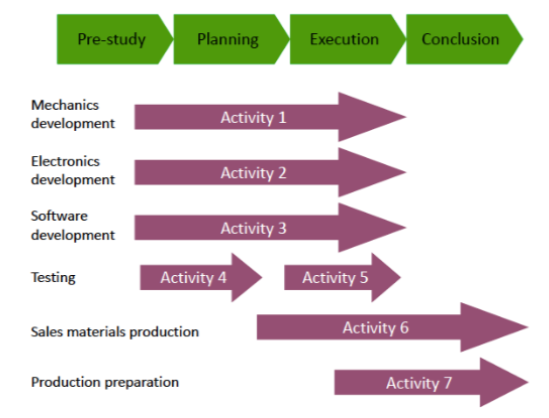
| What is rolling wave planning? Explain. | Different parts of a product are developed simultaneously. This is common in a product development. Mechanisms are designed and constructed alongside electronics and software. Everything is fused into a prototype for testing before the project moves ahead. |
| What are pros and cons of concurrent engineering planning? (Name one + and one -). | + is that the more things you do in parallel the more time you can save. - A drawback is that you are taking a bigger risk. Such risks can be decreased by adding checkpoints in the plan, where development in the different areas is followed up and desired changes are discussed. |
| What is sequential development planning? Explain. | Each activity must be completed and approved before the project can “spill over” into the next activity. |
| What are the pros and cons with sequential development planning? (+ and -) | + Relatively low-risk work method. - Not many projects are executed in this way, it takes too long. |
| What are the 8 steps in the planning chain? | Determine the purpose and goal. Define the scope of the project. Compare with requirements. Create logical network. Plan activities. Draw up aa schedule/bar chart. Map out resource needs. Estimate costs. |
| What are the 5 resources usually needed in projects? | Project members: people must have knowledge necessary for their tasks. Equipment: the complexity and type of project define the need of equipment. Materials: include everything that will be used by the project and is needed to create the product of the project. Time: time that may be invested in working on the project. Money: to pay for the resources in the categories people, equipment and materials. |
| What does a Gantt chart illustrate and why is it used? | Illustrate the activities as bars, milestones as dots and dependencies as arrows. The schedule is an activity plan with a time plan. It is the most visible proof of how the project will be executed and thus provides the basis for follow-up and quality reviews during execution. |
| What does a logical network illustrate and why is it used? | Shows dependencies between activities, they can be different types. There are four different versions of dependencies between activities A) finish-to-start, b) Finish-to-finish c) start-to-start d) start-to-finish. |
| What does a resource histogram illustrate and why is it used? | Shows the resource usage over time. In the resource histogram, the capacity of individual resources and of the project as a whole is presented. Resource histograms are effective tools when resources are shared between different projects, this does require that some form of tool is used to get an overview and share or prioritize resources between projects. |
| What does a Work Breakdown Structure illustrate and why is it used? | An efficient method for visualizing a project is to structure the work that must be executed to achieve the results of the project. Structuring project work is the foundation of the pre-study and eventually, planning. A well-structured WBS facilitates the work of identifying activities and milestones or planning product easier. In structuring, you break down the project goals into smaller parts in a hierarchical structure. The parts on the first level of detail are called main packages, while those on the lowest level are called work packages. |
| To plan for uncertainties is an important aspect of project planning. Name two strategies of estimate uncertainties. Explain each of them. | Lichtenberg: you assess uncertainties, such as how large the chance is that a project will be completed within desired time period. PERT method: analysis method, main difference is the weighting of the expected value and the standard deviation. |
| Why is it risky to have the project manager select the project group? | The drawback of giving a project manager the chance to staff the project is that he or she is likely to choose familiar people, with whom he or she has already worked. The project manager does not want to risk the project by involving people he or she does not know or is unsure about. Competent, experienced people may become overworked, while inexperienced people never get a chance to prove themselves. |
| In a well-functioning matrix organization, how should the process of staffing the project-group take place? | In a well-functioning matrix organization, with line managers who are competent resource owners, the project manager need only to ask for the type and number of resource he or she needs The resource owner then supplies the project manager with people having the right competence. |
| What is procurement process? | Projects that want to acquire resources, equipment or materials from external suppliers must perform a procurement process, which begins with identifying the needs that are the best externally. Usually, the process begins with sending out a request for proposal to the suppliers assessed as capable of fulfilling the demands. PMI defines the following documents: invitation for BID (IFB), Request for proposal (RFB), Request for quotation (REF), Invitation for negotiation and contractor initial response. |
Want to create your own Flashcards for free with GoConqr? Learn more.