
2401021


| Question | Answer |
| The demand curve for the firm operating under perfect competition is | Perfectly horizontal |
| The demand curve for the industry's AS/AD model is ________ | downward sloping to the right |
| What does P = MR mean in perfect competition? | there is no pricing strategy. All firms are price takers, and the demand function is horizontal. |
| What does P = MC mean, in perfect competition? | implies that the price of the product is equal to the extra cost incurred by the seller in producing the extra unit of production. |
| What does P = Minimum Average Cost mean, in perfect competition? | implies that firms are operating at zero economic profits, and that efficiency has been attained. Each unit of production equals the price that the consumer is willing to pay. |
| What is the optimal output in perfect competition? | MR = MC. In some cases, there will be no level of output at which MR = MC. To determine the optimal output in such cases, select the highest level of output at which MR > MC. |
| The difference between price elasticity of supply in the short run vs the long run in perfect competition? | price elasticity of supply is greater in the long run than in the short run since there are more opportunities for substitution of inputs. |
| The firms are price takers in perfect competition because | o The firm sets its price above the market price, customers will buy the identical product from another seller o If a firm lowers its price below the market price, it will incur losses and not increase its sales significantly, if at all, since each firm has a very small share of a very large number of sellers. |
| When is the shut-down position in perfect competition, and why is this so? | If P < AVC, you should stop production. This is the shut-down position. This is because you are actually spending more money on production than you are getting from revenue, and it is not worth it. Just shut down and pay the TFC as your losses. |
| How do you find the total profits at the optimal level of output? | Total Profits = Q(P-ATC) |
| How do you find the total losses at the optimal level of output? | Total Losses=Q(ATC-P) |
| In the short run in perfect competition, what is the supply curve identified as and why? | identified as that portion of the marginal cost (MC) curve above its intersection with the average variable cost (AVC); the firm is only willing to supply its products or services if the given market price is greater than its average variable costs. |
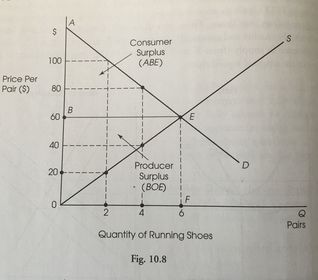
| Producer surplus | the producer was willing to produce a certain output at a lower price than the equilibrium. This can be determined by calculating BOE. |
Want to create your own Flashcards for free with GoConqr? Learn more.