
24491193
Description

Flashcards by Mokshaguru Saravanan, updated more than 1 year ago

|
Created by Mokshaguru Saravanan
over 5 years ago
|
|
| Question | Answer |
| What are the 4 methods of Installation? | Direct cut-over, Parallel, Phased and Pilot |
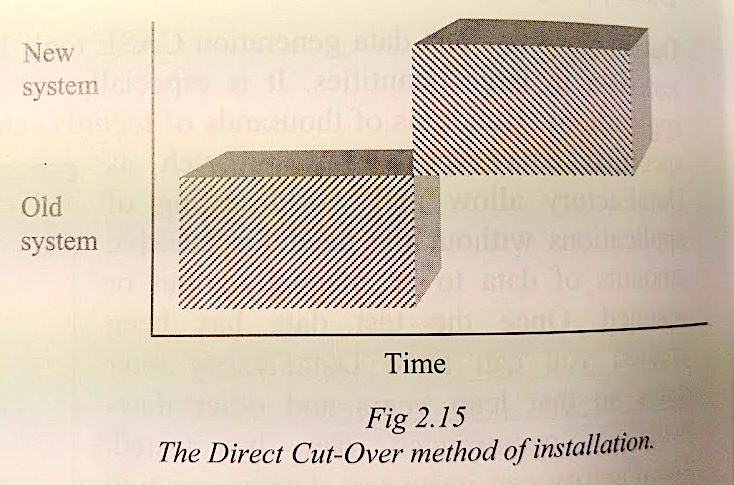
| What does the direct-cut over method involve? | The direct-cut over method involves an old system being completely dropped and a new system being completely installed at the same time. |
| When is the direct-cut over method used? | The direct-cut over method is used when it is not feasible to continues operating two systems together. |
| Advantages and Disadvantages of the direct-cut over method: | Advantages: less expensive since only one system is in need of operation at a time. Disadvantages: You must be absolutely sure that the new system is totally functional and operational. + Users have to be fully trained in the operation of the new system before the conversion takes place. |
| Diagram of the direct-cut over method: | |
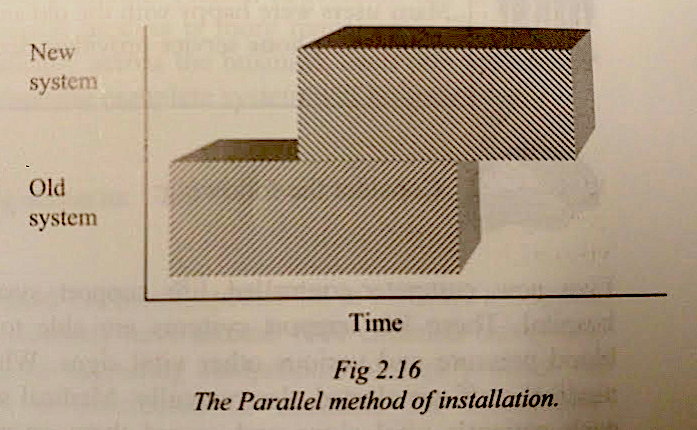
| What does the parallel method involve? | The parallel method involves operating both systems together for a period. |
| When is the parallel method used? | It is especially useful when the product is of a crucial nature and dire consequences would result if the new system were to fail. |
| Advantages and Disadvantages of the parallel method: | Advantages: Allows any major problem with the new system to be encountered and corrected without the loss of data + gives users time to familiarise themselves with the system. Disadvantages: involves double the workload for users as all functions must be performed on both the old and the new system. |
| Diagram of the parallel method: | |
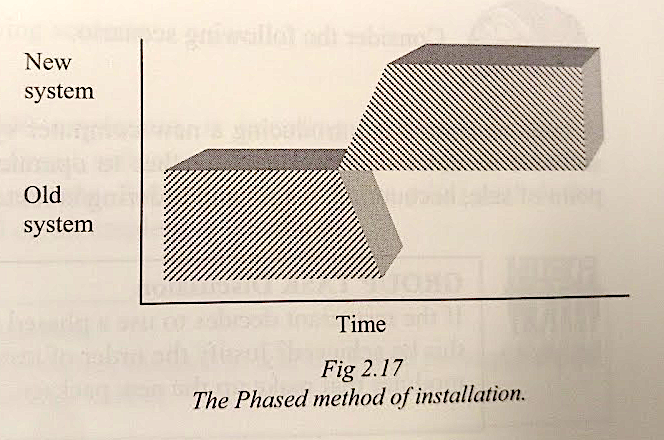
| What does the phased method involve? | The phased method involves a gradual introduction of the new system, whilst the old system is progressively discarded. |
| When is the phased method used? | It is often used because the product, when a whole, is still under development. This way, completed modules are released to customers as they become available. |
| Advantages and Disadvantages of the phased method: | Advantages: For large businesses, the conversion process is more manageable. Disadvantages: Takes a long time since phases need to be implemented separately. |
| Diagram of the phased method: | |
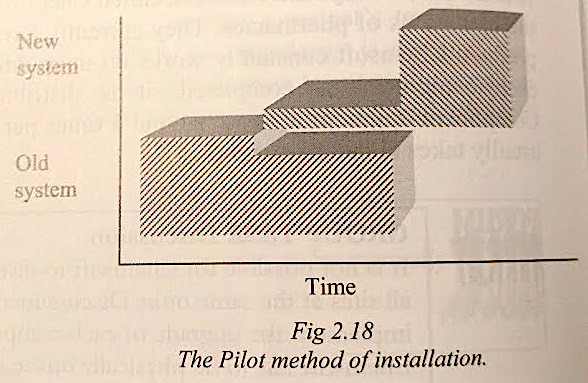
| What does the pilot method involve? | The pilot method involves a new system released and installed for a small number of users, who then can learn, use and evaluate the new system. Once the new system is deemed to be performing satisfactorily, then the system is installed and used by all. |
| When is the pilot method used? | This method is particularly useful for new products, as it ensures functionality is at a level that can perform in a real operational setting. |
| Advantages and Disadvantages of the pilot method: | Advantages: Ensures functionality is at a level that can perform in a real operational setting. + Allows a base of users to learn the new system who can then assist with the training of others. Disadvantages: Department managing the installation could lose data if the new system fails. |
| Diagram of the pilot method: |
Want to create your own Flashcards for free with GoConqr? Learn more.