
34859636
Description

Flashcards by Alice Sohn, updated more than 1 year ago

|
Created by Alice Sohn
about 4 years ago
|
|
| Question | Answer |
| Cubic functions (4 characteristics, graph) | 1. observable I.P. 2. unbounded both direction 3.exhibit an observable extremum 4. two concavities |
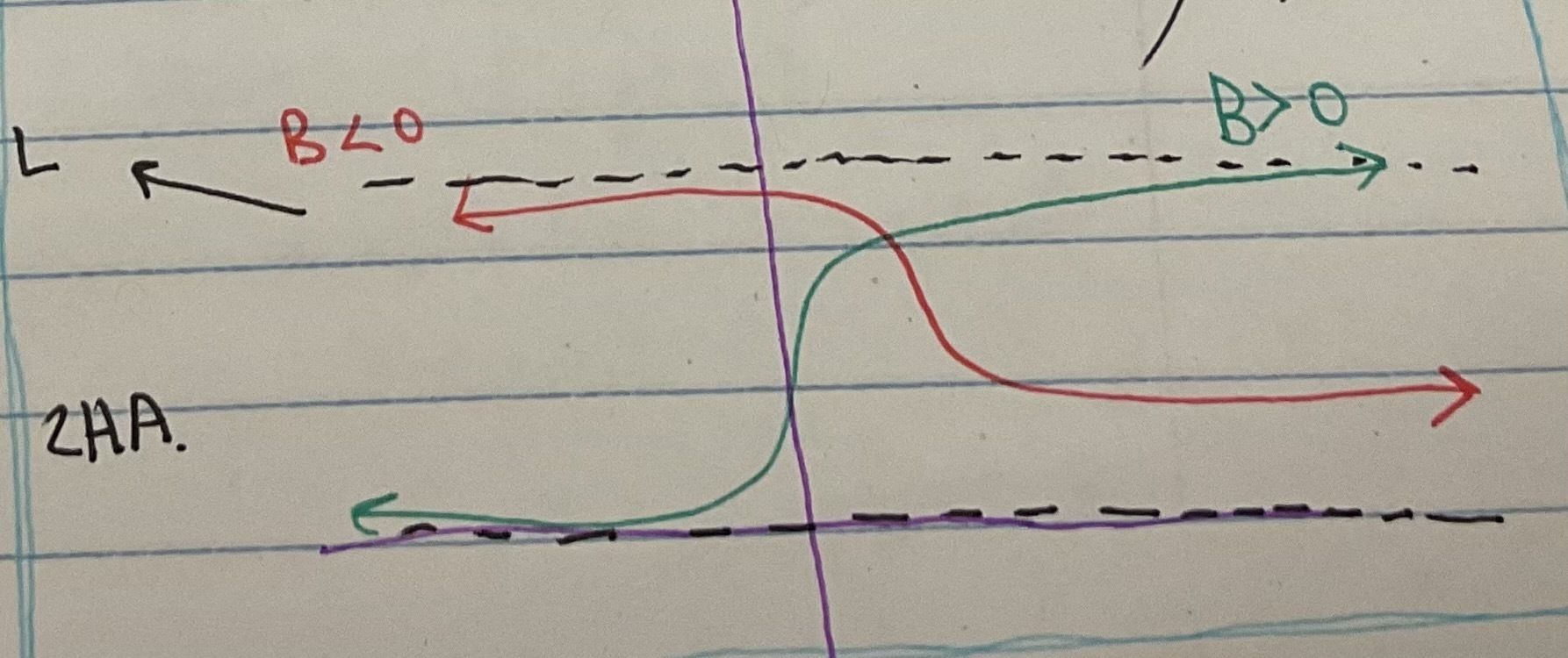
| Logistic (4 characteristics, graph) | 1.observable I.p. 2.bounded 3.Two H.A. 4. limiting value |
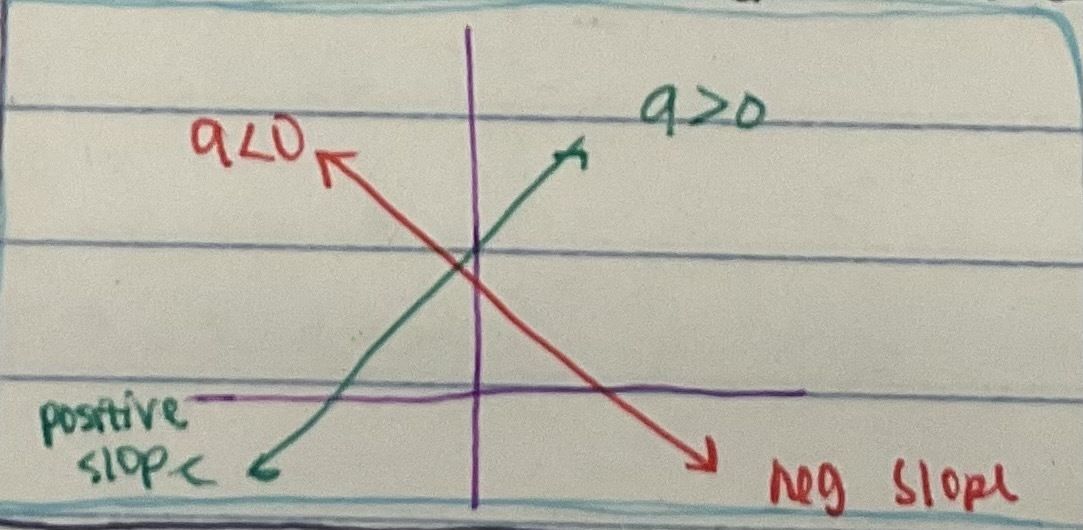
| Linear (5 characters) | 1. no concavity 2. constant ROC 3. unbounded in both directions 4. y-intercept 5. constant first difference |
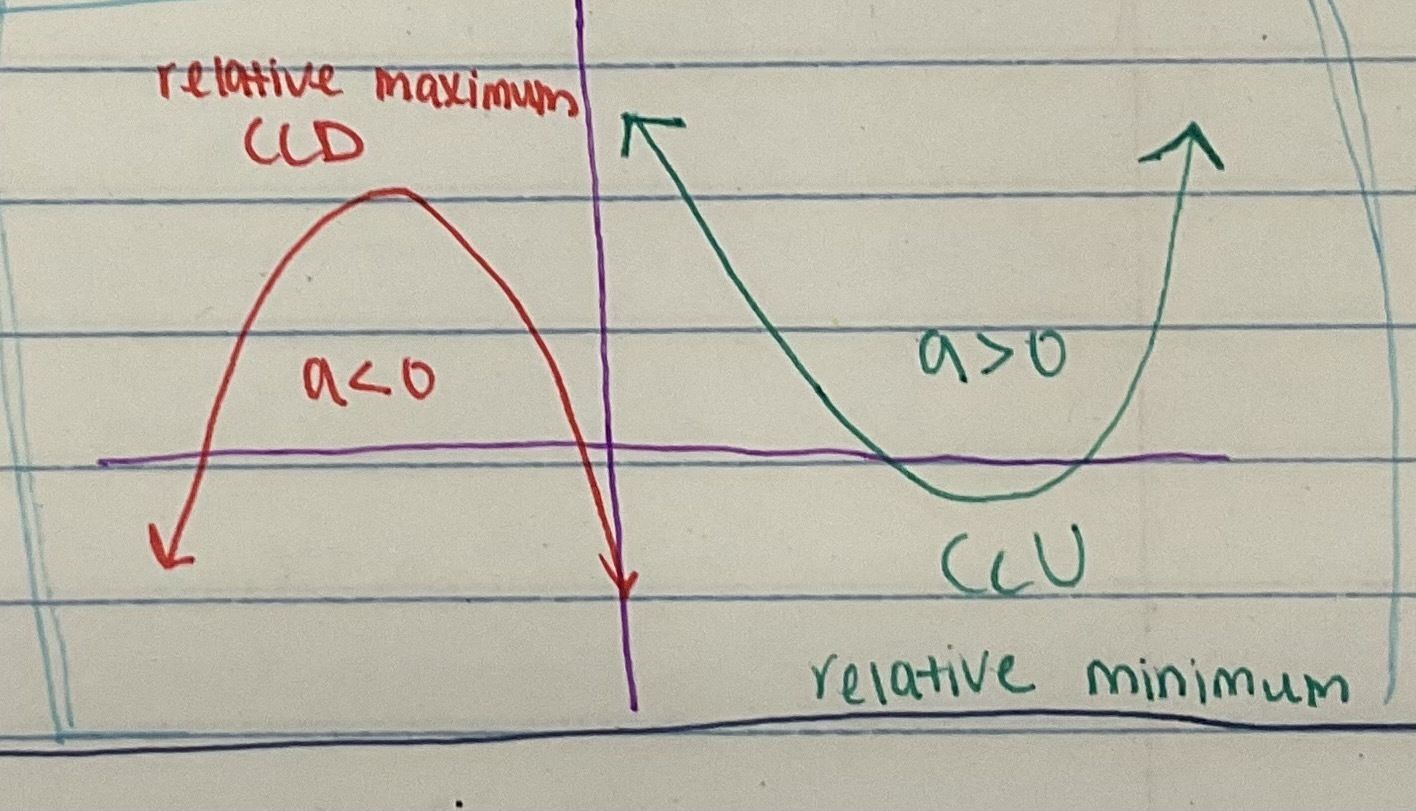
| Quadratic ( 3 characters) | 1.observable extremum 2.one type concavity 3. unbounded in one direction |
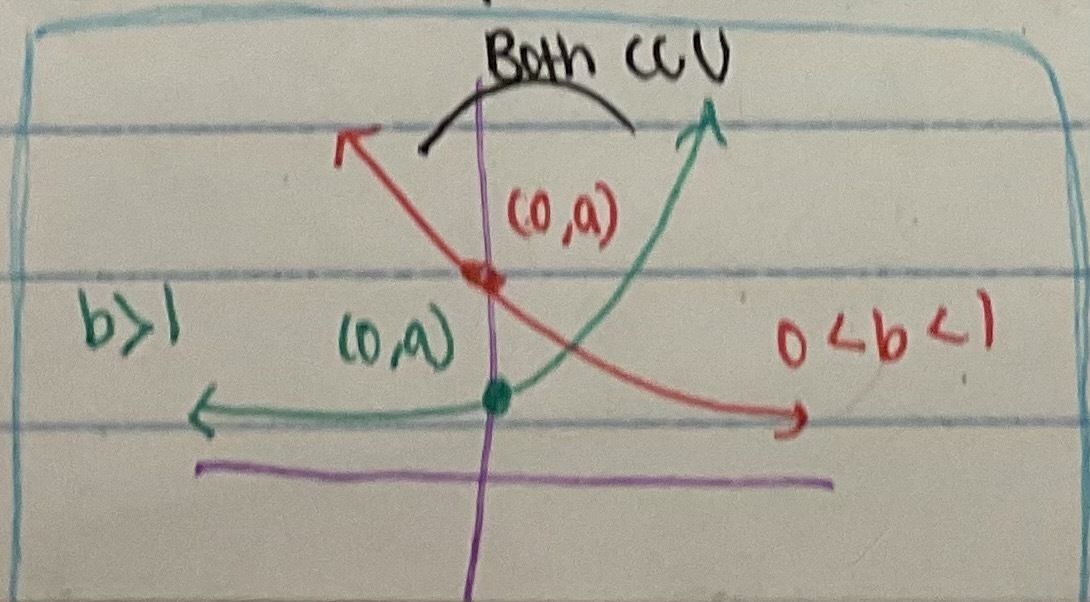
| exponential (6 characters ) | 1. one type of concavity 2.only positive outputs 3. one HA 4. constant percent change 5. bounded in one direction 6. constant percent difference |
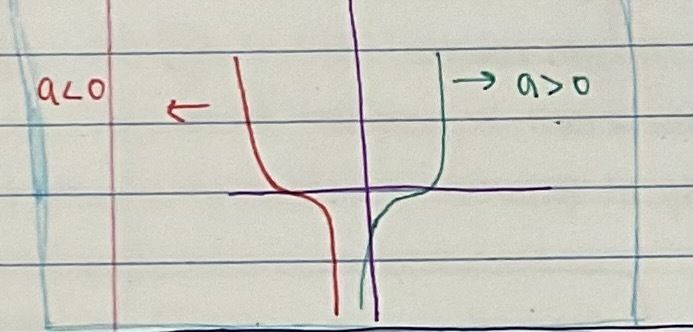
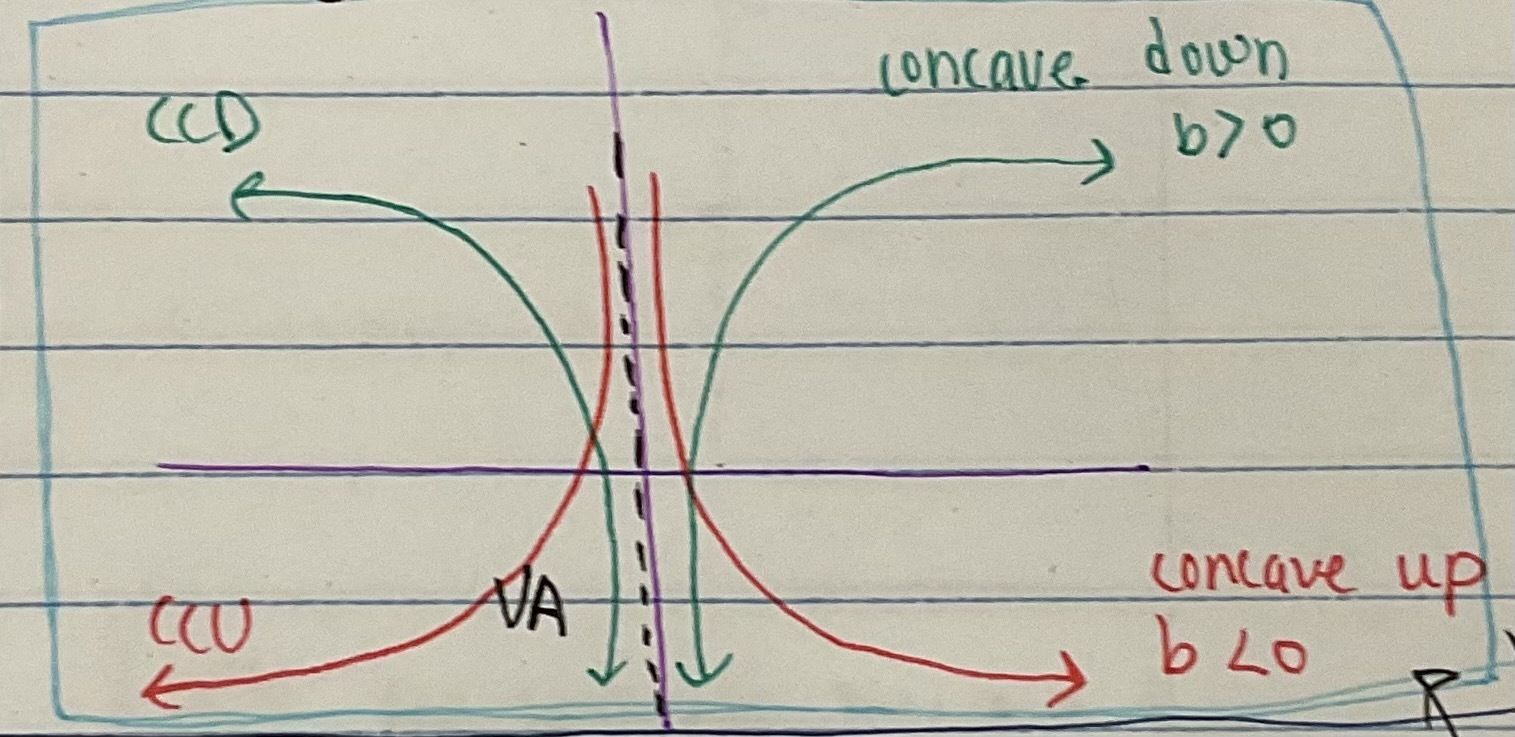
| Logarithimic (4 characters) | 1. one type of concavity usually CCD 2. only positive inputs 3.V.A. 4. unbounded |
| compound interest formula | A(t)= P(1+r/n)^(nt) |
| Continuous Compounding Interst | A(t)= Pe^(rt) |
| APY for. compound interest function | APY= ((1+r/n)^(n)-1)100 |
| APY for continuous interest function | APY=(e^r-1)100 |
| monthly, weekly, daily, hourly, minutes, seconds | 12, 52, 365, 8760 ,52600, 31536000 |
| composition funtions | (f o g)((x) = (f(g(x)) |
| product and quotient have to be what? | h(x)=(f x g)(x)= f(x) x g(x) h(x)=(f/g)(x)= f(x)/g(x) The same input and compatible output |
| Constructions of addition and subtraction needs to have input and out the same | needs to have input and out the same |
| simple change | f(b)-f(a)= outputs |
| percentage.change | f(b)-f(a)/f(a) x 100= percent |
| ave roc | f(b)-f(a)/b-a= outputs per input |
| percentage ROC | f'(a)/f(a) x 100 = percent per input |
| Instantaneous ROC (numeric method) | f'(a)= lim x approaching to a f(x)-f(a)/x-a |
| Formal limit definition of deriv | f'(x)= lim h approaching to zero f(x+h)-f(x)/h |
| (x+h)^2 (x+h)^3 | x^2+xh+h^2 X^3+3x^2h+3xh^2+h^3 |
| e^(x) rule y=e^(ax) | dy/dx= a'e^ax |
| exponential rule y=b^(5x) | dy/dx= ln(b) (b^5x))(5') |
| log rule y=lnx | dy/dx=1/x |
| product rule | f'(x)g(x)+f(x)g'(x) |
| quotient rule | f'(x)g(x)-f(x)g'(x)/ (g(x))^2 |
| finding rapid increase or decrease | 1. on Y2, plug in nDeriv (math to 8) 2.Graph only Y2 3. use calc to find maxi or min |
| finding relative extreme (ip) | f'(x)= changes sign (+/-) is max and CCD f'(x)= changes sign (-/+) is min and CCU graph the original function and find max or min or plug nDeriv on Y2 and use Y2-0 Math solver |
| If f(x) is HTL and IP what happens to f' and f'' | f'(x)=0 IP: f'(x)= show max or min ip; f''=0 |
| If f is ccu or ccd what happens first and second deriv | ccu: first ( increasing) second (positive) ccd: first (decreasing) second (negative) |
| original function is increasing or decreasing what happens to f'(x) and f''(x) | increasing: first will be positive decreasing: first will be negative |
Want to create your own Flashcards for free with GoConqr? Learn more.