
38585265
Description

Flashcards by Ashlin Deatherage, updated more than 1 year ago

|
Created by Ashlin Deatherage
almost 3 years ago
|
|
| Question | Answer |
| Molar absorptivities are proportional to | the probability that an electronic transition will occur. |
| the absorbtivity of allowed transitions are | very high, ∈= 10(^4) to 10(^5) |
| “forbidden” transitions have absorptivity | ∈ < 100 |
| Absorption viewed as a two step process 1. 2. | 1. excitation 2. relaxation |
| what types of relaxation are there | non-radiative (heat) radiative (fluorescence, phosphorescence) photo-decomposition (bonds break) |
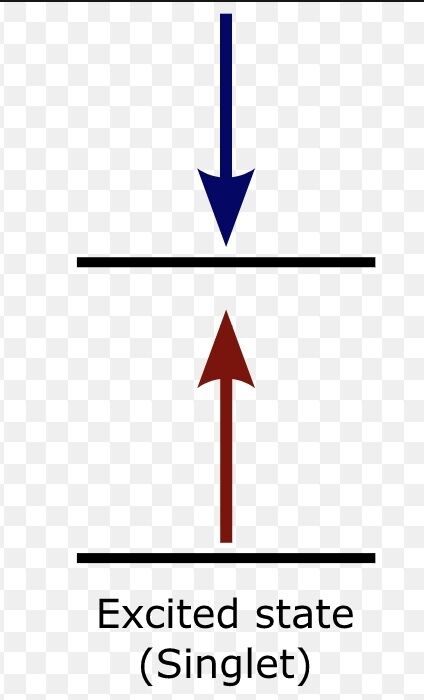
| draw a singlet excited state | |
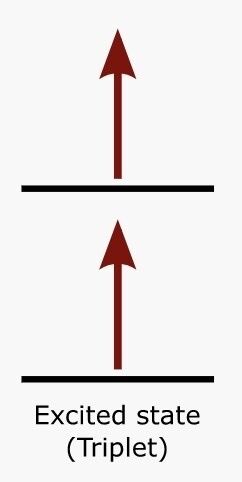
| draw a triplet excited state | |
| which excited state has a lower probablility | triplet excited state |
| give three features of the Franck-Codon Principle | 1. at room temp, most molecules are in ground st., transitions (to excited st.) can be made from any vibrational levels 2. an electronic transition is instantaneous. The transition occurs to the vibrational level in the excited state with the greatest overlap of the vibrational wave function. 3. Solvent effects and intermolecular collisions tend to broaden the UV absorption spectrum. What is normally observed is a broad envelope of absorption bands. |
| In molecular absorption, we are exciting _____ electrons to ______orbitals | 1. bonding 2. non-bonding |
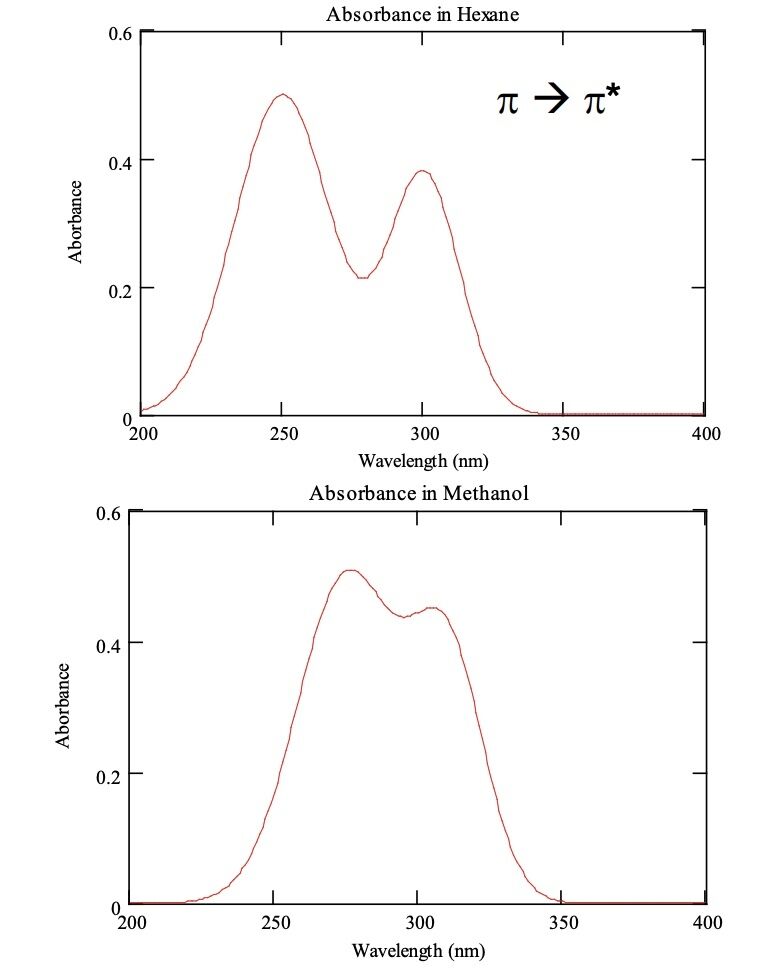
| solvents support or oppose the polarity of the molecule and molecular orbitals, what are the effects | solvents supporting, lowers the energy of the orbital solvents opposing, raises the energy of the orbital |
| • Bonding electrons are localized __________ and are shared ________. | 1. along the bond axis 2. by two nuclei |
| Non-bonding electrons do not participate in bonding and are localized in a molecular orbital on _________ | (usually) a more electronegative atom. |
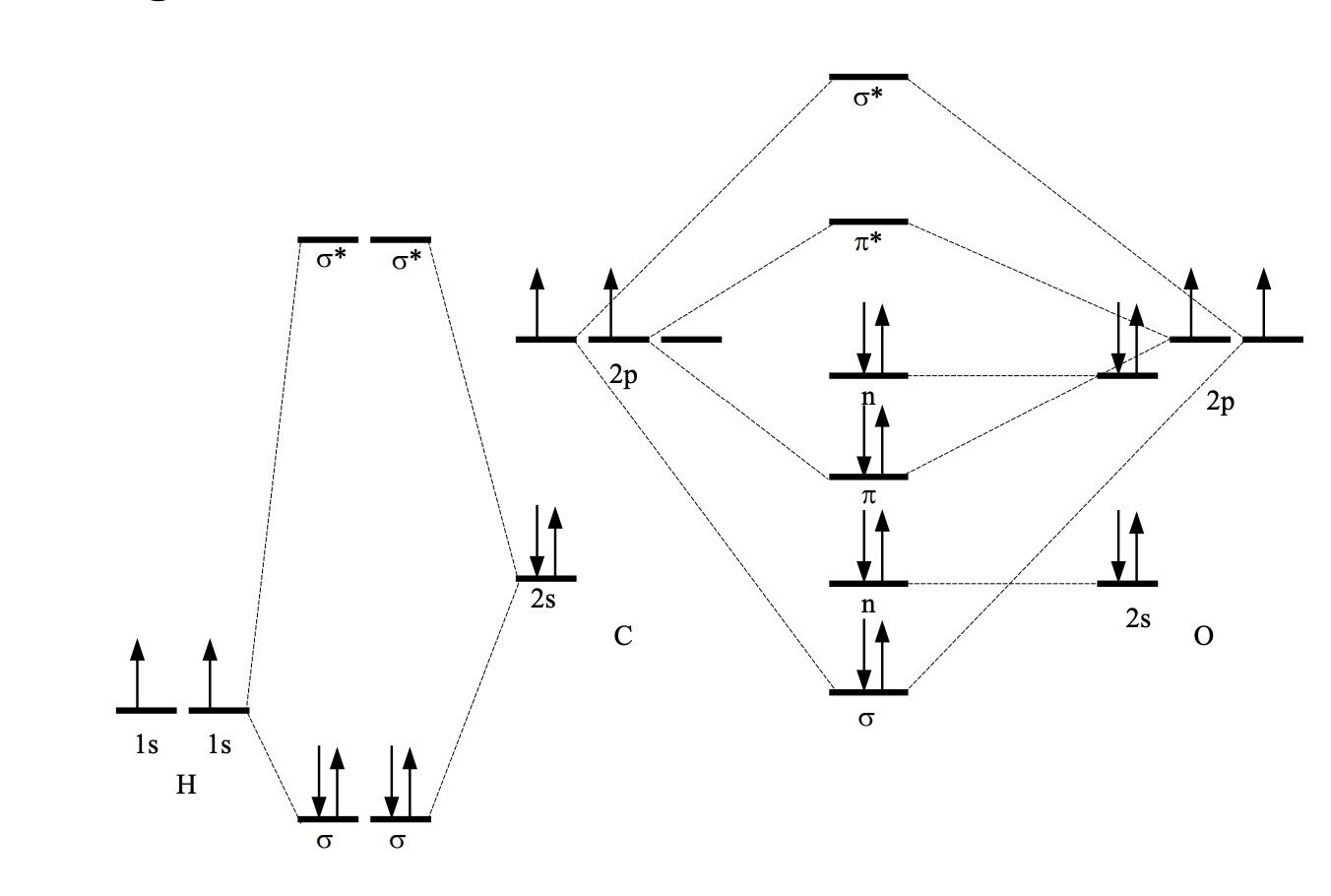
| draw the molecular orbital diagram for formaldehyde | |
| ORGANIC CHROMOPHORES have | conjugated pi-systems |
| conjugated π electrons to be _________ over more than one molecular orbital, _______ the energy. | 1. delocalized 2. stabilizing |
| An increased number of conjugated π bonds decreases | the spacing between orbital energies |
| An increased number of conjugated π bonds decreases the spacing between orbital energies. Closing the energy gap, causing | a bathochromic or “red” shift of the absorption band. |
| effects of solvents on absorption (3) | 1. Molar absorptivity affected by charge distribution of nearest neighbors 2. Molar absorptivity affected by electroylte solutions through the electrostatic interactions of ions 3. Molecular Electronic Orbitals can be either stabilized of destabilized by solvent polarity. |
| observe from methanol to hexane. This is an example of | a bathochromic or “red” shift of the absorption band, the peak shifts to a high wavenumber, and lower energy. The opposite of this is a hypsochromic shift (blue shift) |
| in a singlet excited state, electron spins are | paired and Diamagnetic – slightly repelled by a magnetic field |
| Transition from singlet state does not involve a change in the electron spin state | and therefore has higher probability and shorter lifetimes in excited state; 10(^-8) < 10(^-5) s |
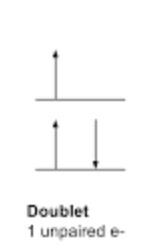
| doublet excited state | |
| Doublet state is | Electronic state of a free radical or lone atom with a single unpaired electron, the odd electron can assume two orientations |
| in a triplet state electrons are | unpaired, Paramagnetic – attracted to a magnetic field |
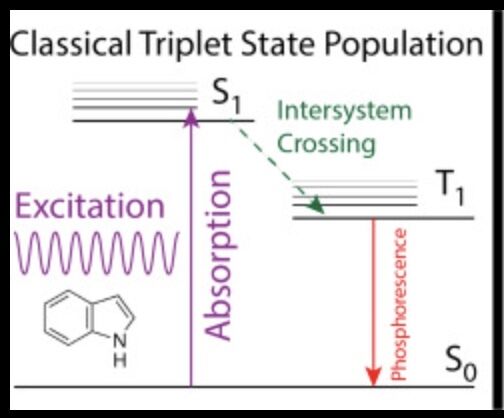
| Transition from singlet to triplet is | forbidden, low probability, lifetimes of 10^-4 seconds |
| what is intersystem crossing? | there is a crossover between electronic states of different multiplicity as demonstrated in the singlet state to a triplet state (S1 to T1) |
| what is an organic auxochrome, what does it do | ‒ functional group which does not absorb UV or visible light, but does shift the absorbance band of a chromophore to longer wavelengths (bathochromic) and increases the intensity. -it stabilizes the pi-anti-bonding orbital because the pi-electrons are delocalized |
| bathochromic shift is nicknamed what and why? | red shift, because it shifts peaks the left, to a higher wavelength, lower energy |
| hypsochromic shift is nicknamed what and why? | blue sift, because peaks shift to the right, to a lower wavelength, and higher energy level |
| to be an organic auxochrome, it must have: | a lone pair of non-bonding electrons, (i.e. -OH or -NH2 |
| inorganic auxochromes anions : | usually n to π∗ transitions on oxianions, nitrates, carbonates |
| inorganic auxochromes cations: | transition metals, lanthanides and actinides absorption causes promotion of non-bonding d or f electron The stronger the ligand field, the greater the energy splitting which causes a hypsochromic shift. |
| inorganic auxochromes cations: lanthanides/actinides | - f electron promoted - deep inner shell, unaffected by solvent or ligand interaction - extremely sharp bands |
| inorganic auxochromes cations: Transition metals | - d electron promoted - affected by “ligand field” or electrostatic interactions between the electronegative ligand and the orbital |
| CHARGE-TRANSFER ABSORPTION | -Analytically important because of the huge molar absorptivities involved ‒ electron donor (ligand) ‒ electron acceptor (metal) ‒ effect is an intramolecular oxidation-reduction reaction |
| at low concentrations, molar absorptivity follows a | linear trend |
| at high concentrations, molar absorptivity follows a | non-linear trend |
| increases slit width causes | an increases peak width with lower intensity |
| advantages of derivative spectroscopy | Advantages: ‒ Precise determination of the 𝜆max can be obtained from the zero crossing of the 1st derivative. ‒ Improved spectral resolution. ‒ Improved discrimination of broad bands. |
| disadvantages of derivative spectroscopy | - Poor reproducibility. ‒ Increased noise. |
| DOUBLE WAVELENGTH SPECTROSCOPY | • Useful to extract information in the presence of scattering or another interferent. -derivative mode or dual wavelength mode |
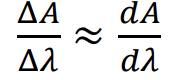
| DOUBLE WAVELENGTH SPECTROSCOPY: derivative mode | Two wavelengths rapidly alternated through sample. ‒ The difference in the absorbances is an approximation of the 1st derivative. |
| DOUBLE WAVELENGTH SPECTROSCOPY: dual wavlength mode | Two wavelengths simultaneously passed through the sample. ‒ Assumption is that the analyte will absorb more at one wavelength than the other. ‒ Combined absorbance improves the sensitivity. |
| conjugated molecules have colors because | their LUMO an HOMO are very close |
| since absorptivity is dependent on wavelength, we must | restrict the bandwidth of our measurement by using a filter |
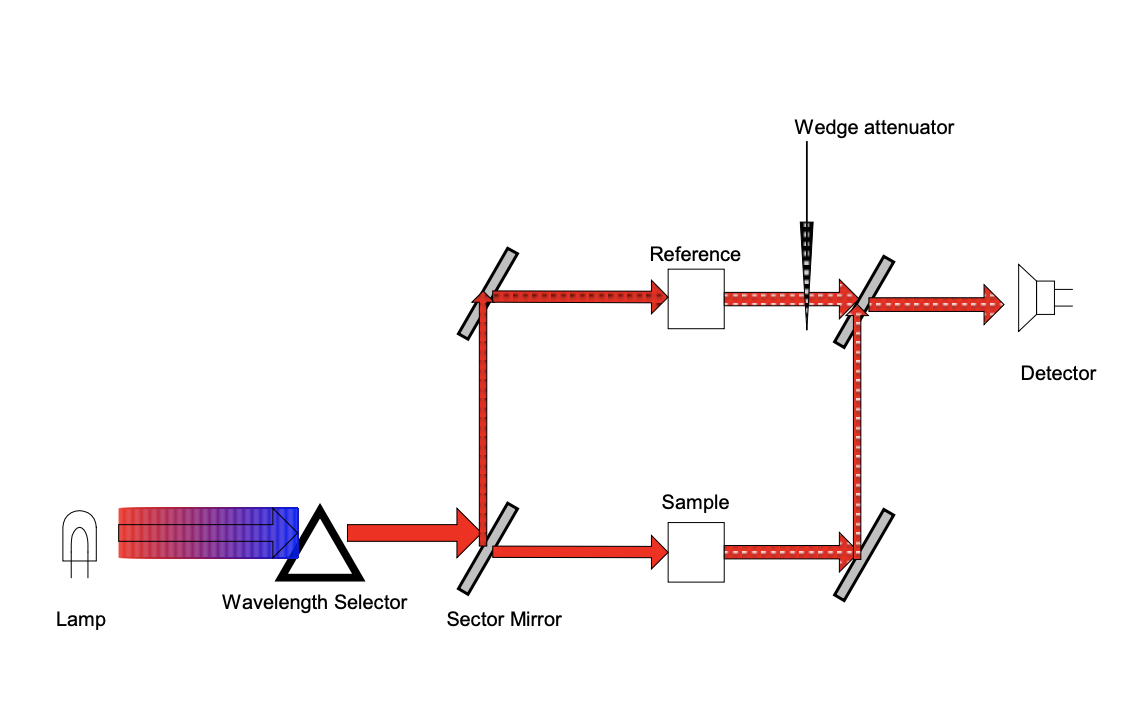
| DOUBLE BEAM advantages | -Free of source drift or flicker ‒ Greater resolution ‒ Spectra corrected for instrument response as a function of wavelength ‒ Absorption of solvent or reference automatically corrected. ‒ Sector mirror chops beam -modulation helps discriminate against noise |
| DOUBLE BEAM disadvantages | - More expensive ‒ Reduced throughput |
| single beam advantages | - Smaller, simpler ‒ Fewer moving parts ‒ Greater throughput ‒ Higher S/N ‒ Inexpensive |
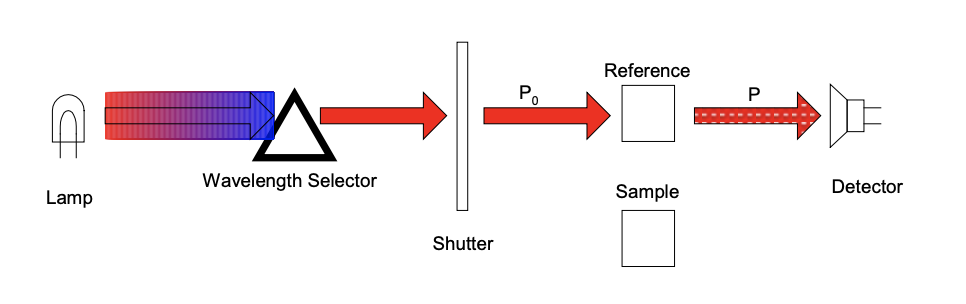
| single beam disadvantages | - Drift and flicker noise ‒ Separate measurements for reference and sample |
| single beam diode arrays | ‒ Higher throughput – fewer optical elements ‒ Allow for signal averaging ‒ Almost no moving parts – shutter ‒ Wavelength reproducibility high ‒ Shorter exposure times reduces chance of photodecomposition. |
| draw single beam | |
| draw double beam | |
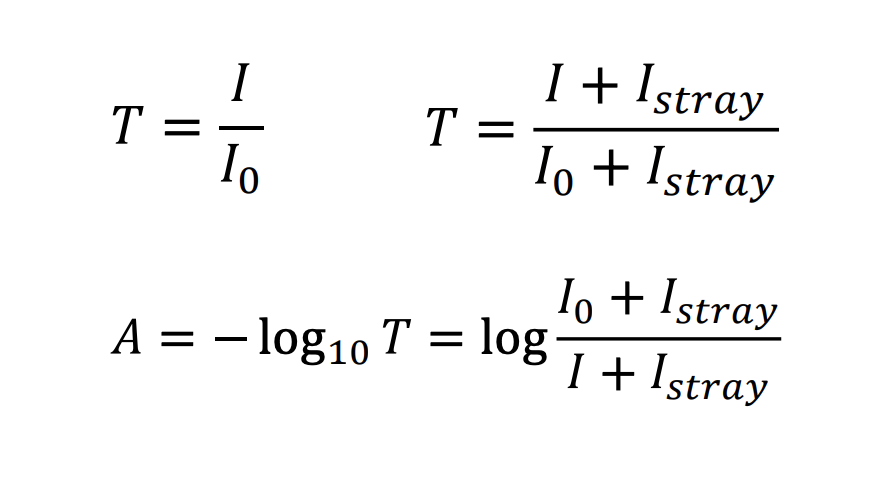
| correction for stray light | |
| the effects of stray light are greater at | higher concentrations |
| effects of scattering | the more scattering a sample has, the less light hits the detector to correct this, use a scattering standard in blank that has the same scattering characteristics. |
| absorbance is proportional to path length, a collimated beam or focused beam has a longer path lenth? | focused |
| changes in refractive index are more extreme when using a | focused beam, which causes some light to not be detected |
| why can photomultiplier tubes not be used in IR radiation | a photon w energy in the UV region is required to free electrons from the phototube-surface. The red light and energy of the IR region is not enough to free an electron |
Want to create your own Flashcards for free with GoConqr? Learn more.