
669012


| Question | Answer |
| Scalar | A quantity with only magnitude |
| Vector | A quantity with both magnitude and direction |
| Speed | The rate of change of distance |
| Velocity | The rate of change of displacement |
| Acceleration | The rate of change of velocity |
| Terminal Velocity | When an object no longer accelerates because its net force = 0 |
| Braking Distance | The distance travelled by the car between the time of the brakes being applied and the car stopping |
| Thinking Distance | The distance travelled by the car in the time taken for the driver to react. |
| Stopping Distance | Braking Distance + Thinking Distance |
| The Newton | The force required to accelerate a mass of 1kg to 1ms-2 |
| Principle of Moment | Clockwise moment = Anticlockwise moment |
| Equilibrium | Net force acting on the object must be zero, net moment about any point must also be zero |
| Centre of Gravity | The point where an object’s entire weight appears to act |
| Couple | A pair of equal and opposite forces separated by a distance |
| A torque of Couple | One of the forces multiplied by the perpendicular distance between the forces |
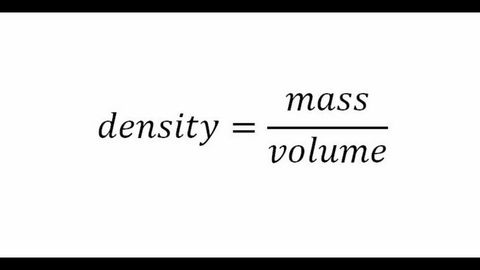
| Density |
Image:
density (image/jpg)
|
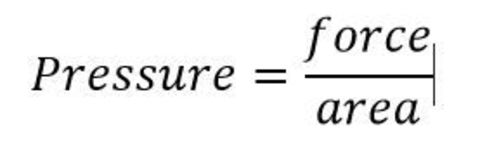
| Pressure |
Image:
Pressure.JPG (image/JPG)
|
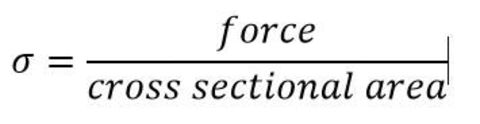
| Stress |
Image:
stress.JPG (image/JPG)
|
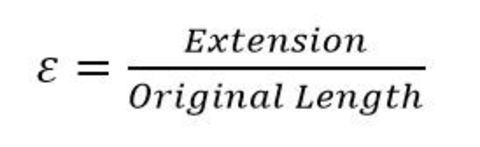
| Strain |
Image:
Strain.JPG (image/JPG)
|
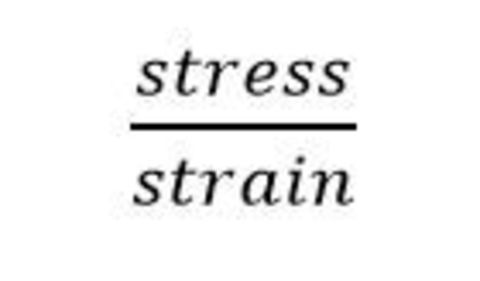
| Young's Modulus |
Image:
ym.JPG (image/JPG)
|
| Hooke's Law | The extension of a spring is directly proportional to the force applied to it (within the elastic region) |
| Elastic Limit | The point after which a material does not return to its original form when stress is removed |
| Plastic Deformation | When the material does not return to its original length/shape/size |
| Brittle Material | Does not have a plastic region, breaks at elastic limit |
| Ultimate Tensile Strength | force ×distance moved in direction of force |
| The Joule | The work done moving 1N through 1m in the direction of the force |
| Power | The rate at which work is done. |
| The Watt | The transfer of energy of one joule per second |
| Principle of Conservation of Energy | In a closed system energy cannot be created or destroyed |
| Special Theory of a Relativity | The mass of an object increases as it approaches the speed of light |
Want to create your own Flashcards for free with GoConqr? Learn more.