
6878135
Description

Flashcards by void pickle, updated more than 1 year ago

|
Created by void pickle
about 9 years ago
|
|
| Question | Answer |
| Suppose you have a monthly entertainment budget that you use to rent movies and purchase CDs. You currently use your income to rent 5 movies per month at a cost of $5.00 per movie and to purchase 5 CDs per month at a cost of $10.00 per CD. Your marginal utility from the fifth movie is 40 and your marginal utility from the fifth CD is 90. | not maximizing utility because the marginal utility per dollar spent on movies is not equal to the marginal utility per dollar spent on CDs. Optimal decisions are made at the margin. The key to making the best consumption decision is to maximize utility by following the rule of equal marginal utility per dollar spent. In this example, the marginal utility per dollar spent renting movies is 8.00, from marginal utility of 40 divided by a rental price of $5.00. The marginal utility per dollar spent on CDs is 9.00, from marginal utility of 90 divided by a price of $10.00. Since the marginal utility per dollar spent renting movies is not equal to the marginal utility per dollar spent on CDs, you are not maximizing utility. |
| What could you do to increase utility? You could increase utility by consuming more ___ and fewer ___. | CDs; movies You could increase utility by consuming more CDs and fewer movies (by spending more of your entertainment budget on CDs and less of your entertainment budget on movies). |
| Suppose ham is an inferior good. How will consumers adjust their buying decisions if the price of ham changes? If the price of ham increases, then consumers will demand | more ham due to the income effect because their purchasing power decreases and less ham due to the substitution effect because the opportunity cost of consuming ham is higher. A price increase decreases a consumer's purchasing power, which, if an inferior good, causes the quantity demanded to increase due to the income effect. A price increase also raises the opportunity cost of consuming the good, which causes the quantity of the good demanded to decrease due to the substitution effect. If ham is an inferior good and the price of ham increases, then consumers will demand more ham due to the income effect and less ham due to the substitution effect. |
| The substitution effect | The change in the quantity demanded of a good that results from a change in price making the good more or less expensive relative to other goods, holding constant the effect of the price change on consumer purchasing power. |
| The income effect | The change in the quantity demanded of a good that results from the effect of a change in price on consumer purchasing power, holding all other factors constant. |
| Instead, suppose ham is a normal good. If the price of ham increases, then consumers will demand ___ ham due to the income effect and ___ ham due to the substitution effect. | less; less If ham is a normal good and the price of ham increases, then consumers will demand less ham due to the income effect and less ham due to the substitution effect. |
| What role does utility play in the economic model of consumer behavior? When modeling consumer behavior, utility | reflects the satisfaction a consumer receives from consuming a particular set of goods and services. Economists assume the goal of a consumer is to spend available income so as to maximize utility. In this context, utility is the enjoyment or satisfaction people receive from consuming goods and services. |
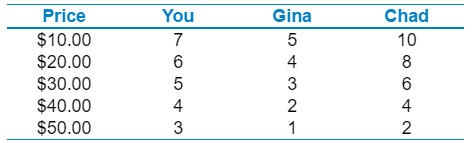
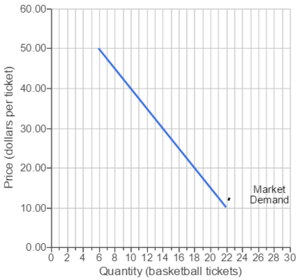
| The table below shows the demand for tickets to professional basketball games for you, Gina, and Chad. Use the line drawing tool to draw the market demand curve for basketball tickets (assuming the market consists of you, Gina, and Chad). Label this line 'Market Demand'. | We obtain the market demand curve by adding horizontally individual demand. For example, when the price is $10.00 per ticket, market demand is 22 tickets (from individual demands of 7, 5, and 10). When the price is $20.00 per ticket, market demand is 18 tickets (from individual demands of 6, 4, and 8). Continuing, market demand at a price of $30.00 is 14 tickets, market demand is 10 tickets at a $40.00 price, and 6 tickets at $50.00. |
| Giffen goods | were not shown to actually exist until 2006. |
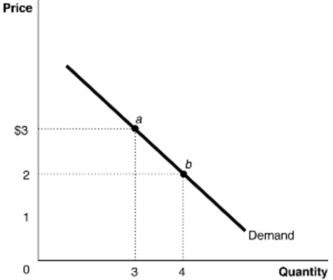
| The figure represents the demand for ice cream cones. Which of the following statements is true? | Points a and b are the utility−maximizing quantities of ice cream cones at two different prices of ice cream. |
| The same figure as above represents the demand for ice cream cones. When the price of ice cream cones increases from $2 to $3, quantity demanded decreases from 4 ice cream cones to 3 ice cream cones. This change in quantity demanded is due to | the income and substitution effects. |
| For a demand curve to be upward sloping, the good would have to be an inferior good, and | the income effect would have to be larger than the substitution effect. |
| Refer to the ice cream diagram. Which of the following statements is true? | Points a and b are the utility−maximizing quantities of ice−cream cones at two different prices of ice−cream. |
| What explanations have economists offered for why firms don't raise prices when doing so would seem to increase profits? Firms might not raise prices when doing so might increase profits because | consumers find it unfair for firms to increase prices after an increase in demand. Economists have provided two explanations for why firms sometimes do not raise prices when doing so would seem to increase profits. First, economist Gary Becker has examined products that buyers consume together with other buyers and suggests that for those products the amount consumers wish to buy may be related to how much of the product other people are consuming. In this case, a firm that increases its prices enough to eliminate excess demand might find that it has also eliminated its popularity. Second, economists Kahneman, Knetsch, and Thaler have found that most people consider it fair for firms to raise their prices following an increase in costs but unfair to raise prices following an increase in demand. These explanations share the same idea: Sometimes firms will give up some profits in the short run to keep their customers happy and increase their profits in the long run. |
| What affects the desirability of a product? Products become more desirable when | all of the above. In many cases, it is not just the number of people who use a product that makes it desirable but the types of people who use it. For example, if consumers believe that movie stars or professional athletes use a product, demand for the product will often increase, partly because consumers believe public figures are particularly knowledgeable about products. Many consumers also feel more fashionable and closer to famous people if they use the same products these people do. |
| Are consumers only interested in making themselves as well off as possible in a material sense? Consumers are | also concerned with fairness as exemplified by donations to charity. If people were only interested in making themselves as well off as possible in a material sense, they would not be concerned with fairness. There is a great deal of evidence that people like to be treated fairly and that they usually attempt to treat others fairly even if doing so makes them worse off financially. Two examples where people willingly part with money when they are not required to do so and receive nothing material in return are donations to charity and tips in restaurants that will never be visited again (such as dining while on vacation). |
| What effect does a network externality have on the market for a product? If a network externality is present for a product, then | consumers may be more likely to buy the product because it is more useful. Network externality A situation in which the usefulness of a product increases with the number of consumers who use it. For example, if you owned the only cell phone in the world, it would not be very useful. If a network externality is present, then consumers may be more likely to buy the product because it is more useful. Unfortunately, network externalities may result in market failure due to two reasons: Switching costs. When a product becomes established, consumers may find it to costly to a new product that contains better technology. Path dependence. Due to switching costs, the technology that was first available may have advantages over better technologies that were developed later. The path along which the economy has developed is important. |
| Consider a form of public consumption such as wearing jewelry. An individual's demand for jewelry depends on | all of the above. Public consumption of goods and services: The decision to buy a product depends partly on the characteristics of the product and partly on how many other people are buying the product. Therefore, an individual's demand for jewelryjewelry depends on the cost of the jewelryjewelry, the individual's tastes and preferences, and social forces such as the popularity of the jewelryjewelry and how many other people are wearing the jewelrywearing the jewelry. |
| Identify the one statement that does not demonstrate how social effects influence consumer choice. | Students in an Economics class are required to purchase a textbook assigned by the professor. |
| In recent years, some economists have begun studying situations in which people do not appear to be making choices that are economically rational. This new area of economics is called | Behavioral Economics The study of situations in which people make choices that do not appear to be economically rational. |
| Why might consumers not act rationally? Consumers might | The most obvious reason why consumers might not act rationally would be that they do not realize that their actions are inconsistent with their goals. For example, consumers commonly commit the following three mistakes when making decisions: 1. They take into account monetary costs but ignore nonmonetary opportunity costs. 2. They fail to ignore sunk costs. 3. They are overly optimistic about their future behavior. |
| Behavioral economist Richard Thaler has studied several examples of how businesses make use of inconsistencies in consumer decision-making. Which of the following is an example of this? An example of businesses taking advantage of inconsistencies in consumer decision-making is | credit card companies not allowing stores to charge a fee to cons Nonmonetary opportunity costs: Economist Richard Thaler studies how businesses often make use of consumers' failure to take into account nonmonetary opportunity costs. For example, credit card companies do not allow stores to charge a fee if a consumer pays with a credit card but allow stores to provide a discount if they pay in cash. There really is no difference in terms of opportunity cost between being charged a fee and not receiving a discount. The credit card company is relying on the fact that not receiving a discount is a nonmonetary opportunity costlong dash—and, therefore, likely to be ignored by consumerslong dash—but a fee is a monetary cost that people do take into account. Other examples include: 1. Firms requiring consumers to pay to develop every picture on a role of film, even for fuzzy pictures, but then offering them a refund for those pictures. 2. Firms competing over the price of a "base good," such as a printer, but then hiding the prices of "add-ons," such as ink cartridges. |
| Behavioral economists attribute some consumer behavior to the endowment effect. Which of the following is an example of the endowment effect? An example of the endowment effect is | being unwilling to sell a car for a price that is greater than the price you would be willing to pay to buy the car if you didn't already own it. Endowment effect The tendency of people to be unwilling to sell a good they already own even if they are offered a price that is greater than the price they would be willing to pay to buy the good if they didn't already own it. The endowment effect illustrates the inconsistency that comes from a failure to take into account nonmonetary opportunity costs. For example, being unwilling to sell a car for a price that is greater than the price you would be willing to pay to buy the car if you didn't already own it is an example of the endowment effect. |
| How should sunk costs be used in consumer decision-making? In consumer decision-making, sunk costs should | be ignored. Sunk cost A cost that has already been paid and cannot be recovered. Once you have paid money and can't get it back, you should ignore that money in any later decisions you make. |
| Suppose you bought a ticket to a football game. The ticket is nonrefundable (and can't be resold) and must be used on Saturday. Then, a friend calls and invites you to a play on Saturday. You only have time to attend one of the events, and your friend offers to pay the cost of going to the play. If you prefer plays over football games, then you should attend the | play. Sunk cost A cost that has already been paid and cannot be recovered. Once you have paid money and can't get it back, you should ignore that money in any later decisions you make. If you prefer plays to football games, then the fact that you have already paid for a ticket to the football game is irrelevant. This is because the cost of the ticket to the football game is a sunk cost. Therefore, you should attend the play. |
| What explanation might an economist provide why some people smoke cigarettes when such behavior can lead to health consequences? Some people likely smoke cigarettes because | their preferences are not consistent over time. Unrealistic future behavior: Economists suggest that when people overeat or smoke cigarettes, they are overvaluing the utility from current choices—eating chocolate cake or smoking—and undervaluing the utility to be received in the future from being thin or not getting lung cancer. That is, economists argue that many people have preferences that are not consistent over time. In the long run, people would like to be thin or give up smoking, but each day, they make decisions (such as to eat too much or smoke) that are not consistent with this long-run goal. If consumers are unrealistic about their future behavior, then they will underestimate the costs of choices—like overeating or smoking—that are made today. |
| Economically rational means that consumers and firms | take actions that are appropriate to reach goals given available information. |
| Consider the ultimatum game, where an "allocator" is given, say, $50.0050.00 to decide how to divide with a "recipient," who then decides whether to accept or reject the allocation, ultimately determining whether the pair receives the allocation or nothing. What is the optimal play in the ultimatum game? The optimal play in the ultimatum game is for the allocator to propose a division of the money such that the recipient receives $___ and the recipient then ___ the division. (Enter your response as a real number rounded to two decimal places.) | The optimal play in the ultimatum game is straightforward: The allocator should propose a division of the money in which the allocator receives $49.99 and the recipient receives $0.01. The allocator has maximized his or her gain. The recipient should accept the division because the alternative is to reject the division and receive nothing at all: Even a penny is better than nothing. When the ultimatum game experiment is carried out, both allocators and recipients act as if fairness is important. Allocators usually offer recipients at least a 40 percent share of the money, and recipients almost always reject offers of less than a 10 percent share. |
| Ultimatum game | An experiment that tests whether fairmess is important in consumer decision making. |
Want to create your own Flashcards for free with GoConqr? Learn more.