
8520196
Description

Flashcards by Fionnuala O'Brien, updated more than 1 year ago

|
Created by Fionnuala O'Brien
almost 9 years ago
|
|
| Question | Answer |
| prokaryotes | - Includes bacteria and archaea - Small, structurally simple cells 0.2-2um Few, if any, organelles - Genome is usually a closed circular chromosome (essential genes) - Often contain plasmids too (special properties) - In a bacterium, the DNA is “supercoiled” and found in a region of the cell called the nucleoid |
| Eukaryotes | - Includes algae, protozoa and fungi - Much larger cells 10-100um - Possess an assortment of membrane enclosed organelles - DNA contained within the nucleus - DNA and protein complex-chromosomes |
| Chromosomal differences | The bacterial chromosome is a double-stranded, circular DNA molecule associated with a small amount of protein Eukaryotic chromosomes have linear DNA molecules associated with a large amount of protein |
| prokaryotic genomes and genes | - Bacterial genomes vary in length –110,000 to 13 million bp. - Small fragments of the genome (DNA) encode for different genes (for different cell functions). - Number and length of genes vary too - Indicative gene length = 1,000 bp. |
| Eukaryotic genomes and genes | Eukaryotic genomes have large regions of “junk DNA”, i.e. Non-protein coding DNA -Exons -Introns Humans: 3.2 billion bp yet only 3% of this encodes proteins |
| Central dogme | The central dogma is the concept that cells are governed by a cellular chain of command: DNA > RNA > protein |
| Proteins | -Made up of units called amino acids. -There are 20. -Amino acids join in a specific order to form a polypeptide chain. Very important -Enzymes, Structural, Transport, Defence |
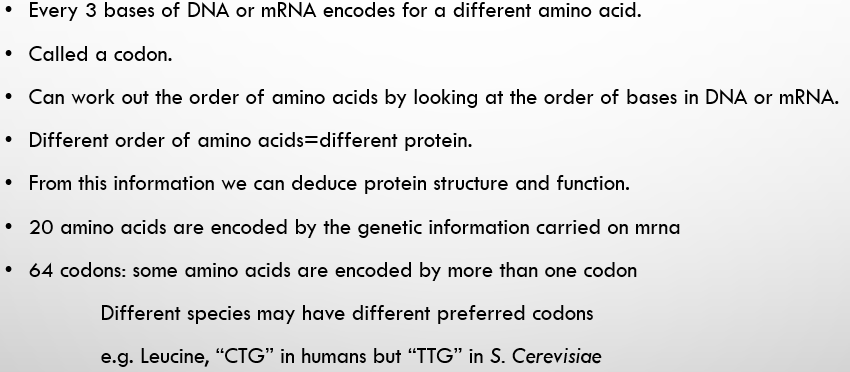
| Codons |
Image:
Untitled (image/png)
|
| RNA Types | - Messenger RNA (mRNA): conveys genetic information from DNA to the ribosome - Transfer RNA (tRNA): converts the genetic information into a sequence of amino acids -Ribosomal RNA (rRNA): catalytic and structural part of the ribosome |
| RNA v DNA | RNA contains the sugar ribose instead of deoxyribose RNA contains the base uracil instead of thymine RNA is single-stranded (exception: some viruses) |
| Transcription in RNA | -Transcription produces messenger RNA (mRNA) -Transcription is the synthesis of RNA using DNA as a template. -Carried out by the enzyme RNA polymerase - Initiation sites on the DNA (promoter regions) are recognised by sigma factors (proteins) - Transcription produces messenger RNA (mRNA), mRNA has short life (degraded in minutes) |
| Translation in RNA | -Translation is the synthesis of a polypeptide, which occurs under the direction of mRNA - Ribosomes are the sites of translation - tRNA carries the amino acids (complementary to the codon on mRNA ) |
| Mutation | refer to first power point |
| types of DNA repair systems | Direct reversal: mutated base is still recognizable and can be repaired without referring to other strand |
| Types of DNA repair system | Repair of single strand damage: damaged DNA is removed and repaired using opposite strand as template |
| types of DNA repair system | Repair of double strand damage: a break in the DNA Requires more error-prone repair mechanisms |
| genetic transfer | genetic material can be transferred between bacteria by several means, most often by conjunction transformation transduction |
| Transformation | - Genetic transfer process by which free DNA is incorporated into a recipient cell -Several prokaryotes (bacteria and archaea) are naturally transformable -Free DNA originates from lysed cells -Free DNA fragments ~10 kbp (~10 genes) -Usually 1 or a few DNA fragments are taken up by the recipient (transformed) cell |
| integration of transforming DNA | a. A membrane DNA binding protein enables the binding of double-stranded DNA. b. One of the two strands passes into the cell while nuclease activity degrades the other strand. |
| integration of transforming DNA | c. Recombination of the single strand with homologous regions of the bacterial chromosome is mediated by the RecA protein. d. Transformed cell. |
| Transduction | - In transduction, a bacterial virus (bacteriophage) transfers DNA from one cell to another. - Not all phages can transduce, and not all bacteria are transducible, but the phenomenon is quite widespread - Viruses can transfer DNA in two ways: Generalised transduction and Specialised transduction |
| generalised transduction |
Want to create your own Flashcards for free with GoConqr? Learn more.