
8535735
Description

Flashcards by Mohamed Essa, updated more than 1 year ago

|
Created by Mohamed Essa
over 8 years ago
|
|
| Question | Answer |
| what is gravitational field | the region surrounding an object in which it exerts a gravitional force on any other object. |
| what is field lines / line of force? | whan a small test mass is placed next to a massive body, the massive body pulls/ attracts the small test mass. the path the small test mass follows is called field line. |
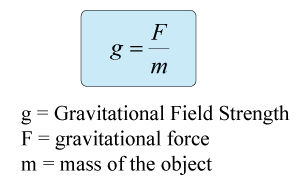
| what is the strength of a gravitational field? | it's the force per unit mass on a small test mass placed in the field. state the formula |
| why is an object that free falls not weightless | because its acted on by the force of gravity instead we say its unsupported |
| what is radial fields | a field in which the field lines are straight and converge or diverge as if from a single point |
| when does gravity field get strong | when the field lines get closer |
| what is uniform field | a region where the gravitational field strength is the same in magnitude and direction at every point in the field. the field lines are parallel. like a small region on the surface of the earth. |
| what is the gravitational field strength of the earths surface | 9.8N kg^-1 |
| does earth have a radial or uninorm field | it has a radial field |
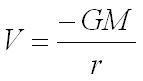
| define gravitational potential | at a point is the work done per unit mass to move a small object from infinity to that point. state the formula |
| what is equipotential? | a line or surface in a field along which the electric or gravitational potential is constant. |
| Newton's law of gravitation | every particle in the universe attracts every other particle with gravitational force that is proportional to the product of the masses and inversely proportional to the square of the distance between them (form their centres). state the formula |
| Newtons law of gravitation assumes.. | the force between two point objects is *always attractive force *proportional to the product of masses *inversely proportional to distance apart squared |
| gravitational potential is a scalar or a vector? | scalar |
| formulae for gravitational field strength | |
| formula for gravitational potential | |
| formula for gravitational potential. work done formual | work done = gravitional potential x mass |
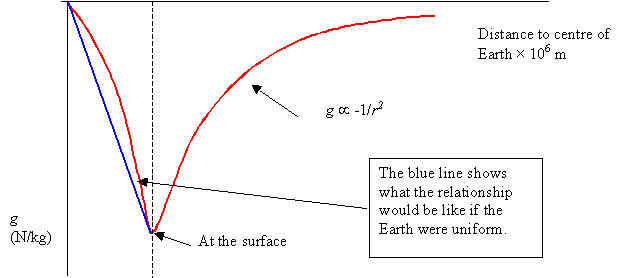
| graph of gravitational field strength vs distance for earth | |
| graph of gravitational potential field strength vs distance for the moon | check notes |
| gravitational potential strength vs distance sum of potential energy for moon and earth | check notes |
| derive an expression for geostationary satellite | F = m x v^2 / r F = G x M x m / r^2 m x v^2 /r = G x M x m / r^2 v^2 = G x M / r because v = circumference of orbit / time 2 pie r / t (2 pie r)^2 = G x M / r r^3 / t^2 = G x M / 4 pie^2 |
| properties of geostationary satellite | orbits the earth directly above the equator and has a time period of exactly 24 hours remains in a fixed position above the equator because it has same time period as the earth's rotation. |
| properties of geosynchronous satellite | orbits over equator maintains a fixed position relative to surface of earth period is 24 hours same as earths rotation steerable dish not necessary. offers uninterrupted communication between transmitter and receiver. |
| from a planet where is the gravitational energy 0 | its at infinity. the surface of the planet has negative gravitational potential, it increases to zero (infinity) |
| what s the total energy when the satellite is in circular orbit | its total energy is constant since gpe and kinetic energy are both constant. kinetic energy increases when its moving towards the earth. gpe increases when its mvng away from the earth. |
Want to create your own Flashcards for free with GoConqr? Learn more.