
9306919
Description

Flashcards by Lewis Johnson, updated more than 1 year ago

|
Created by Lewis Johnson
over 8 years ago
|
|
| Question | Answer |
| Changes to Allele Frequency Mutations | • A mutation occurs when a DNA gene is damaged or changed in such a way as to alter the genetic message carried by that gene. • An organism that possesses a characteristic resulting from a mutation is called a mutant. • A mutagen Is an agent or substance that can bring about a permanent alteration to the physical composition of a DNA gene such that the genetic message is changed. • In most cases, DNA changes either have no effect or cause harm, but occasionally a mutation can improve an organism's chance of surviving. • Mutations in reproductive cells can be passed on to an organism’s descendants. • Two types of mutations can occur: → Chromosomal mutations → Somatic mutations |
| Changes to Allele Frequency Natural Selection Definition | Is a theory proposed by Charles Darwin and Alfred Wallace stating that more organisms with favourable characteristics (alleles) survive when conditions within the environment alter, while many of those with unfavourable characteristics die before they had an opportunity to reproduce and pass on the unfavourable characteristics. |
| Changes to Allele Frequency Natural Selection | • Carolus Linnaues created the binomial system of naming organisms and this greatly influenced Darwin's theories and observations. • Individuals are not all the same because of differences in their genes. So this means that there is variation within a population. • Most organisms give birth to more than just one offspring so the offspring can survive to adulthood. • Populations don’t increase quickly in size because individuals have to compete with each other for resources that are limited in supply. • Those individuals with characteristics that make them better adapted to the environment have a better chance of survival and are more likely to breed successfully. • Where individuals are less adapted to the environment and less able to compete are less likely to survive and reproduce. • Beneficial characteristics will be passed on and less beneficial characteristics will be lost. |
| Charles Darwin's based natural selection was based off three observations: | → Variation • Darwin noted that all members of a species vary. • He made no attempt to explain the source of this variation. • He did point out that these variations were passed on from one generation to the next, characteristics displayed by the parents being passed on to their offspring. → Birth Rate • Inspired by Malthus - all living organisms reproduce at a rate far greater than that at which their available food supply and other resources increase. • This would normally result in overcrowding. → Natures Balance • Although the birth rate of organisms was very high, each species tended to maintain its numbers at a relatively constant level. |
| Examples of Natural Selection Inuits (Eskimos) | → Characteristics • Long-bodied • Short-limbed • smaller surface area in relation to body volume → Result • Lose less heat in very cold environments |
| Examples of Natural Selection Africans (Maassai) | → Characteristics • Short-bodied • Long-limbed • Larger surface area in relation to body volume. → Result • Lose more heat in very hot environments. |
| Changes to Allele Frequency Random Genetic Drift | • Random Genetic Drift is the occurrence of characteristics in a population as a result of chance rather than natural selection. • Occurs only in small populations. • Is not related to the environment. |
| Random Genetic Drift The Dunkers Population | • The Dunkers population Is a small religious population in America. • The Dunkers arrived in Pennsylvania, America in the early 1700’s from Germany and due to their strict rules its restricts them to marry outside their group, resulting in gene frequencies which vary quite considerably from the surrounding American population even though they were living in the same environment. Therefore, this variation is not due to different selection pressures. • A study of the blood types of the isolated group was carried out in the 1950s. The results showed nearly 60% of the Dunkers had blood type A. The West German population was 45% Blood type A and the USA population was only 40%. • So the Dunkers' type A frequency was was extreme, rather than intermediate, between the two comparison groups. • Without random genetic drift the Dunkers would be expected to be similar to the German population or possibly in between it and the USA population. • This process can be seen to provide an explanation for differences between gene pools that otherwise should be similar. |
| Changes to Allele Frequency Founder Effect | • Founders effect is when a small group forms a new colony, isolated from the main population. • This new colony is started by members of the “original” population. • The small population size means that the new colony may have: → Reduced genetic variation from the original population. → A non-random sample of the genes in the original population. |
| Changes to Allele Frequency Migration | • When people move from one country to another, they are bringing alleles that may or may not be there already. • People from other countries bring certain diseases to Australia that haven’t been around for sometime. • HIV/AIDS is on the increase as people from Africa are leaving there country and bringing certain/different diseases. |
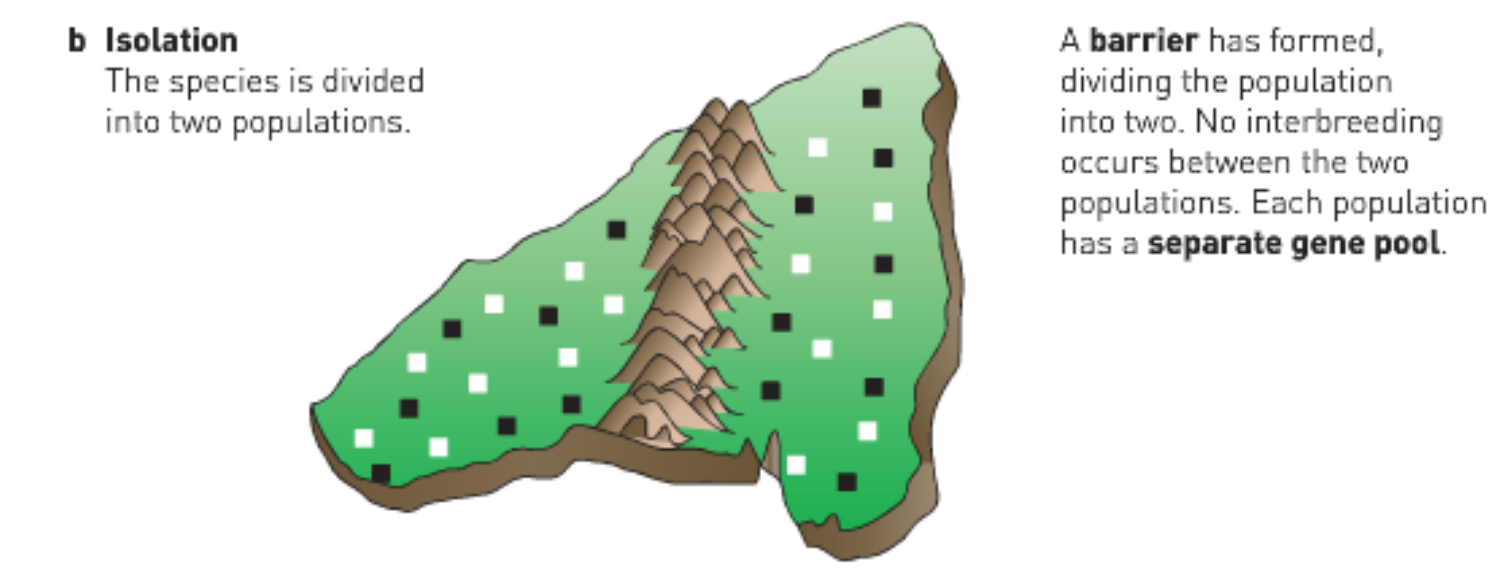
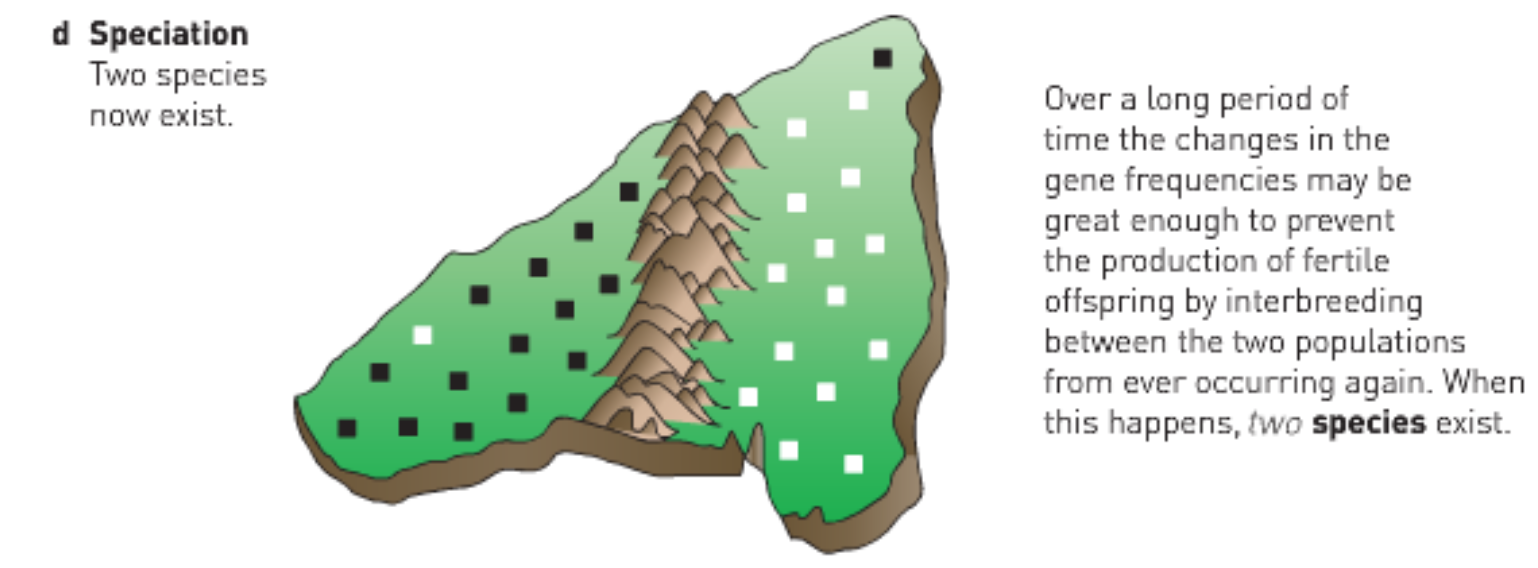
| Changes to Allele Frequency Barriers Of Gene Flow | • Involves a barrier that prevents a population from breeding. • Barriers include: → Geographical Barriers (physical) • Oceans • Mountain ranges • Deserts → Example • Australia is isolated from other countries. → Sociocultural Barriers • Different languages, religion • Economic status • Education → Example • Australians tend to marry people of the same education status or background and same religious background. • Characteristics can change in one group and benefit them which in over time the allele frequency of that gene pool will change to become beneficial and favourable for survival. • Over time the two populations will become less alike. |
| Changes to Allele Frequency Genetic Diseases | • Genetic diseases result in changes to the allele frequencies. • A population who has a fatal disease will eventually die and not pass the disorder or disease on. |
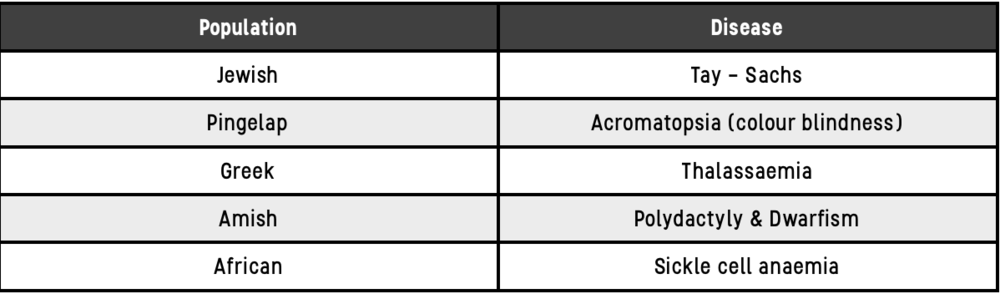
| Genetic Diseases Tay-Sachs Disease (TSD) | • The mutated gene causing Tay - Sachs disease is found on chromosome 15 which causes the body to not have a particular enzyme which breaks down lipids. They will accumulate fat in the brain and nerve cells which will cause damage. • Is a hereditary disease that can be passed on and will only show if the baby inherits both recessive genes from parents. The offspring could also be a carrier of the disease and show no symptoms. • Is a lethal recessive gene mutation, so the person affected will die. • Death will usually occur at 4 or 5 yrs of age. • Affects the Jewish population. • Tay-Sachs is an autosomal recessive disease. |
| Genetic Diseases Sickle Cell Anaemia | • Sickle cell anaemia is a disorder that affects a protein called haemoglobin which transports oxygen from the lungs to the rest of the body. • Patients with sickle cell disease have a mutation in a gene on chromosome 11. As a result, haemoglobin molecules don't form properly, causing red blood cells to be rigid and have a concave shape. • These irregularly shaped cells get stuck in the blood vessels and are unable to transport oxygen effectively, causing pain and damage to the organs. • Is a hereditary disease that can be passed on and will only show if the offspring inherits both recessive genes from parents. The offspring could also be a carrier of the disease and show no symptoms. • People affected by Sickle Cell Anaemia have increased protection against malaria. • Affects the African population. • Sickle Cell Anaemia is an autosomal recessive disease. |
| Genetic Diseases Thalassaemia | • Thalassaemia is a blood disorder which involves an abnormal haemoglobin production caused by a mutation on chromosome 11 and / or chromosome 16 • Is a hereditary disease that can be passed on and will only show if the offspring inherits both recessive genes from parents. The offspring could also be a carrier of the disease and show no symptoms. • Affects the Greek population. • Thalassaemia is an autosomal recessive disease. |
| Table of populations that have genetic diseases in greater numbers | |
| Survival Of The fittest | • Most favourable characteristics survive and less favourable die out. • Favourable characteristics are suited for their environment. • Favourable characteristics are passed onto the next generation. |
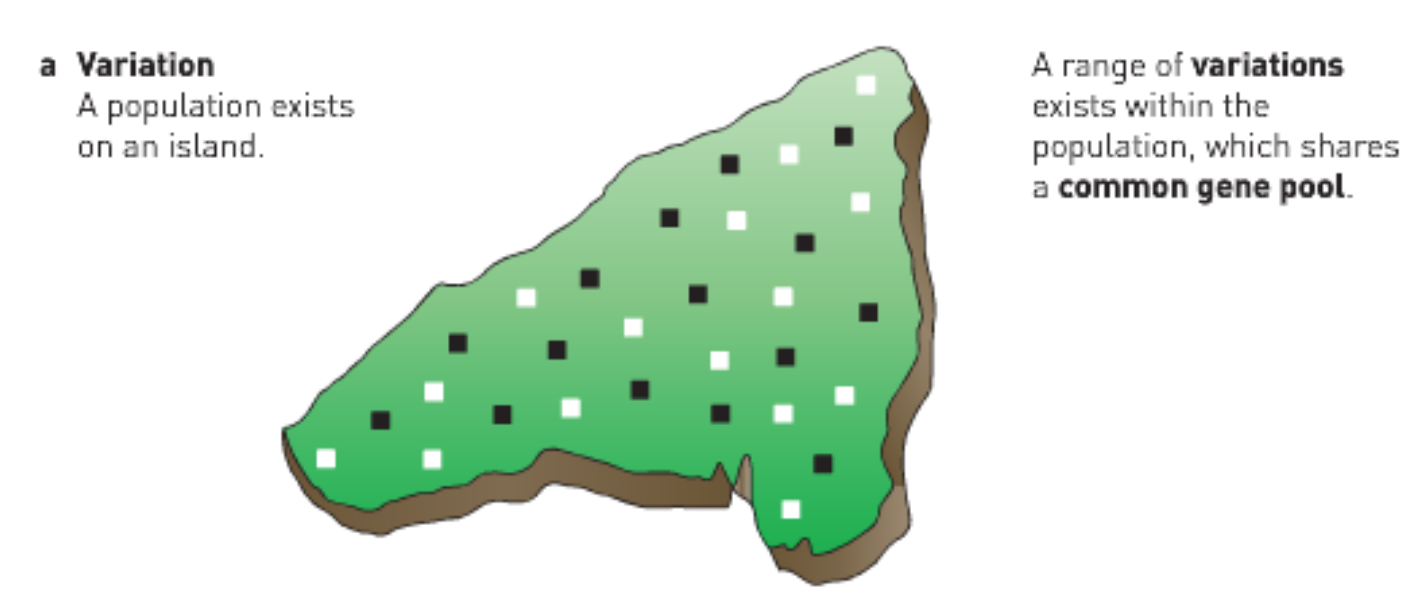
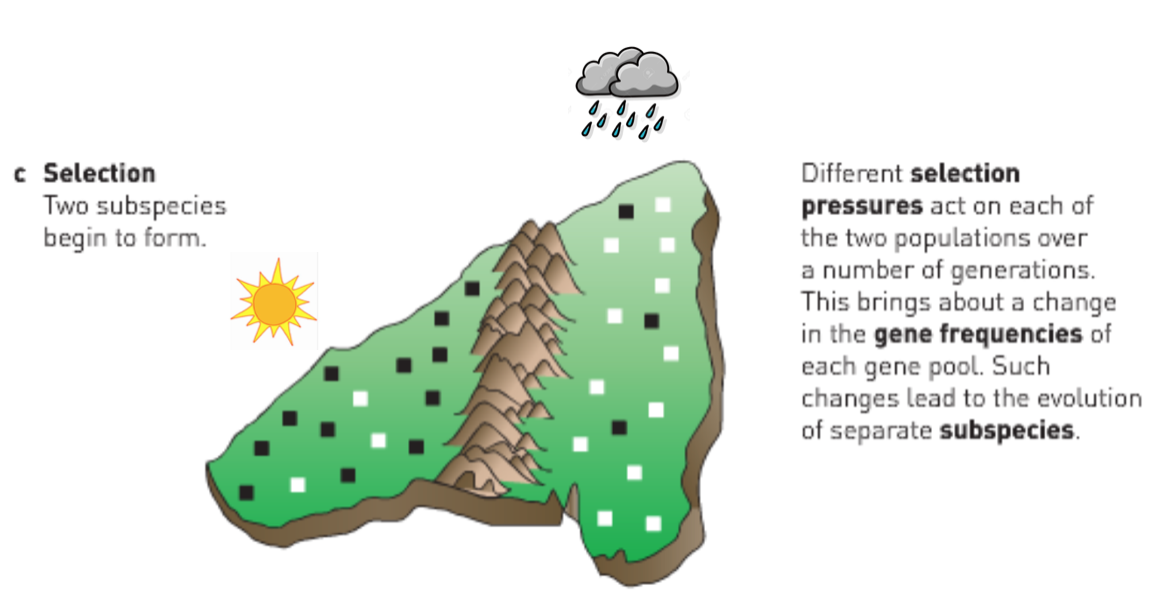
| Speciation | • When a population started as one / a common gene pool, but over time the population becomes two due to a barrier (mountain), then 2 sub species form which will change the gene frequencies. Then speciation occurs where it now has two separate species. |
| Population Size Small Populations | • Individuals make a relatively large contribution to the gene pool. • Evolution can occur rapidly. • Many changes are non-adaptive. • Many changes are due to chance events. |
| Population Size Large Populations | • Individuals make only a small contribution to the gene pool. • Evolution occurs slowly. • Most changes are adaptive. • Natural selection is the main driving force. • An allele that is rare in large populations may, purely by chance, become frequent in a small population |
| Genetic Bottleneck | Anything that creates a sudden drop in population size (e.g. wars, natural disasters or migration), or prevents individuals from breeding, reduces mating possibilities and can cause a genetic bottleneck. |
| Consanguinity (Inbreeding) | • Reduced mating opportunities often lead to an increase in in-breeding, or consanguinity (related by blood). • In-breeding results in reduced genetic diversity in the population’s gene pool. • In-breeding can result in non-adaptive changes occurring. • It can amplify desirable traits but, it can also greatly increase the risk of unusual, often harmful traits being expressed. |
| Process of Speciation Variation | |
| Process of Speciation Isolation | |
| Process of Speciation Selection | |
| Process of Speciation Speciation |
Want to create your own Flashcards for free with GoConqr? Learn more.