
10442829
Description

Mind Map by Edinson Ceferino, updated more than 1 year ago

|
Created by Edinson Ceferino
about 9 years ago
|
|
TCP/IP NETWORK ADMINISTRATION
- Overview of TCP/IP
- TCP/IP and the Internet
- this network, called the ARPAnet, was built to study techniques for providing robust,
reliable, vendor-independent data communications. Many techniques of modern data.
so the internet that we use today, over the years has been sold strengthening by
growing in agencies, corporations that have experimented with the tcp / ip network
innovating new features
- this network, called the ARPAnet, was built to study techniques for providing robust,
reliable, vendor-independent data communications. Many techniques of modern data.
so the internet that we use today, over the years has been sold strengthening by
growing in agencies, corporations that have experimented with the tcp / ip network
innovating new features
- TCP/IP Features
- these protocols tended to have an idea of growth, to the measure of the real
nesecidades of the users, the creators of this protocol had an intuition to be
recognized in the worldwide communications
- these protocols tended to have an idea of growth, to the measure of the real
nesecidades of the users, the creators of this protocol had an intuition to be
recognized in the worldwide communications
- Protocol Standards
- Protocols are formal rules of behavior,In data
communications, these sets of rules are also called
protocols.tcp/IP protocols are available to everyone and are
developed and changeTCPd by consensus,
- A Data Communications Model
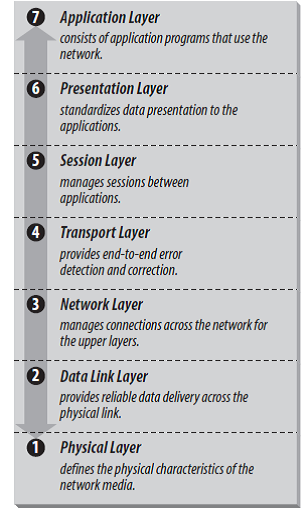
- The OSI Reference Model contains
seven layers that define the functions
of data communications protocols
- The OSI Reference Model contains
seven layers that define the functions
of data communications protocols
- Network Access Layer
- ne for each physical network standard.
Functions performed at this level include
encapsulation of IP datagrams into the frames
transmitted by the network, and mapping of IP
addresses to the physical addresses used by the
network.
- ne for each physical network standard.
Functions performed at this level include
encapsulation of IP datagrams into the frames
transmitted by the network, and mapping of IP
addresses to the physical addresses used by the
network.
- Internet Layer
- . The Internet Protocol (IP) is the most
important protocol in this layer., The
Internet Protocol is the heart of TCP/IP. IP
provides the basic packet delivery service
on which TCP/IP networks are built
- . The Internet Protocol (IP) is the most
important protocol in this layer., The
Internet Protocol is the heart of TCP/IP. IP
provides the basic packet delivery service
on which TCP/IP networks are built
- Internet Protocol
- The Internet Protocol relies on
protocols in other layers to
establish the connection if
they require
connection-oriented service.
- The Internet Protocol relies on
protocols in other layers to
establish the connection if
they require
connection-oriented service.
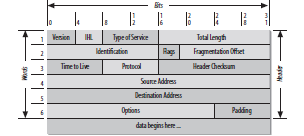
- The datagram
- The datagram is the packet
format defined by the Internet
Protocol., Each packet travels
the network independently of
any other packet.
- The datagram is the packet
format defined by the Internet
Protocol., Each packet travels
the network independently of
any other packet.
- Routing datagrams
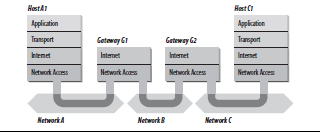
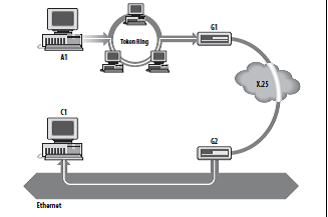
- . Gateways forward packets between networks,
and hosts don’t. However, if a host is connected
to more than one network (called a
multi-homed host), it can forward packets
between the networks.
- . Gateways forward packets between networks,
and hosts don’t. However, if a host is connected
to more than one network (called a
multi-homed host), it can forward packets
between the networks.
- fragmenting datagrams
- passing datagrams to the
transport layer
- When IP receives a datagram that is
addressed to the local host, it must
pass the data portion of the datagram
to the correct Transport Layer protocol
- When IP receives a datagram that is
addressed to the local host, it must
pass the data portion of the datagram
to the correct Transport Layer protocol
- internet control message protocol
- . This protocol is part of
the Internet Layer and
uses the IP datagram
delivery facility to send
its messages
- . This protocol is part of
the Internet Layer and
uses the IP datagram
delivery facility to send
its messages
- transport layer
- . The two most important
protocols in the Transport Layer
are Transmission Control
Protocol (TCP) and User
Datagram Protocol (UDP).
- . The two most important
protocols in the Transport Layer
are Transmission Control
Protocol (TCP) and User
Datagram Protocol (UDP).
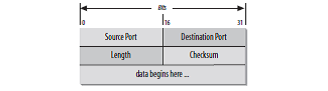
- user datagram protocol
- The User Datagram Protocol
gives application programs
direct access to a datagram
delivery service, UDP is the
most efficient choice for a
Transport Layer protocol
- The User Datagram Protocol
gives application programs
direct access to a datagram
delivery service, UDP is the
most efficient choice for a
Transport Layer protocol
- transmission control protocol
- TCP indicates the control
function of a segment by
setting the appropriate bit in
the Flags field in word 4 of the
segment header.
- TCP indicates the control
function of a segment by
setting the appropriate bit in
the Flags field in word 4 of the
segment header.
- application layer
- This protocol allows files to be
shared by various hosts on the
network. Some protocols, such
as Telnet and FTP, can be used
only if the user has some
knowledge of the network
- This protocol allows files to be
shared by various hosts on the
network. Some protocols, such
as Telnet and FTP, can be used
only if the user has some
knowledge of the network
- summary
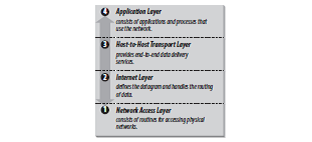
- We have seen that TCP/IP
is a hierarchy of four
layers: Applications,
Transport, Internet, and
Network Access.
- We have seen that TCP/IP
is a hierarchy of four
layers: Applications,
Transport, Internet, and
Network Access.
- TCP/IP Protocol Architecture
- The four-layered structure
of TCP/IP is seen in the way
data is handled as it passes
down the protocol stack
from the Application Layer
to the underlying physical
network
- The four-layered structure
of TCP/IP is seen in the way
data is handled as it passes
down the protocol stack
from the Application Layer
to the underlying physical
network
- TCP/IP and the Internet
Media attachments
Want to create your own Mind Maps for free with GoConqr? Learn more.