
13946977
Description

Created by ida muñoz rojas

|
Created by ida muñoz rojas
over 8 years ago
|
|
PRACTICE STANDARD FOR EARNED
VALUE MANAGEMENT
- INTRODUCTION
- Has been developed as a supplement to A Guide to the Project
Management Body of Knowledge (PMBOK Guide)
- Purpose of this Practice Standard
- Identifies a subset of project management practices that are used for
earned value management. Also promotes a common vocabulary.
- Identifies a subset of project management practices that are used for
earned value management. Also promotes a common vocabulary.
- Relationship to the PMBOK ® Guide
- The Practice Standard for Earned Value Management focuses on the effective integration of
those project management practices that are used for earned value management.
- The Practice Standard for Earned Value Management focuses on the effective integration of
those project management practices that are used for earned value management.
- Assumptions
- While the basic concept of EVM can and perhaps should be applied on every
project where resource management and cost/schedule outcomes are important,
this practice standard presents information for implementation on a large project.
- While the basic concept of EVM can and perhaps should be applied on every
project where resource management and cost/schedule outcomes are important,
this practice standard presents information for implementation on a large project.
- Structure of the Practice Standard
- This practice standard has ten chapters.
- This fi rst chapter is an introduction. Chapter 2
provides a highlevel overview of EVM.
- This practice standard has ten chapters.
- Has been developed as a supplement to A Guide to the Project
Management Body of Knowledge (PMBOK Guide)
- EARNED VALUE PROJECT MANAGEMENT OVERVIEW
- Outlines the basic principles and concepts of
earned value management.
- Basic EVM Terminology
- Throughout this practice standard, core terminology is used
frequently and is fairly unique to earned value management.
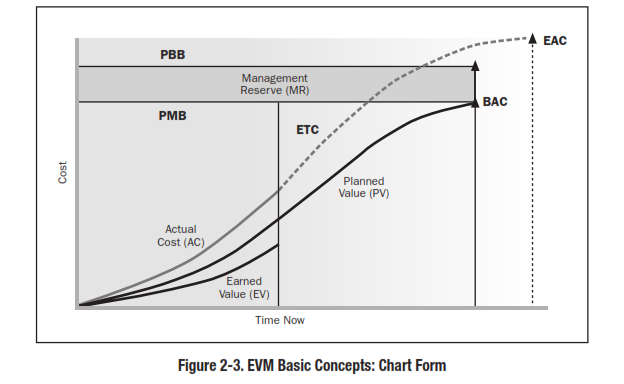
- Actual Cost (AC)
- Budget at Completion (BAC).
- Contingency Reserve
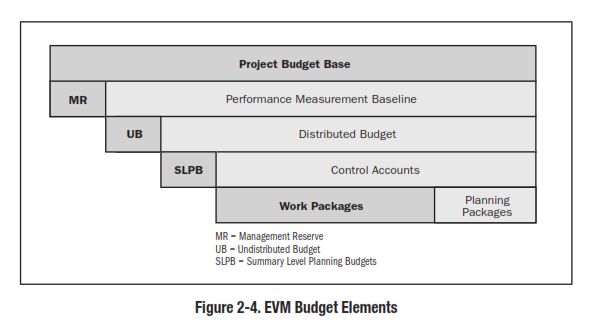
- Control Account
- Distributed Budget.
- Earned Value (EV)
- Estimate at Completion (EAC)
- Estimate To Complete (ETC)
- Management Reserve (MR)
- Performance Measurement Baseline (PMB)
- Planned Value (PV)
- Planning Package
- Project Budget Base (PBB).
- Summary Level Planning Budget (SLPB).
- Undistributed Budget (UB).
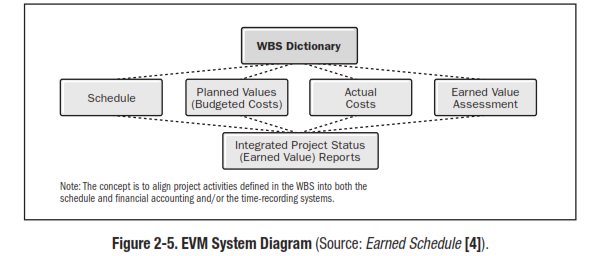
- Work Package
- Work Breakdown Structure (WBS)
- Work Breakdown Structure Dictionary
- Throughout this practice standard, core terminology is used
frequently and is fairly unique to earned value management.
- Introduction
- Earned value management is a management methodology for integrating scope, schedule, and resources; for
objectively measuring project performance and progress; and for forecasting project outcome.
- The Practice Standard for Earned Value Management was developed as a supplement to A Guide to the Project
Management Body of Knowledge (PMBOK ® Guide) .
- Earned value management is a management methodology for integrating scope, schedule, and resources; for
objectively measuring project performance and progress; and for forecasting project outcome.
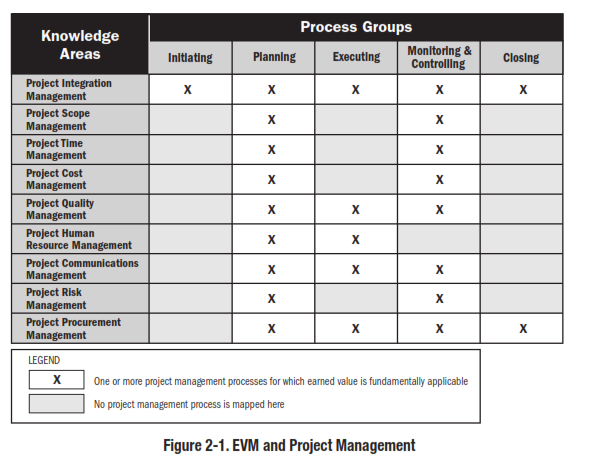
- EVM and the Project Management Process
- The practice of EVM is consistent with good project management as outlined in
A Guide to the Project Management Body of Knowledge ( PMBOK ® Guide ).
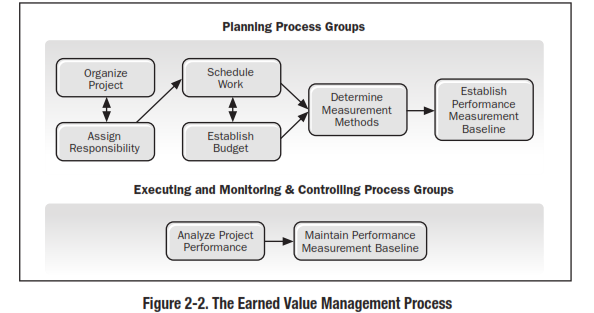
- Project planning is mostly a matter of determining:
- What work must be done (scope) and in what pieces (work breakdown structure).
- Who is going to perform and manage the work (responsibility assignment matrix)
- When the work will be done (schedule).
- The cost and quantity of the labor, material, and related resources the work will require.
- What work must be done (scope) and in what pieces (work breakdown structure).
- The practice of EVM is consistent with good project management as outlined in
A Guide to the Project Management Body of Knowledge ( PMBOK ® Guide ).
- Basic EVM Concepts
- Proper planning requires a fi rm grasp of product and project scope.
- During the planning process, emphasis is placed on gaining agreement
among the key stakeholders regarding the project objectives.
- In the project execution process, EVM requires the recording of resource utilization (i.e., labor, materials, and the
like) for the work performed within each of the work elements in the project management plan
- Proper planning requires a fi rm grasp of product and project scope.
- Considerations
- While this practice standard assumes the implementation of EVM on a large project in order to provide all
necessary information on EVM, this practice standard may be applicable to smaller scale projects as well.
- EVM basics:
- Measuring and comparing the value of the work performed (earned value) with the value planned and actual costs
expended to accomplish that work as the project progresses.
- Developing forecasts, for example, EAC, ETC, VAC, etc.
- Measuring and comparing the value of the work performed (earned value) with the value planned and actual costs
expended to accomplish that work as the project progresses.
- While this practice standard assumes the implementation of EVM on a large project in order to provide all
necessary information on EVM, this practice standard may be applicable to smaller scale projects as well.
- Outlines the basic principles and concepts of
earned value management.
- Is a complement to A Guide to the Project Management Body of
Knowledge ( PMBOK guide).
Media attachments
Want to create your own Mind Maps for free with GoConqr? Learn more.