
Mind map
INCLUSIVE EDUCATION AND ELT POLICIES IN COLOMBIA
Map content
INCLUSIVE EDUCATION AND ELT POLICIES IN COLOMBIA
INTRODUCTION
- 1994
- 92 Governments
- They argued in favor of a move from integrated to inclusive education
- Model of education that encompasses such diversity
- Policies that can either
- Facilitate
- Prevent
- The development of inclusive educative systems and practices
- Policies that can either
- Model of education that encompasses such diversity
- The achievement of better and more inclusive policies and practices
- must be based in
- Research
- Poor financial resources
- ideology socialization
- COLOMBIA
- The National Program
- Implementing language policies
- allow the inclusion
- All the languages
- Cultures present
- allow the inclusion
- Implementing language policies
- The National Program
- must be based in
- They argued in favor of a move from integrated to inclusive education
- 25 International organizations
- Education
- Provide quality basic education for everybody
- 92 Governments
- 1994
THEORETICAL FRAMEWORK
- INCLUSION
- 4 elements
- Process
- A never-ending search for adequate forms to respond
- to diversity
- learn to live with
- Differences
- to take advantage of them and to comprehend them
- to achieve sustainable changes
- to take advantage of them and to comprehend them
- Differences
- learn to live with
- to diversity
- A never-ending search for adequate forms to respond
- Identification and elimination
- Barriers
- which embrace
- Personal
- Social
- Cultural
- Social
- Conditions
- Resources
- that produce exclusion
- Resources
- Personal
- which embrace
- Barriers
- Assistance and good school performances
- Appropriate places
- to achieve a better quality of their scholar experiences
- Appropriate places
- Different perspectives
- Some countries
- A way to integrate children
- with disabilities in the general education system
- A way to integrate children
- Other countries
- Transformation of the education systems
- to respond to the students’ diversity.
- Transformation of the education systems
- Some countries
- Process
- INCLUSION IS A HUMAN RIGHT
- Different
- pursues the creation of curriculums
- as an opportunity to learn in several ways.
- inclusion involves the cessation of putting minority groups in the midst of
- those educative systems that claimed themselves as regular educative centers
- inclusion involves the cessation of putting minority groups in the midst of
- as an opportunity to learn in several ways.
- Integration
- Promotes adaptation processes in curriculums
- 4 elements
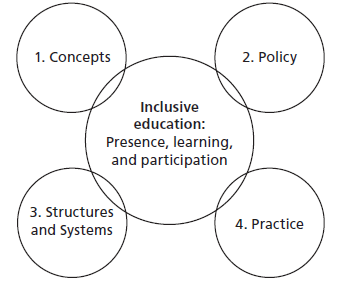
- INCLUSIVE EDUCATION
- Inclusive education
- Centers of education must recognize the educative practices
- and the existent knowledge on the dynamics of the school.
- Adopt an attentive attitude of analysis of the elements
- that obstruct student participation
- educative centers
- make effective use of support assets and human resources
- Inclusive schools should be:
- flexible, informal, horizontal, participative, competent.
- Framework for the Evaluation of Inclusive Educative Systems
- flexible, informal, horizontal, participative, competent.
- Inclusive schools should be:
- make effective use of support assets and human resources
- Centers of education must recognize the educative practices
- Education
- Construction of individual knowledges
- Inclusion
- Entails making effective human rights
- Inclusive education
- INCLUSIVE EDUCATION IN COLOMBIA
- MEN
- The right to education and equality must be guaranteed to all Colombian citizens
- The State propose
- Develop organizational strategies
- implement flexible and innovative teaching practices
- that allow a personalized education
- The State has the obligation to
- ´prevent the victims of discrimination of any kind.
- The State propose
- Established policies to regulate pedagogical support
- with disabilities and exceptional aptitudes or talent
- which doesn't allow
- the access to education
- for people with different conditions and disabilities.
- the access to education
- The right to education and equality must be guaranteed to all Colombian citizens
- Insufficient financial resources
- MEN
- INCLUSION
CONCLUSIONS
- Examine the topic of inclusion in elt in Colombia in regard to the policies
- Inclusion in elt means to recognize
- The local contexts and necessities
- The local expertise and knowledge
- The right to be different and to have access to education of quality and equal opportunities
- The duty to learn about others
- The students’ learning paces, desires, and needs
- Inclusion in elt means to recognize
- The policies are characterized
- by the
- instrumentalization of language teaching,
- Standardization
- Exclusion of local knowledge
- Expertise
- Minority groups
- Expertise
- Exclusion of local knowledge
- by the
- Characteristics
- allow concluding that the
- National Bilingual programme and Standards
- do not facilitate the promotion of inclusive practices.
- National Bilingual programme and Standards
- allow concluding that the
- Examine the topic of inclusion in elt in Colombia in regard to the policies
Images and files in the map






































Information
- Description
- Mind map: Inclusive Education in Colombia-Stefany Reyes Rodriguez
- Created by
- stefany reyes rodriguez
- Views
- 24
- Rating