
22394883
Description

Mind Map by Jonathan Rendon, updated more than 1 year ago

|
Created by Jonathan Rendon
over 5 years ago
|
|
Routing Concepts
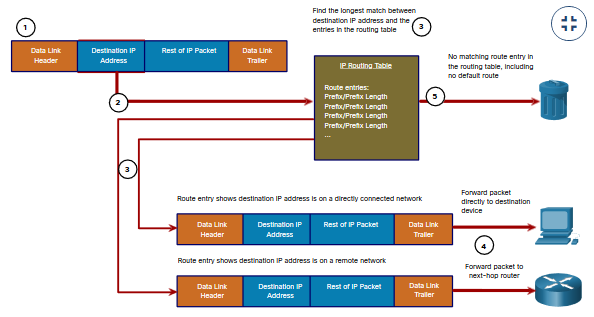
- Path Determination
- The router uses its IP
routing table to
determine which path to
use to forward a packet
- Two Functions of Router
- Determine the best path
for the packet to take
- Routing
- Determine the best path
for the packet to take
- The longest match is the route in the
routing table that has the greatest
number of far-left matching bits with
the destination IP address of the packet
- The router uses its IP
routing table to
determine which path to
use to forward a packet
- Packet Forwarding
- Decision Process
- Packet Forwarding
Mechanisms
- Process switching
- Fast switching
- Cisco Express Forwarding (CEF)
- Process switching
- Decision Process
- Basic Router
Configuration Review
- Configuration
Commands
- ipv6 unicast-routing
- ipv6 address X.X.X.X
- ipv6 address X.X.X.X
link-local
- ipv6 unicast-routing
- Verification
Commands
- show ip
interface brief
- show running-config
interface interface-type
number
- show interfaces
- show ip interface
- show ip route
- ping
- show ip
interface brief
- Filter Command Output
- section
- include
- exclude
- begin
- section
- Configuration
Commands
- IP Routing Table
- Route Source
- Directly connected
networks
- Static routes
- Dynamic routing
protocols
- Directly connected
networks
- Routing Table Principle
- Decision based on
the information
- The information not
necessarily match
the routing table
- Does not provide return
routing information
- Decision based on
the information
- Routing Table Entries
- Route source
- Destination network
- Administrative distance
- Metric
- Next-hop
- Route timestamp
- Exit interface
- Route source
- Static Routes
- Dynamic Routing
Protocols
- Default Route
- Route Source
- Static and
Dynamic Routing
- Dynamic Routing
Protocol Concepts
- Data structures
- Routing protocol
messages
- Algorithm
- Data structures
- Best Path
- RIP
- OSPF
- EIGRP
- RIP
- Load Balancing
- The routing table contains the
single destination network, but
has multiple exit interfaces, one
for each equal cost path.
- The routing table contains the
single destination network, but
has multiple exit interfaces, one
for each equal cost path.
- Dynamic Routing
Protocol Concepts
Media attachments
Want to create your own Mind Maps for free with GoConqr? Learn more.