
26848377
Description

Mind Map by Emilio Torres, updated more than 1 year ago

|
Created by Emilio Torres
over 5 years ago
|
|
Past perfect
- Regular verbs
- Phone/Phoned
Pick/picked
Play/played
Invite/invited
Return/returned
- Phone/Phoned
Pick/picked
Play/played
Invite/invited
Return/returned
- Irregular verbs
- Eat/ate
Find/found
Go/went
Lose/lost
take/took
- Eat/ate
Find/found
Go/went
Lose/lost
take/took
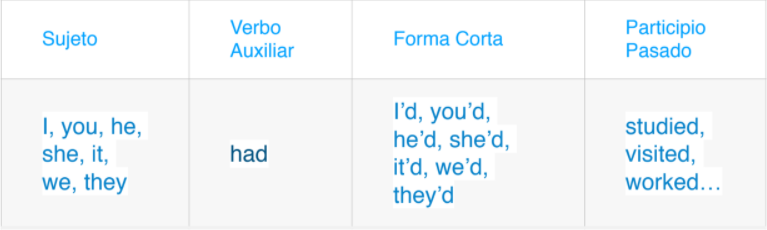
- Grammatical rules
Igual que en el
present perfect, se
forma el past perfect
con el verbo auxiliar
"to have" y el
participio pasado. El
verbo auxiliar estará
en pasado.
- La contracción “-’d” también se utiliza con el verbo modal “would” para
formar el condicional. Como tal, la forma corta “I’d” puede tener dos
significados diferentes. Podemos distinguir entre estos dos significados por la
forma del verbo principal que les sigue. Si queremos decir “I’d” en el sentido
de pasado perfecto, el verbo principal está en la forma de participio pasado,
mientras que con el condicional, “I’d” va seguido por el verbo en infinitivo.
Example: I'd visited Cancun in Mexico last summer. (Yo había visitado Cancún en México el último verano). I'd like visite Cancun in
Mexico once again (Me gustaría visitar Cancún en México una vez más).
- La contracción “-’d” también se utiliza con el verbo modal “would” para
formar el condicional. Como tal, la forma corta “I’d” puede tener dos
significados diferentes. Podemos distinguir entre estos dos significados por la
forma del verbo principal que les sigue. Si queremos decir “I’d” en el sentido
de pasado perfecto, el verbo principal está en la forma de participio pasado,
mientras que con el condicional, “I’d” va seguido por el verbo en infinitivo.
Example: I'd visited Cancun in Mexico last summer. (Yo había visitado Cancún en México el último verano). I'd like visite Cancun in
Mexico once again (Me gustaría visitar Cancún en México una vez más).
- Affirmative sentences (+)
- Subject + "had" + past participle verb
- Example: Erasmo had played with his cousin soccer all day until he
broke his leg.
- Example: Nelly had cooked something delicious for dinner
unfortunately, she forgot add spices to the recipe.
- Subject + "had" + past participle verb
- Negative sentences (-)
- Subject + had not (hadn't) + past participle verb
- Example: They had not returned to home early, because they
went to Johnny house for watch horror movies all night.
- Example: Ivan had not responded his mother phone, because
he lost his own phone in the subway yesterday.
- Example: They had not returned to home early, because they
went to Johnny house for watch horror movies all night.
- Subject + had not (hadn't) + past participle verb
- Interrogative sentences
(?)
- Had + subject + past
participle verb + ?
- Example: Had you visited Machu Picchu
before? Yes, I had visited Machu Picchu
before, because my brother is living in
Peru.
- Example: Alice said that loves you, had you had a girlfriend
before?
- Had + subject + past
participle verb + ?
Media attachments









Want to create your own Mind Maps for free with GoConqr? Learn more.