
31456510
Description

Created by María Alejandra Lainfiesta Wahl

|
Created by María Alejandra Lainfiesta Wahl
over 5 years ago
|
|
HOW IS THE DNA IN EUKARYOTIC
CHROMOSOMES ORGANIZED?
- The length of DNA in the nucleus is far greater
than the size of the compartment in which it is
contained. To fit into this compartment the
DNA has to be condensed in some manner.
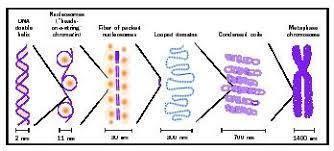
- DNA is not packaged directly into final structure of chromatin.
Instead, it contains several hierarchies of organization. The first level
of packing is achieved by the winding of DNA around a protein core to
produce a "bead-like" structure called a nucleosome.
- This gives a packing ratio of about 6. This structure is
invariant in both the euchromatin and heterochromatin
of all chromosomes.
- This gives a packing ratio of about 6. This structure is
invariant in both the euchromatin and heterochromatin
of all chromosomes.
- The second level of packing is the coiling of beads in a helical
structure called the 30 nm fiber that is found in both
interphase chromatin and mitotic chromosomes. This
structure increases the packing ratio to about 40.
- The final packaging occurs when the fiber is organized
in loops, scaffolds and domains that give a final
packing ratio of about 1000 in interphase
chromosomes and about 10,000 in mitotic
chromosomes.
- Eukaryotic chromosomes consist of a
DNA-protein complex that is organized in a
compact manner which permits the large
amount of DNA to be stored in the nucleus of
the cell.
- The subunit designation of the chromosome is
chromatin. The fundamental unit of chromatin
is the nucleosome.
Media attachments
Want to create your own Mind Maps for free with GoConqr? Learn more.