
Mapa mental
GPS B GRAMMAR
Contenido del mapa
GPS B GRAMMAR
CLAUSES: MAIN VS SUBORDINATE
- PHRASES VS SENTENCES
- Phrase
- Doesn't express a complete thought
- Doesn't have a subject, predicate
- Doesn' have a meaning by itself
- Is part of a sentence
- ...during the rainy season
- ...have been painting landscape
- Sentence
- Express a complete thought
- Has both subject, complement
- Has ain independent meaning
- Can stand alone
- Traffic gets worst during the rainy season
- They have been paiting the landscape
- Phrase
- COMPLEX SENTENCES AND CLAUSES
- Simple sentences
- Anne considered the weather report this morning. She changed her plans for today
- Compound sentences
- Anne considered the weather report this morning, and she changed her plans for today
- Complex sentences
- Becouse Anne considered the weather report this morning, (subordinate clause) she changed her plans for today. (main clause)
- Subordinate clause starts with a conjunction or linkin word
- Luke is the man WHO rebuilt all the place in three days
- AFTER you park the car, you should stop the engine
- LINKING WORDS
- Because
- After
- That
- Who
- Where
- Which
- Although
- Whom
- Why
- Whose
- Simple sentences
- PHRASES VS SENTENCES
ADJECTIVE CLAUSES
- Are subordinate clauses which describes/modify a NOUN as adjectives do
- Begins with relative pronouns or adverbs, working as Linking Words
- Clark will buy a HOUSE THAT is near the lake
- Subordinate clause describes HOUSE
- Theh view was the REASON WHY we chose that hotel
- Subordinate clause describes REASON
- Clark will buy a HOUSE THAT is near the lake
- Can be placed between commas only if the information they contains doesn' affect the meaning of the whole sentence
- Children, WHO ARE NATURALLY HYPERACTIVE, need an adequate place to play
- FROM ADJECTIVES PHRARE TO ADJECTIVE CLAUSES
- Thi adds extra description that will enrich what you want to express
- The coffe house ON THE CORNER serves the best pumpking pie
- The coffe houase WHICH IS ON THE CORNER serves the ...
- The members OF THE CITY COUNCIL decided to preserve the monument
- The members WHO FORM THE CITY COUNCIL decided to preserve...
- Thi adds extra description that will enrich what you want to express
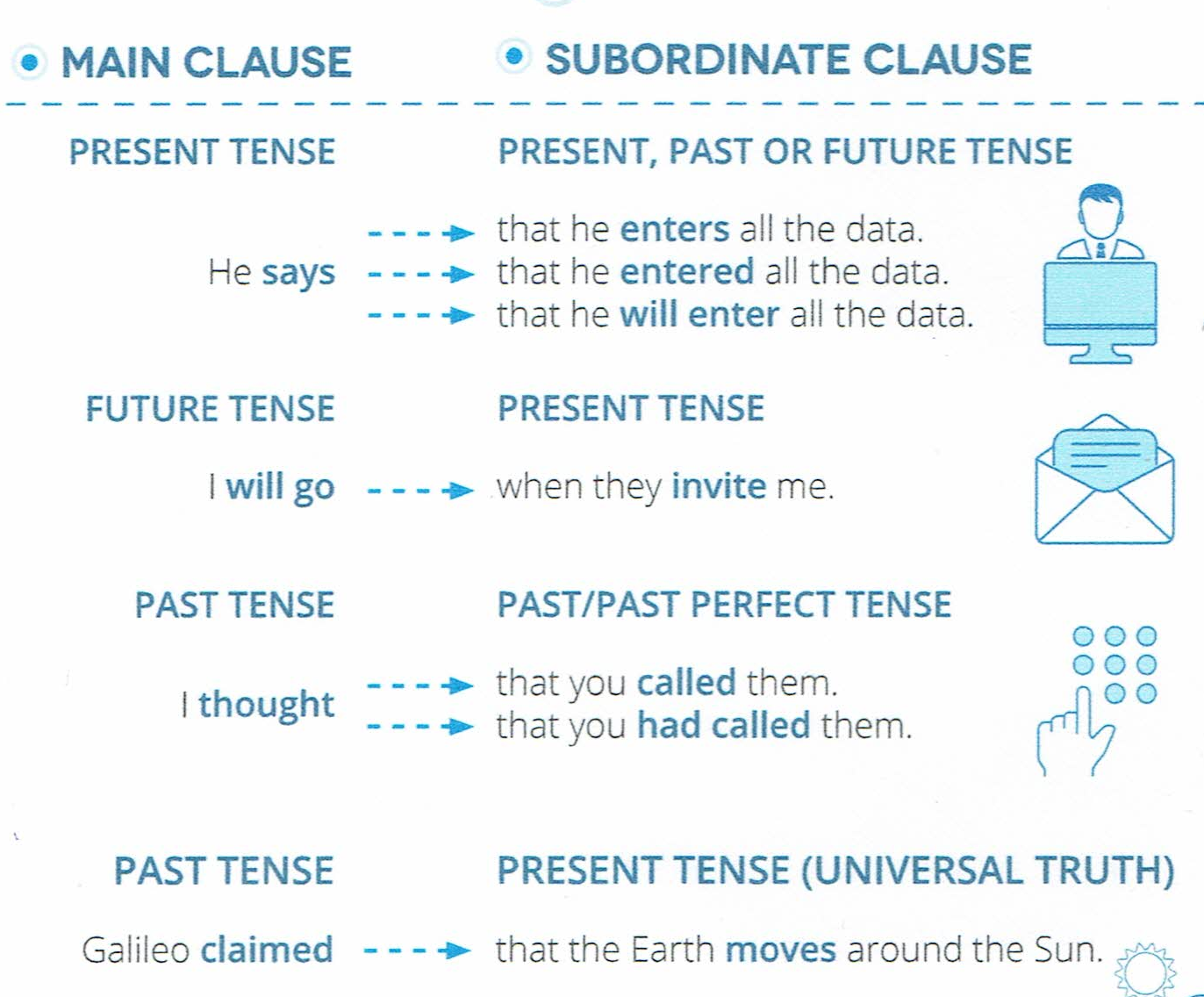
THE SECUENCE OF TENSES
- Means the agreement in time that 2 clauses have
- PAST TENSES
CONDITIONALS
- Begins with the conjuction IF
- Also called If-clause, is expressed with tenses, it begins the sentence
- FIRST CONDITIONAL
- Suppositions about the future, the supposition is probable
- IF i HAVE any doubts, i WILL ASK you a question
- If + person + verb s. form + complement + person + auxiliar + verb s. present
- IF it didn't rain, we may go to the beach
- If + person + verb s. form + complement + person + auxiliar + verb s. present
- IF i HAVE any doubts, i WILL ASK you a question
- Suppositions about the future, the supposition is probable
- SECOND CONDITIONAL
- Express an unreal, imagined or impossible condition
- IF you HAD enough time, you WOULD TRAVEL to many places
- If + person + verb past + complement + person + auxiliar + verb s, present + complement
- If i were invisible, i could play some tricks on my friends
- If + person + verb past + complement + person + auxiliar + verb s, present + complement
- IF you HAD enough time, you WOULD TRAVEL to many places
- The veb in the if-clause is past in form, but it doesn't express past
- The form of "BE" is "WERE" for any person
- Express an unreal, imagined or impossible condition
- THIRD CONDITIONAL - UNREAL PAST
- Ideas that are impossible up to this moment to be done becouse they were chances no taken in the past and this might have been different is something else had happend before (to regret)
- The 2 clauses use the perfect form of the veb
- If + person + past perfect (had) + verb p.participle + complement + person +perfect modal + verb p,participle
- If i had gone to the concert, i would have seen my favorite singer
- If we had bought the tickets a week before, we gotten a goos discount
- If Tom hadn't had his documents in order, he would not have been able to travel
- PERFECT MODALS
- Could have
- Would have
- MIght have
- Should have
- Shall have
- I, WE
- Ought to have
- Must have
- Ideas that are impossible up to this moment to be done becouse they were chances no taken in the past and this might have been different is something else had happend before (to regret)
- Begins with the conjuction IF
ADVERB CLAUSES:
- PLACE AND TIME
- Place
- Where the action happends
- Introduced by subordinating cojuctions "where", "wherever"
- The scientists went WHERE they expected to find the minerals needed
- WHEREVER they go, they'll always bring modernity and great work standards
- Introduced by subordinating cojuctions "where", "wherever"
- Where the action happends
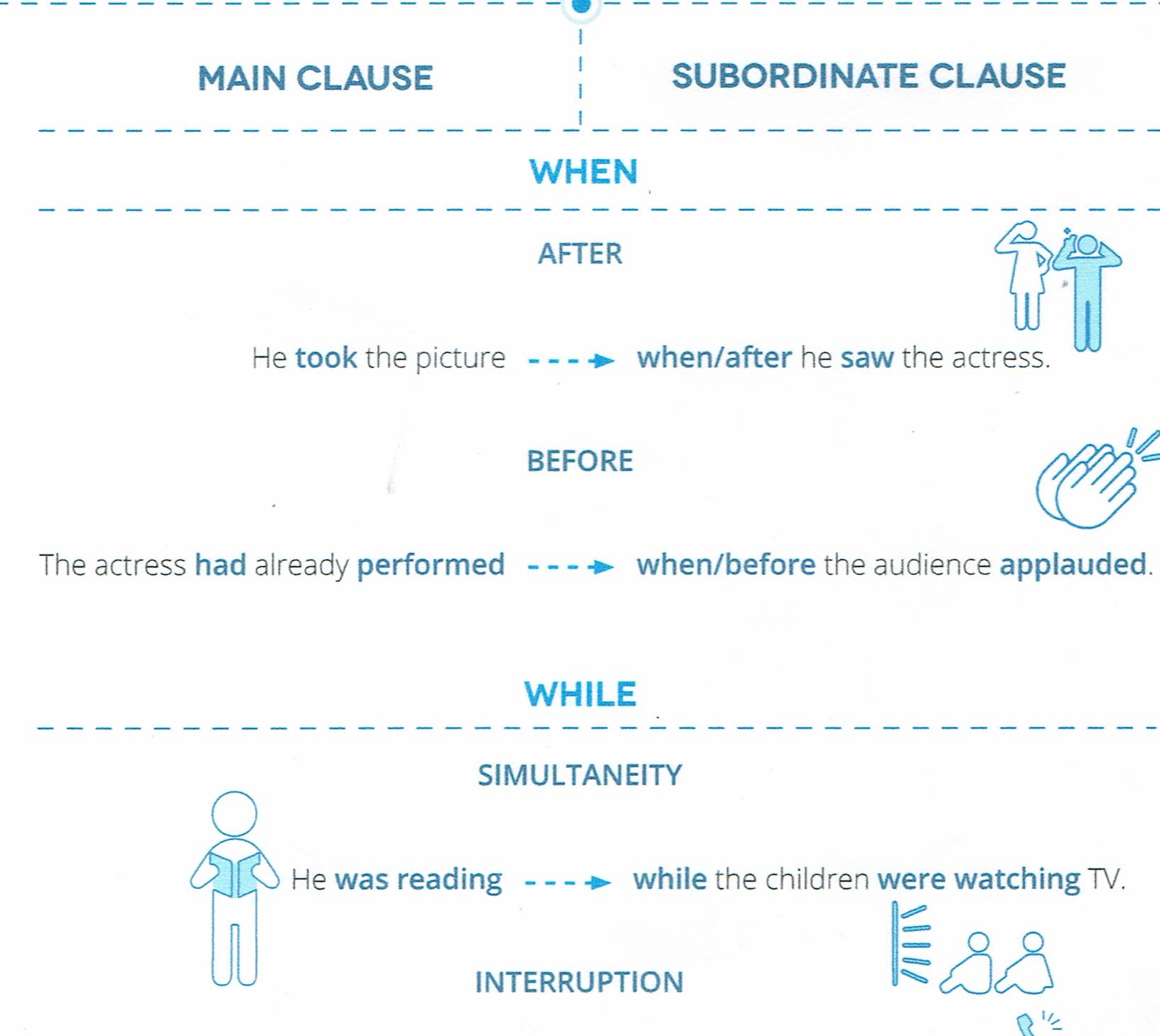
- Time
- Thell when an action is done
- introduced by subordinating conjuctions "after" "as "as soon as" "before" "since" "by the time" "once" "when" "by the time" "once" "when" "whenever" "until" "till" "while"
- AFTER the got married, they moved to Toronto
- The store won't close UNTIL the last clients leaves
- introduced by subordinating conjuctions "after" "as "as soon as" "before" "since" "by the time" "once" "when" "by the time" "once" "when" "whenever" "until" "till" "while"
- Thell when an action is done
- Place
- MANNER AND CONDITION
- Manner
- Answers "How? introduced by:
- As
- Formal
- You should do this task everyday AS i am teaching you now
- Formal
- As if
- Informal/exaggeration
- You did your job AS IF you were to be promoted
- Informal/exaggeration
- Like
- Casual
- As
- Answers "How? introduced by:
- Condition
- Express a degree of probability an action is done, was done, will be done
- Introduced by S.C
- If - Condition
- IF you decide to travel abroad, keep your passport in a safe place at all times
- Even if/unless/wheter - the result is always the same
- EVEN IF it rains, i will go to the store
- If - Condition
- Introduced by S.C
- Express a degree of probability an action is done, was done, will be done
- Manner
- REASON, RESULT AND PURPOSE
- Purpose
- Explain the intention for doing something "Whats is the intention of it?"
- Introduced by S.C
- So, so that, in order that
- We must solve all the doubts IN ORDER THAT an agreement can be reached today by 6 p.m.
- Clear the door SO THAT people can exit the elevator quicky
- So, so that, in order that
- Introduced by S.C
- Explain the intention for doing something "Whats is the intention of it?"
- Result
- Result, consecuence or effect of the main clause "So whats happend then?"
- Introduced by S.C
- So, so that, so...that, such...that
- We knew our father's birthday was coming up, SO we started organizing a suprise party
- It was SUCH a stormy night THAT we deided to stay home and miss the movie premiere
- So, so that, so...that, such...that
- Introduced by S.C
- Result, consecuence or effect of the main clause "So whats happend then?"
- Reason
- Tells whyb an action is done or happend "Why?"
- Introduced by S.C
- Because, since, for, as
- BECAUSE the dentist injected an anesthesic in my gums, the tooth stopped aching
- They decided to rest SINCE they had been walking a long way under the scorching sun
- Because, since, for, as
- Introduced by S.C
- Tells whyb an action is done or happend "Why?"
- Purpose
- CONCESSION AND COMPARISON
- Concession
- Express unexpected result, contradiction to what is tated in the main clause or contrasting comparison with the information in the main clause
- In one side the sentence need to be positive and in the other negative or viceversa (+ -) (- +)
- Introduced by S.C like
- Though, Althought, Even though, While, Whereas
- ALTHOUGH i wasn't hungry, i ate 5 hamburgers
- I went to the park THOUGH it was raining heavily
- I spent a lot of money EVEN THOUGH i didn't want to buy anything
- I told her to go to the party WHILE she didn't want to
- I didn't pass the exam WHEREAS i studied for a complete week
- Though, Althought, Even though, While, Whereas
- Introduced by S.C like
- In one side the sentence need to be positive and in the other negative or viceversa (+ -) (- +)
- Express unexpected result, contradiction to what is tated in the main clause or contrasting comparison with the information in the main clause
- Comparison
- Compare people, things or situations of the same kind, can omit auxiliary verbs
- Introduced by S.C llike:
- As...as
- The local software company is no AS famous AS the one coming from Silicon...
- MC Donalds is not as good as Carl's Jr
- The local software company is no AS famous AS the one coming from Silicon...
- Might
- We can MIGHT leave some words behind
- So...as
- English is SO important AS Spanish
- That
- The sudents studies more THAN the teachers (do)
- As...as
- Introduced by S.C llike:
- Compare people, things or situations of the same kind, can omit auxiliary verbs
- Concession
- Modify the verb of the main clause, adjective, adverb
- PLACE AND TIME
SUBJECTS
- Refers to the doer of the action in a sentence, it's found before a verb
- Noun
- Exercise is good for your health
- Pronoun
- It is good for your health
- Gerund
- Exercising is good for your health
- Infinitive
- To exercise is good for your health
- Noun clause
- a subject working as the idea being talked about: the subject
- What you are watching is interesting
- NOUN CLAUSES
- FORMATION
- Can be substituted with the pronouns "it" "someone" "somethting"
- When a pronoun such as "it" "this" "that" substitutes a whole sentence
- A new planet has been discovered + This was enough to launch sponsirship campaigns
- That a new planet has been discovered was enough to launch sponsorship campaigns
- A new planet has been discovered + This was enough to launch sponsirship campaigns
- When a pronoun such as "he "him" "she" "her" or any reference to a person substitues "someone" "somebody
- Someone called you this morning + That person didn't want to leave the message
- Whoever called you this morning didn't want to leave a message
- Someone called you this morning + That person didn't want to leave the message
- When a pronoun such as "it" "this" "what" substitutes "something"
- The teacher told us something + That was off the topic of today's lesson
- What the teacher told us was off the topic of today's lesson
- The teacher told us something + That was off the topic of today's lesson
- When a pronoun such as "it" "this" "that" substitutes a whole sentence
- What
- May be known/one has idea of/is important
- Whatever
- Is unknown/is not relevant/both
- Can be substituted with the pronouns "it" "someone" "somethting"
- SUBJECT AND SUBJECT COMPLEMENT
- N.C act as a subject
- WHAT CAUSES THE ALLERGY IN THE LITTLE BOY is the esposure to dust
- N.C act as a Subject Complement
- When it restates, renames, completes, describes the subject after a linking verb
- The greatest asset is THAT THEY ARE HARD WORKERS
- When it restates, renames, completes, describes the subject after a linking verb
- N.C act as a subject
- Is a Subordinate clause which works as a noun and starts with a L.W like:
- Who Whom Which What Where When How Why That Whoever Whomever Whichever Whatever Wherever Whenever However Wheter If
- The linking word ending in -ever refer to unknown information
- Who Whom Which What Where When How Why That Whoever Whomever Whichever Whatever Wherever Whenever However Wheter If
- DIRECT OBJECT AND OBJECT OF PREPOSITION
- Can act as a DIRECT OBJECT if is after an action verb
- FORMATION
- a subject working as the idea being talked about: the subject
Imágenes y archivos del mapa
Información
- Descripción
- Mapa Mental sobre GPS B GRAMMAR, creado por Alejandro Rios Alvarado el 07/04/2022.
- Creado por
- Alejandro Rios Alvarado
- Visitas
- 1
- Valoración