
4992789


2nd partial topics.
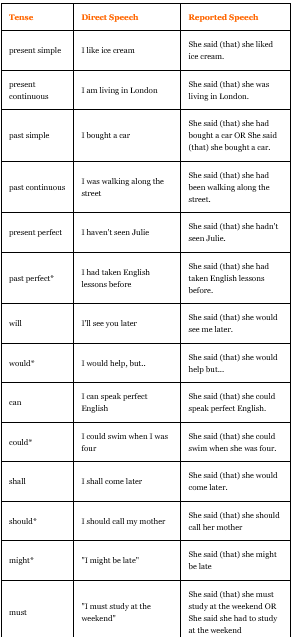
- Reported speech
- If we report what another
person has said, we usually
do not use the speaker’s
exact words (direct speech),
but reported (indirect)
speech.
- Present Simple --- Past Simple. Present
Continuous. ---- Past Continuous.
---Present Perfect--Past Perfect.
---Future Simple -- Would Infinitive.
- Present Simple --- Past Simple. Present
Continuous. ---- Past Continuous.
---Present Perfect--Past Perfect.
---Future Simple -- Would Infinitive.
- If we report what another
person has said, we usually
do not use the speaker’s
exact words (direct speech),
but reported (indirect)
speech.
- Conditionals
- They describe the
result of something
that might happen
(in the present or
future) or might
have happened but
didn't (in the past) .
- The Zero Conditional:
(if + present simple, ...
present simple) If you
heat water to 100
degrees, it boils.
- --- If I am late, my father takes me to school.
----She doesn't worry if Julian stays out after
school.
- --- If I am late, my father takes me to school.
----She doesn't worry if Julian stays out after
school.
- The First Conditional:
(if + present simple,
... will + infinitive) If it
rains tomorrow, we'll
go to the cinema.
- If it rains, we will stay at home. He will arrive
late unless he hurries up. Simon will buy a
new car, if he gets his raise.
- If it rains, we will stay at home. He will arrive
late unless he hurries up. Simon will buy a
new car, if he gets his raise.
- The Second Conditional:
(if + past simple, ... would
+ infinitive) If I had a lot of
money, I would travel
around the world.
- If he studied more, he would pass the exam. I would
lower taxes if I were the the Prime Minister. They
would buy a new house if they won the lottery.
- If he studied more, he would pass the exam. I would
lower taxes if I were the the Prime Minister. They
would buy a new house if they won the lottery.
- The Third Conditional:
(if + past perfect, ...
would + have + past
participle) If I had
gone to bed early, I
would have caught the
train.
- If he had known that, he would have decided differently.
Joanna would have found a new job if she had stayed in
Gorzów.
- If he had known that, he would have decided differently.
Joanna would have found a new job if she had stayed in
Gorzów.
- The Zero Conditional:
(if + present simple, ...
present simple) If you
heat water to 100
degrees, it boils.
- They describe the
result of something
that might happen
(in the present or
future) or might
have happened but
didn't (in the past) .
- Prepositions
- Prepositions are essential to
sentences because they
provide additional and
necessary details.
- ◾on ◾off ◾up to ◾along ◾across ◾as for ◾next ◾through ◾of ◾as ◾along with ◾apart from
◾about ◾around ◾according to ◾against ◾after ◾to ◾up ◾within ◾in spite of ◾at ◾out ◾behind
◾past ◾out of ◾by means of ◾between ◾before ◾beneath ◾beyond ◾beside ◾during ◾except for
◾under ◾down ◾below ◾by ◾over ◾inside ◾underneath ◾except ◾round ◾from ◾outside
◾toward ◾without ◾in addition to ◾in ◾into ◾until ◾unlike ◾in back of ◾like ◾because of ◾with
◾concerning ◾for ◾near ◾instead of ◾in front of ◾in ◾since ◾despite ◾on top of ◾throughout ◾in
place of ◾onto ◾upon
- ◾The child quickly hid under the thick
covers.◾My kite soared above the
building.◾From my father◾At noon, I went to
my wife’s office◾During the summer, I always
spend my time playing
- ◾The child quickly hid under the thick
covers.◾My kite soared above the
building.◾From my father◾At noon, I went to
my wife’s office◾During the summer, I always
spend my time playing
- ◾on ◾off ◾up to ◾along ◾across ◾as for ◾next ◾through ◾of ◾as ◾along with ◾apart from
◾about ◾around ◾according to ◾against ◾after ◾to ◾up ◾within ◾in spite of ◾at ◾out ◾behind
◾past ◾out of ◾by means of ◾between ◾before ◾beneath ◾beyond ◾beside ◾during ◾except for
◾under ◾down ◾below ◾by ◾over ◾inside ◾underneath ◾except ◾round ◾from ◾outside
◾toward ◾without ◾in addition to ◾in ◾into ◾until ◾unlike ◾in back of ◾like ◾because of ◾with
◾concerning ◾for ◾near ◾instead of ◾in front of ◾in ◾since ◾despite ◾on top of ◾throughout ◾in
place of ◾onto ◾upon
- Prepositions are essential to
sentences because they
provide additional and
necessary details.
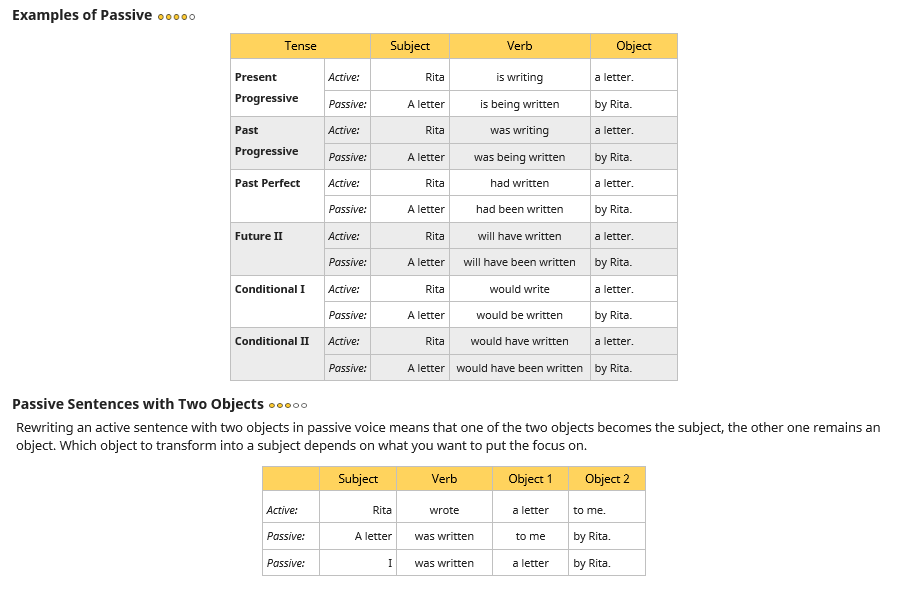
- The passive.
- Passive voice is used when
the focus is on the action.
- Subject + finite form of to be + Past
Participle (3rd column of irregular verbs)
- Subject + finite form of to be + Past
Participle (3rd column of irregular verbs)
- When rewriting active sentences in
passive voice, note the following:
- The object of the active
sentence becomes the
subject of the passive
sentence ◾the finite
form of the verb is
changed (to be + past
participle) ◾the subject
of the active sentence
becomes the object of
the passive sentence
(or is dropped)
- The object of the active
sentence becomes the
subject of the passive
sentence ◾the finite
form of the verb is
changed (to be + past
participle) ◾the subject
of the active sentence
becomes the object of
the passive sentence
(or is dropped)
- Passive voice is used when
the focus is on the action.
- The to infinitive + ing
- After certain verbs we use
the -ing form, and after
other verbs we use the
infinitive. Sometimes we
can use either form and
there is no change in
meaning. Occasionally we
can use either form and
there is a change in
meaning.
- The verbs followed by -ing include enjoy, mind, stop and
recommend. ------ I told him you really enjoy cooking. ---Would
you mind helping me? ----- It didn't stop raining all day
yesterday. -----Daisy recommends trying Alfie’s tiramisú. The
negative is verb + not + -ing. ---- Imagine not having pizza! I eat
it all the time. -
- These include decide, want, promise, plan and forget. ---She
decided to go with Elliot instead. I wanted to visit Rome. ----- She
promised to take me there. ---I planned to go to some real
Italian restaurants. ----She didn’t forget to phone. The negative is
verb + not + infinitive. ---They decided not to make pizza.
- The verbs followed by -ing include enjoy, mind, stop and
recommend. ------ I told him you really enjoy cooking. ---Would
you mind helping me? ----- It didn't stop raining all day
yesterday. -----Daisy recommends trying Alfie’s tiramisú. The
negative is verb + not + -ing. ---- Imagine not having pizza! I eat
it all the time. -
- After certain verbs we use
the -ing form, and after
other verbs we use the
infinitive. Sometimes we
can use either form and
there is no change in
meaning. Occasionally we
can use either form and
there is a change in
meaning.
- Modals
- Can be used when we want to say
how sure we are that something
happened / is happening / will
happen.
- Probabilty: We often call these 'modals of deduction' or
'speculation' or 'certainty' or 'probability'. They don't use an
's' for the third person singular.They are followed directly by
the infinitive of another verb (without 'to').
- •It's snowing, so it must be very cold outside. •I don't
know where John is. He could have missed the train.
•This bill can't be right. £200 for two cups of coffee!
- •It's snowing, so it must be very cold outside. •I don't
know where John is. He could have missed the train.
•This bill can't be right. £200 for two cups of coffee!
- Ability: We use 'can' and 'could' to talk
about a skill or ability.
- •She can speak six languages.
•My grandfather could play golf
very well. •I can't drive
- •She can speak six languages.
•My grandfather could play golf
very well. •I can't drive
- Obligation and Advice: We can use verbs such
as 'must' or 'should' to say when something is
necessary or unnecessary, or to give advice.
- •Children must do their homework.
•We have to wear a uniform at work.
•You should stop smoking.
- •Children must do their homework.
•We have to wear a uniform at work.
•You should stop smoking.
- Permission: We can use verbs such as 'can',
'could' and 'may' to ask for and give
permission. We also use modal verbs to say
something is not allowed.
- •Could I leave early today, please?
•You may not use the car tonight.
•Can we swim in the lake?
- •Could I leave early today, please?
•You may not use the car tonight.
•Can we swim in the lake?
- Habits: We can use 'will' and 'would' to talk
about habits or things we usually do, or
did in the past.
- •When I lived in Italy, we would often eat in the
restaurant next to my flat. •John will always be late!
- •When I lived in Italy, we would often eat in the
restaurant next to my flat. •John will always be late!
- Past Modals: past modal verbs are all
used hypothetically, to talk about
things that didn't really happen in the
past.
- Probabilty: We often call these 'modals of deduction' or
'speculation' or 'certainty' or 'probability'. They don't use an
's' for the third person singular.They are followed directly by
the infinitive of another verb (without 'to').
- Can be used when we want to say
how sure we are that something
happened / is happening / will
happen.
- Linking Words
- They can be used to
develop coherence
whithin a paragraph that
is linkin an idea or an
argment.
- Sequence: We use linking words
of sequence to add information
and to show the order in which
things happen.
- Firstly, I prefer the train because I can see the
landscape. Secondly, I have control over my luggage,
and thirdly, it is better for the environment.
- Firstly, I prefer the train because I can see the
landscape. Secondly, I have control over my luggage,
and thirdly, it is better for the environment.
- Result: We use linking words of result
to show the results or the
consequence of an action.
- Hector decided not to use a map;
consequently, he got lost and
never found his way out of the
forest
- Hector decided not to use a map;
consequently, he got lost and
never found his way out of the
forest
- Example: We use
linking words of
example to explain
something.
- ◾ You can do whetever you
want, for example go to parties.
◾For instance, my value may
be “I don´t like being hot”
- ◾ You can do whetever you
want, for example go to parties.
◾For instance, my value may
be “I don´t like being hot”
- Emphasis: We use linking
words of emphasis to
show an answer with
doubt
- ◾ In fact, now she felt nothing
◾Indeed, why should anyone feel
sorry for her?
- ◾ In fact, now she felt nothing
◾Indeed, why should anyone feel
sorry for her?
- Comparison: We use linking words
of comparison to show similarities
and differences
- ◾It was like reading an
open book. ◾ Pamela
danced in the festival, just as
Pamela did
- ◾It was like reading an
open book. ◾ Pamela
danced in the festival, just as
Pamela did
- Contrast: We use linking
words of contrast to show
two perspectives.
- ◾Dean turned from the
highway, however he had
the road for himself.
◾Living in a cold climate is
diffcilut, on the other hand,
there are many fun winter
activities.
- ◾Dean turned from the
highway, however he had
the road for himself.
◾Living in a cold climate is
diffcilut, on the other hand,
there are many fun winter
activities.
- Addition: We use linking words of addition
to add information
- ◾He is handsome and also silly.
◾ Furthermore he felt ordes no to
be disturbed.
- ◾He is handsome and also silly.
◾ Furthermore he felt ordes no to
be disturbed.
- Sequence: We use linking words
of sequence to add information
and to show the order in which
things happen.
- They can be used to
develop coherence
whithin a paragraph that
is linkin an idea or an
argment.
Media attachments
Want to create your own Mind Maps for free with GoConqr? Learn more.