
6478142
Description

Mind Map by javier Menjibar, updated more than 1 year ago

|
Created by javier Menjibar
about 10 years ago
|
|
NETWORK TOPOLOGYS
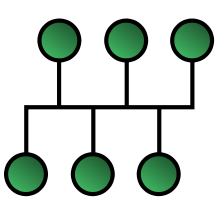
- Bus Topology
- In local area networks where bus topology is used, each node is connected to a single cable, by the help
of interface connectors. This central cable is the backbone of the network and is known as the bus (thus
the name). A signal from the source travels in both directions to all machines connected on the bus
cable until it finds the intended recipient.
- In local area networks where bus topology is used, each node is connected to a single cable, by the help
of interface connectors. This central cable is the backbone of the network and is known as the bus (thus
the name). A signal from the source travels in both directions to all machines connected on the bus
cable until it finds the intended recipient.
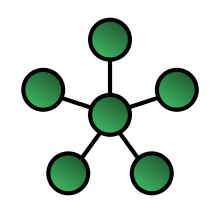
- Star
- In local area networks with a star topology, each network host is connected to a central hub with a
point-to-point connection. So it can be said that every computer is indirectly connected to every other
node with the help of the hub.
- In local area networks with a star topology, each network host is connected to a central hub with a
point-to-point connection. So it can be said that every computer is indirectly connected to every other
node with the help of the hub.
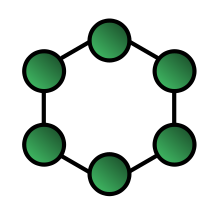
- Ring
- A ring topology is a bus topology in a closed loop. Data travels around the ring in one direction. When
one node sends data to another, the data passes through each intermediate node on the ring until it
reaches its destination. The intermediate nodes repeat (retransmit) the data to keep the signal strong
- A ring topology is a bus topology in a closed loop. Data travels around the ring in one direction. When
one node sends data to another, the data passes through each intermediate node on the ring until it
reaches its destination. The intermediate nodes repeat (retransmit) the data to keep the signal strong
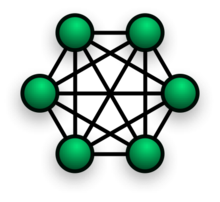
- Fully connected network
- In a fully connected network, all nodes are interconnected. (In graph theory this is called a complete
graph.) The simplest fully connected network is a two-node network. A fully connected network doesn't
need to use packet switching or broadcasting.
- In a fully connected network, all nodes are interconnected. (In graph theory this is called a complete
graph.) The simplest fully connected network is a two-node network. A fully connected network doesn't
need to use packet switching or broadcasting.
- Mesh
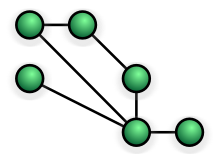
- Hybrid networks combine two or more topologies in such a way that the resulting network does not
exhibit one of the standard topologies (e.g., bus, star, ring, etc.). For example, a tree network (or star-bus
network) is a hybrid topology in which star networks are interconnected via bus networks.
- Hybrid networks combine two or more topologies in such a way that the resulting network does not
exhibit one of the standard topologies (e.g., bus, star, ring, etc.). For example, a tree network (or star-bus
network) is a hybrid topology in which star networks are interconnected via bus networks.
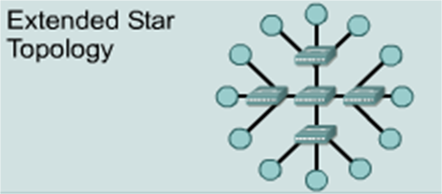
- Snow Flake
- is a star network of star networks.
- is a star network of star networks.
- Point To Point
- A permanent link is very easy to understand, is a point-to-point communications channel that
appears, to the user, to be permanently associated with the two endpoints.
- A permanent link is very easy to understand, is a point-to-point communications channel that
appears, to the user, to be permanently associated with the two endpoints.
Media attachments

Want to create your own Mind Maps for free with GoConqr? Learn more.