
8786867
Description

Mind Map by Manuel Hernández Zorrilla, updated more than 1 year ago

|
Created by Manuel Hernández Zorrilla
almost 9 years ago
|
|
Integration Techniques
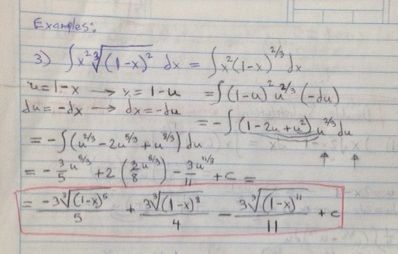
- Double Substitution
- This method simplifies
algebraically the form of a function
in a way that its antiderivative is
required. It is also known as
u-substitution. It can be related
differentially to the chain rule.
- This method simplifies
algebraically the form of a function
in a way that its antiderivative is
required. It is also known as
u-substitution. It can be related
differentially to the chain rule.
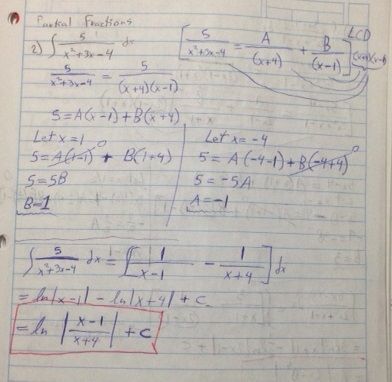
- Partial Fractions
- This method is used when the problem
is an improper fraction (degree is higher
on the numerator than the
denominator). Long division will take
place to simplify the problem. The
division shall give a polynomial as well
as a rational expression. This rational
expression will be decomposed into
partial fractions. Once a proper fraction
has been achieved, the denominator will
be factored by using quadratic or linear
factors.
- This method is used when the problem
is an improper fraction (degree is higher
on the numerator than the
denominator). Long division will take
place to simplify the problem. The
division shall give a polynomial as well
as a rational expression. This rational
expression will be decomposed into
partial fractions. Once a proper fraction
has been achieved, the denominator will
be factored by using quadratic or linear
factors.
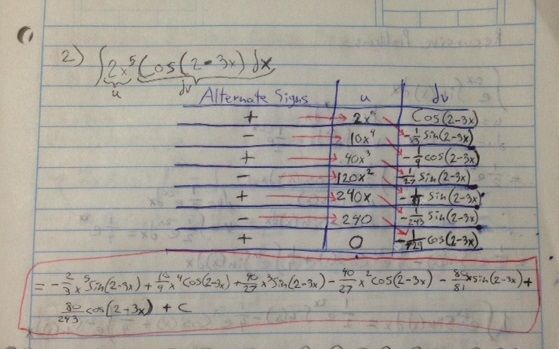
- Tabular Method
- This method uses a three column table. The
first column represents "Signs" (either
positive or negative), the second column
represents "u", and the third column "dv".
The order of the first column (signs) will
always start with positive, then negative,
and so on and so forth. The second columns
brings the function that wants to be
integrated all the way to 0 by
differentiation. As for the final column, it
will contain the repetitive action of
integrating the problem. You then multiply
the results on the table diagonally in order
to get the final answer.
- This method uses a three column table. The
first column represents "Signs" (either
positive or negative), the second column
represents "u", and the third column "dv".
The order of the first column (signs) will
always start with positive, then negative,
and so on and so forth. The second columns
brings the function that wants to be
integrated all the way to 0 by
differentiation. As for the final column, it
will contain the repetitive action of
integrating the problem. You then multiply
the results on the table diagonally in order
to get the final answer.
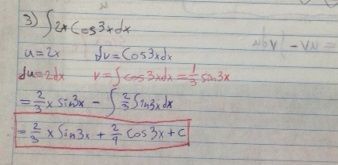
- Integration by Parts
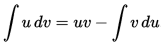
- Integration by parts uses the
following formula:
- This method of integration requires to find the
function "u" and the differential "dv". In order to
detect these two on the equation, LATE must be
used. L (Logarithmic), A (Algebraic), T
(Trigonometric), and E (Exponential). The order of
letter priority must be followed in order to detect
"u" and "dv".
- This method of integration requires to find the
function "u" and the differential "dv". In order to
detect these two on the equation, LATE must be
used. L (Logarithmic), A (Algebraic), T
(Trigonometric), and E (Exponential). The order of
letter priority must be followed in order to detect
"u" and "dv".
- Integration by parts uses the
following formula:
Media attachments
Want to create your own Mind Maps for free with GoConqr? Learn more.