
10506481
Description

Mind Map by Sophie Payne, updated more than 1 year ago
|
|
Created by Sophie Payne
over 8 years ago
|
|
Energy
- Elastic
- Examples: Stretching a
rubber band/ spring
- What is it? Potential energy
stored as a result of a
deformation of an elastic
object
- How it's produced: Work
is done on the object.
F=KE
- Examples: Stretching a
rubber band/ spring
- Sound
- Examples: Any sound we hear
- What is it? Quite often a
waste product, sound
energy is the energy
associated with the vibration
of matter, causing sound
waves which create the
sound we hear.
- How its produced :Objects vibrating
- Examples: Any sound we hear
- Light
- Examples: A light bulb, fire
- What is it? Only form
of energy we see
directly
- How it's produced: Through
chemical, radiation and
mechanical means.
- Examples: A light bulb, fire
- Thermal
- Examples: Kettles
- What is
it? Energy from heat
- How it's produced: Particles vibrate
faster causing them to heat up.
Conductors can spread this vibration
easily to carry heat
- Examples: Kettles
- Kinetic
- Examples:
aeroplane in
flight
- What is it? Energy from motion
- How is it produced: An object
gains this energy from
acceleration
- Formula: 1/2 x mass x speed squared
- Examples:
aeroplane in
flight
- Gravitational Potential Energy
- Examples: A rock on the top of a hill
- What is it? The energy resulting
from position or place (being high
up).
- How it's produced: It
is there because of
gravity, GPE changes
into kinetic energy.
e.g a rock rolling
down a hill.
- Formula: GPE = Mass X Gravitational field strength X Height
- Examples: A rock on the top of a hill
- Electrical
- Examples: Pylons, PCs
- What is it? It moves charged
particles through a wire to
create a current
- How it's produced:
Generated at power
stations by
electromechanical
generates fueled by
combustion, wind etc
- Examples: Pylons, PCs
- Chemical
- Examples:
Batteries, food,
fuels
- What is it? Energy
stored in the bonds
of molecules.
- How it's produced:
Chemical energy
is released in a
chemical reaction
when new bonds
are made
- Examples:
Batteries, food,
fuels
- Nuclear
- Examples: Generating
electricity
- What is it? The energy
released during nuclear
fission or fusion
- How it's
produced:
Relatively large
atoms are split in
controlled
reactions, this
produces heat
which then heats
water to create
steam to turn a
turbine
- Examples: Generating
electricity
- Non-renewable energy sources
- Non renewable energy resources cannot be
replaced as they are used up, so we will
eventually run out.
- Examples include Fossil fuels which can
be used in energy generation, transport
and heating
- Fossil Fuels produce
greenhouse gases
- Fossil Fuels can be relied on at
all times
- Fossil Fuels produce
greenhouse gases
- Nuclear energy
- Atoms are split in a
controlled environment,
the heat created by this
is used to heat water,
making steam that turns
a steam turbine to
generate electricity.
- Can
produce
nuclear
waste
- Atoms are split in a
controlled environment,
the heat created by this
is used to heat water,
making steam that turns
a steam turbine to
generate electricity.
- Non renewable energy resources cannot be
replaced as they are used up, so we will
eventually run out.
- Renewable
energy
sources
- Renewable
energy
resources
are ones
that can be
replaced as
they are
used up.
- Solar
- Solar energy is
generated by solar
panels which
convert sun's rays
into electricity by
exciting electrons
in silicon cells using
photons of light.
- Not always reliable
- Hardly any greenhouse gases
- Sustainable-
sun should be
around for a
long time
- Needs lots of
land- destroys
habitats?
- Costy
- Accessible everywhere
- Not always reliable
- Solar energy is
generated by solar
panels which
convert sun's rays
into electricity by
exciting electrons
in silicon cells using
photons of light.
- Geothermal
- Geothermal energy
generation uses heat
energy below the earth's
surface to heat water or
working fluid the
steam/working fluid is
then used to turn a
turbine- thus generating
electricity.
- Costy
- can cause earthquakes
- small amount of pollution
- geothermal reservoirs are naturally replenished
- Costy
- Geothermal energy
generation uses heat
energy below the earth's
surface to heat water or
working fluid the
steam/working fluid is
then used to turn a
turbine- thus generating
electricity.
- Hydroelectricity
- Hydroelectricity plants capture
falling water in turbines which
convert their kinetic energy
into electrical energy.
- Not polluting
- Reliable
- Safe- no
fuel
involved
other than
water
- May affect animals (and fish)
- Expensive
- Droughts inhibit it
- Limited reservoirs
- Not polluting
- Hydroelectricity plants capture
falling water in turbines which
convert their kinetic energy
into electrical energy.
- The tides
- Large underwater
turbines (tidal energy
generators) capture
kinetic movement of
tides to generate
electricity.
- No greenhouse gasses
- Reliable
- Can destroy habitats of animals/
wading birds
- Expensive
- No greenhouse gasses
- Large underwater
turbines (tidal energy
generators) capture
kinetic movement of
tides to generate
electricity.
- Wind
- Wind turbines
are turned by the
wind and are
connected to
generators which
turn kinetic
energy into
electrical
- Cost effective
- No greenhouse gases
- Non reliable
- Threat to wildlife
and people (birds
especially)
- Noise + visual pollution
- Destroy habitats
+ expensive to
set up
- Rapid growth
- Cost effective
- Wind turbines
are turned by the
wind and are
connected to
generators which
turn kinetic
energy into
electrical
- Biofuels
- Biofuels are used to replace
fossil fuels. They are made up of
plants and crops.
- Use up crops
that would
otherwise be
food
- Renewable
- Use up crops
that would
otherwise be
food
- Biofuels are used to replace
fossil fuels. They are made up of
plants and crops.
- Renewable
energy
resources
are ones
that can be
replaced as
they are
used up.
- Energy Transfers
- Energy input-> Process -> Energy output
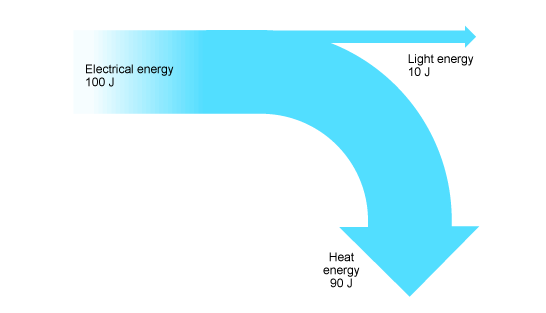
- Sankey diagrams show all energy transfers taking place in a process
- Mechanical :When a force moves through a distance (GPE->Kinetic)
- Electrical: When a charge moves through a potential difference
- By heating: because of temp difference
- By radiation/ waves: light, sound, microwaves
- By radiation/ waves: light, sound, microwaves
- By heating: because of temp difference
- Electrical: When a charge moves through a potential difference
- ENERGY CANNOT
BE DESTROYED
OR CREATED IT
CAN ONLY
CHANGE FORM
- Energy input-> Process -> Energy output
Media attachments
Want to create your own Mind Maps for free with GoConqr? Learn more.