
Mind map
Thyroid Diseases (Management)
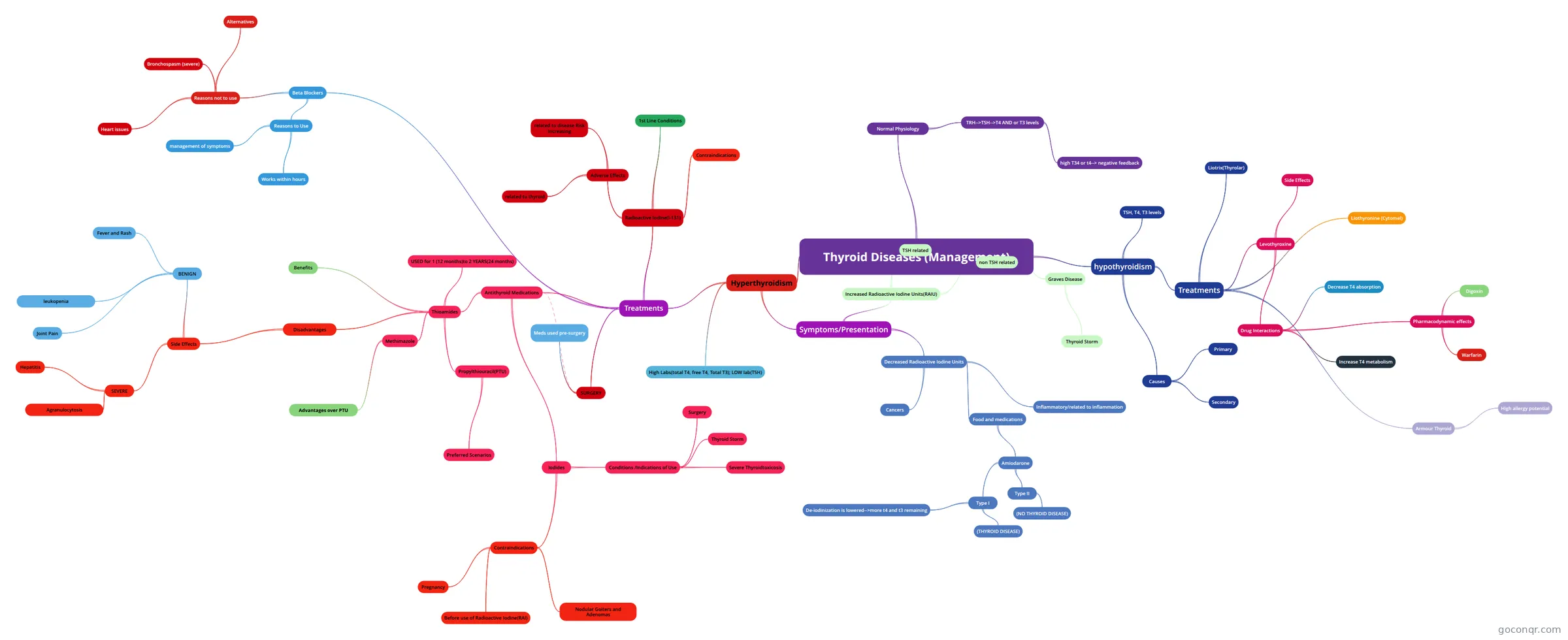
Mind map: Thyroid diseases management
Map content
Thyroid Diseases (Management)
Hyperthyroidism
- High Labs(total T4, free T4, Total T3); LOW lab(TSH)
- Symptoms/Presentation
- Heat intolerance Tremor Nervousness Goiter Weakness/ Insomnia Frequent bowel movement; diarrhea
- Increased Radioactive Iodine Units(RAIU)
- TSH related Reistance to Pitutiary TH secretion
- TSH related
- TSH causes the overprod of T3, T4
- non TSH related
- Meds Pituitary resists Thyroid hormone Various thyroid cancers Goiter(due to "fooled gland" thinking that there is too little T3/T4; there is more than enough).
- Graves Disease
- This is an autoimmune disease and a common cause of increased RAIU--hyperthyroidism!
- Thyroid Storm
- high fever (often >103°F), tachycardia, tachypnea, dehydration, delirium, coma, nausea, vomiting, and diarrhea
- Decreased Radioactive Iodine Units
- Cancer Inflammatory thyroid Too much outside thyroid intake Meds Food
- Inflammatory/related to inflammation
- Cancers
- Food and medications
- Amiodarone
- Iodine makes up 37% of the weight. Can cause Type I or Type II thyroid disease!
- Type I
- This is known as thyrotoxicosis:hyperthyroidism!
- De-iodinization is lowered-->more t4 and t3 remaining
- See MedScape Article; but Amiodarone blocks T4 and T3 from entering the cell and ALSO stops conversion of T4 to T3 in the peripheral/other organ tissues
- (THYROID DISEASE)
- Type II
- (NO THYROID DISEASE)
- Amiodarone
- Treatments
- SURGERY
- Meds used pre-surgery
- For 6 to 8 weeks Iodine is used for 1 to 2 weeks
- Meds used pre-surgery
- Radioactive Iodine(I-131)
- 1st Line Conditions
- Graves' disease Nodules Goiters
- Contraindications
- Pregnancy and nursing mothers.
- Adverse Effects
- related to disease Risk Increasing
- Thyroid Cancer Cardiovascular Disease Death (Got it? Yes, but sad nevertheless!!)
- related to thyroid
- radiation thyroiditis hypothyroidism
- related to disease Risk Increasing
- 1st Line Conditions
- Antithyroid Medications
- Thioamides
- Propylthiouracil(PTU)
- Preferred Scenarios
- Phrase that helps you remember when this should be used Peter ran a LaP in Th(ialand) La-Lactation P-Pregnancy Th-Thyroid Storm
- Preferred Scenarios
- Methimazole
- Advantages over PTU
- Less liver issues and works faster. Top recommended thioamide (The article on Thyroid function testing also made reference to use in patient...saw Real world application )
- Advantages over PTU
- Benefits
- Disadvantages
- Side Effects
- SEVERE
- Agranulocytosis
- Hepatitis
- BENIGN
- Joint Pain
- Fever and Rash
- leukopenia
- SEVERE
- Side Effects
- USED for 1 (12 months)to 2 YEARS(24 months)
- Propylthiouracil(PTU)
- Iodides
- Conditions /Indications of Use
- Thyroid Storm
- Severe Thyroidtoxicosis
- Surgery
- Contraindications
- Pregnancy
- Before use of Radioactive Iodine(RAI)
- Nodular Goiters and Adenomas
- Conditions /Indications of Use
- Thioamides
- Beta Blockers
- Should be used until the more specific anti-thyroid medication effect takes place The peripheral T4 to T3 conversion (propranolol, nadolol) is inhibited.
- Reasons to Use
- AKA indications and Uses/Conditions
- management of symptoms
- Works within hours
- Reasons not to use
- Also known as contraindications and precautions
- Bronchospasm (severe)
- Heart issues
- 2nd or 3rd degree heart block Decompensated heart failure
- Alternatives
- CCBs, beta 2 antagonists and other sympatholytics CAN be used.
- SURGERY
hypothyroidism
- Treatments
- Levothyroxine
- Synthetic T4(AKA thyroxine)! Multiple brands are available but these may not be therapeutic equivalent to each other.
- Drug Interactions
- Decrease T4 absorption
- ¡Cholestyramine- Brand Name (Questran) and associated products ¡Calcium- Brand Names(Phoslo, Eliphos, Phoslyra, and Calphron) ¡Ferrous sulfate ¡Aluminum hydroxide ¡Sucralfate- Carafate, Orafate, and ProThelial
- Increase T4 metabolism
- ¡Rifampin- Rifadin ¡Phenytoin- Dilantin, Phenytek and others ¡Phenobarbital- Lumina ¡Sertraline-Zoloft
- Pharmacodynamic effects
- Warfarin
- Elevated INR and bleeding risk
- Digoxin
- More digoxin may be needed if using levothyroxine
- Warfarin
- Decrease T4 absorption
- Side Effects
- Liothyronine (Cytomel)
- Not first line Synthetic T3/TriiodothyronineAdvantageous against myxedema coma
- Armour Thyroid
- Think "it varies": -Ratio of hormones varies -The products vary in potency among the brands
- High allergy potential
- Liotrix(Thyrolar)
- Combination of Synthetic T4 AND T3 It is predictable and stable NOT dispensed often though
- Adverse reactions: Rare but clinical pharmacology does note itching, hypersensitivity and a skin rash
- Levothyroxine
- TSH, T4, T3 levels
- TSH is high T4 and T3 are low. Note Radioactive Iodide Uptake is not used in diagnosis.
- Causes
- Primary
- Secondary
- Treatments
Normal Physiology
- TRH-->TSH-->T4 AND or T3 levels
- high T34 or t4--> negative feedback
- TRH-->TSH-->T4 AND or T3 levels
Information
- Description
- Focus on the medications and treatments in managing thyroid based disorders.
- Created by
- Chuchi Oka-Zeh
- Views
- 100
- Tags
- Rating