
11501254
Description

Mind Map by Connor O'Hare, updated more than 1 year ago

|
Created by Connor O'Hare
about 8 years ago
|
|
Chapter 14-
Thermal physics
- The triple point of a substance- "one specific temperature where the 3
phases of matter exist in thermal equilibrium"
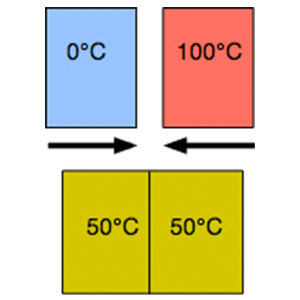
- Thermal equilibrium- "A state in which there is no net flow of thermal energy
between the objects involved"
- Objects in thermal equilibrium must be at the same temperature
- Zeroth law- "If 2 objects are each in thermal
equilibrium with a third, then all 3 are in thermal
equilibrium with each other
- Zeroth law- "If 2 objects are each in thermal
equilibrium with a third, then all 3 are in thermal
equilibrium with each other
- Objects in thermal equilibrium must be at the same temperature
- Thermal equilibrium- "A state in which there is no net flow of thermal energy
between the objects involved"
- Celsius scale
- °C
- Uses triple point of water and absolute zero
- Increment change is the same size as the Celsius scale
- K=θ°C+273
- °C
- Absolute scale
- Kelvin (K)
- Uses 2 fixed points (Boiling water & freezing point of water
- 100 increments (Between 0°C and 100°C)
- Kelvin (K)
- The
Kinetic
model
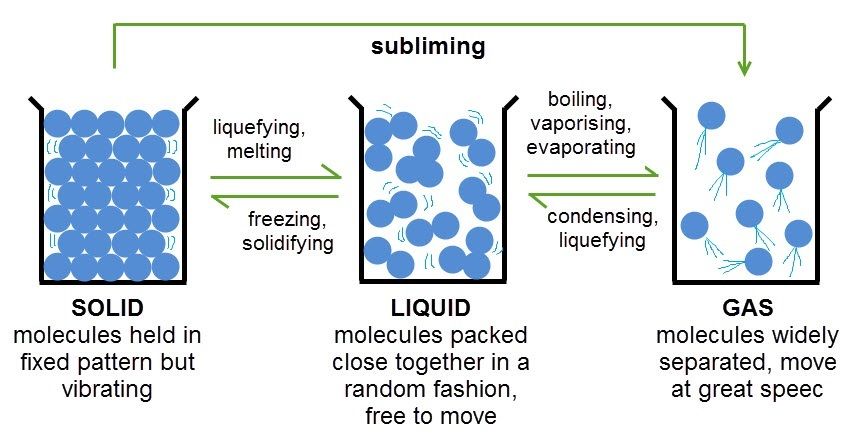
- There are 3 main phases
- Solid
- Liquid
- Gas
- Solid
- There are 3 main phases
- Internal energy- "The sum of the
randomly distributed kinetic and
potential energies of
atoms/molecules within the
substance
- Kinetic energy is determined by the
temperature of the susbstance
- Forces of attraction between particles
determines potential energy (This is always
negative)
- Kinetic energy is determined by the
temperature of the susbstance
- Specific heat capacity
- "The energy required per unit mass to
change the temperature by 1K/1°C
- Jkg^-1K^-1
- c=E/(m*Δθ)
- Water has exceptionally high specific heat capacity
- "The energy required per unit mass to
change the temperature by 1K/1°C
- Specific latent heat
- "The energy required to change the
phase per unit mass while at constant
temperature"
- L=E/m
- A substance still requires energy to
change phase even when at its
melting or boiling point.
- L=E/m
- Specific latent heat of fusion (Lf)
- Solid--> Liquid
- Solid--> Liquid
- Specific latent heat of vapourisation (Lv)
- Liquid--> Gas
- Liquid--> Gas
- For this to occur the other way the
substance must transfer the latent heat
energy to its surroundings
- "The energy required to change the
phase per unit mass while at constant
temperature"
Media attachments
Want to create your own Mind Maps for free with GoConqr? Learn more.