
14229259
Description

Mind Map by Miranda Barnes, updated more than 1 year ago

|
Created by Miranda Barnes
over 7 years ago
|
|
Herpes Simplex Virus
- 2 Types
- HSV 1
- Prevalence of antibodies against it increases with age
- Mostly
oral
- Mild gingivostomatitis (ulceration and pain when severe)
- Shedding in saliva provides transmission
route
- Mild gingivostomatitis (ulceration and pain when severe)
- Establishes latency in trigeminal
ganglion
- Reactivation seeds to oral or nasal
mucosa
- Typically transmitted during
childhood
- Preferentially establishes latency in neurons with A5
marker
- Maintenance of latency requires NGF interaction with receptor TrkA
- Transfer of LAT exon 1 deletes regions responsible for productive infection of A5 + and KH10
+
- Function mapping productive infection between LAT TATA box and Pvul site
44bp
- Almost identical to HSV2 except for apparent 20bp deletion of region required for productive A5 + infection
- Almost identical to HSV2 except for apparent 20bp deletion of region required for productive A5 + infection
- Believed to help by repressing lytic genes or inhibiting
apoptosis
- Reaches lumbar cord more effectively
- Related to ability to establish latency in sympathetic
fibers?
- Related to ability to establish latency in sympathetic
fibers?
- Function mapping productive infection between LAT TATA box and Pvul site
44bp
- Express Gal beta1-4GlcNAc-R epitote
- Immnoreactive to calcitonin gene-related peptide
- Maintenance of latency requires NGF interaction with receptor TrkA
- Encephalitis
- Prevalence of antibodies against it increases with age
- HSV2
- Less prevalent type
- Mostly
genital
- Sexually transmitted but often
asymptomatic
- Recurs more
frequently
- Sheds more
frequently
- More painful
- Can remit
spontaneously
- Sexually transmitted but often
asymptomatic
- Establishes latency in sacral dorsal root
ganglia
- Preferentially establishes latency in neurons identified with KH10
- A5+ permissive for productive infection
- Determined in part by LAT
- Reaches sacral cord more
effectively
- Determined in part by LAT
- Express Gal alpha1-3Gal beta1-4NAc-R epitote
- Colabel with lectin BSL-IB4
- Population of small-diameter glial cell-line-derived neurotrophic factor-response neurons
- A5+ permissive for productive infection
- 2 regulatory sequences in LAT for productive infection
- dLAT (deletion in promoter) much less effective in
A5+
- NotI-NotI promotes productive infection in A5 +
- Transferable
- Transferable
- LAP2 inhibits productive infection in KH10+
- Not transferable as independent functional element
- Not transferable as independent functional element
- LAT sequence containing 5' exon and LAT intron has essential elements for type-specific
reactivation
- Contributes to
virulence
- Transcribed from repeat region in antisense direction from ICP0 and
ICP345
- Spliced into one stable intron (two in HSV1)
- Contributes to
virulence
- dLAT (deletion in promoter) much less effective in
A5+
- Recurrent meningitis
- Less prevalent type
- HSV 1
- Maintains high levels of infection through reactivation and shedding
- Endemic in all populations
- Neurotropic
- Establishes latency in primary sensory
neurons
- Travels back to periphery to facilitate epithelial cell
infection
- Have single bifurcated
axon
- Periphery
- Spinal
cord
- Periphery
- Reach neurons in a manner proportional to representation in unaffected ganglia
- Both types equally permissive for accumulation of HSV-1 and HSV-2 LAT
- Both sensory trigeminal ganglion and sympathetic superior ganglion neurons expressed adrenergic receptors and glucocorticoid receptors
- Epinephrine treatment increases levels of HSV-1 replication in SCG but not TG
- Corticosterone decreases levels of HSV-2 in SCG but not TG
- Autonomic neurons more responsive than sensory neurons
- Autonomic role in pathogenesis
- Autonomic role in pathogenesis
- Different responses to stress in different HSV types
- Shows immune suppression may not be only factor
- Shows immune suppression may not be only factor
- Neuronal populations express different patterns of receptors
- Epinephrine involved in cAMP levels
- Increased cAMP levels shown to reactivate HSV-1 in SCG
- Serum- and glucocorticoid-regulated protein kinases implicated in HSV_1 replication stimulation
- Increased cAMP levels shown to reactivate HSV-1 in SCG
- Epinephrine treatment increases levels of HSV-1 replication in SCG but not TG
- Travels back to periphery to facilitate epithelial cell
infection
- Enters sensory nerve terminals and travels backwards
- Retrograde microtubule-associated
transport
- Retrograde microtubule-associated
transport
- Establishes latency in primary sensory
neurons
- Common Sites
- Skin
- Caused in other dorsal root ganglia by infected secretions
- Bad with atopic dermatitis
- Caused in other dorsal root ganglia by infected secretions
- Eye
- Major cause of corneal blindness
- Recurrent acute bilateral keratoconjuctivitis causing dendritic ulcers
- Major cause of corneal blindness
- CNS
- Rare form of
encephalitis
- Alzheimer's?
- Rare form of
encephalitis
- Congenital/neonatal
- Acquired in birth canal or uterus
- High
mortality
- Acquired in birth canal or uterus
- Skin
- Lytic
Infection
- Characterized by classes of gene products
- Immediate Early
- Require presence of VP16
- Virion transactivator protein
- One of the most powerful transcriptional activation domains yet described
- Late structural component of tegument layer
- Protein network between envelope and capsid
- Protein network between envelope and capsid
- Binds to host cell factor 1 w/ nuclear localization
sequence
- Transported to nucleus
- Forms trimeric complex on consensus VREs in IE promoters
- with
- October binding protein - 1
- Downregulated
- Downregulated
- Homeodomain
protein
- HCF-1 localized in cytoplasm of sensory neurons
- HCF-1 localized in cytoplasm of sensory neurons
- October binding protein - 1
- Stimulates IE transcription cascade
- Impaired by restrictions in member availability?
- During reactivation
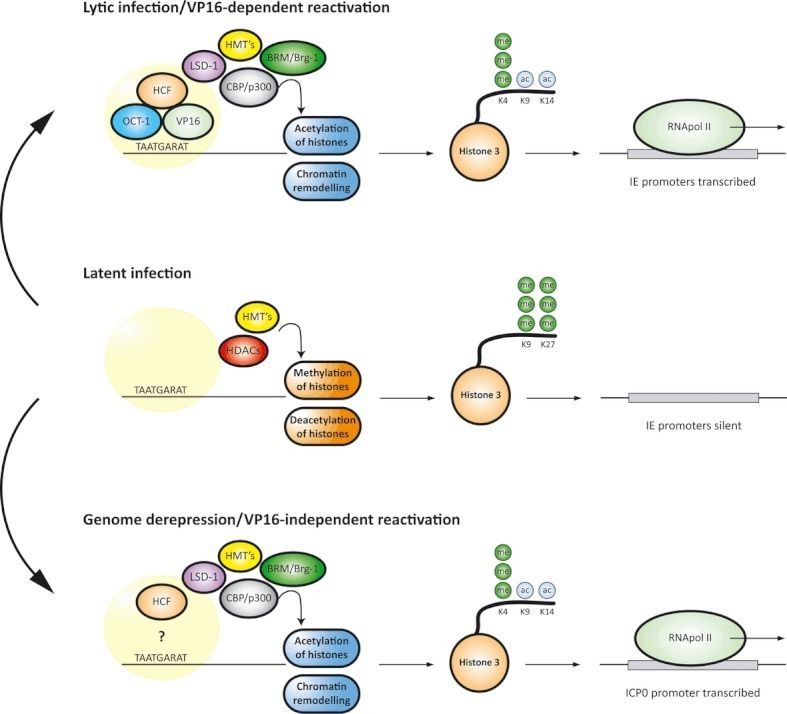
- Interacts with
- Histone acetyltransferases (CBP/p300)
- Chromatin remodeling factors (BGRT-1 and
BRM)
- Histone methyltransferases (HMT's)
- Lysine-specific demethylase-1 (LSD-1)
- Histone acetyltransferases (CBP/p300)
- Interacts with
- Molecular trigger following hyperthermic stress?
- If so, Oct-1 and HCF-1 also probably important
- HCF-1 relocalizes from Golgi to nucleus and associates with promoters
- Recruits LSD to reverse repressive methylation at IE promoters
- Recruits LSD to reverse repressive methylation at IE promoters
- HCF-1 relocalizes from Golgi to nucleus and associates with promoters
- If so, Oct-1 and HCF-1 also probably important
- with
- Forms trimeric complex on consensus VREs in IE promoters
- Transported to nucleus
- Virion transactivator protein
- Regulation of viral gene expression
- IE1 (ICP0)
- Likely has crucial role in reactivation
- ND10 bodies (similar distribution)
- Nuclear accumulations of proteins regulated by interferons
- Role in replication of DNA viruses
- Transcription factors associated with domains
- Transcription factors associated with domains
- Domain change to favor lytic transcription?
- Nuclear accumulations of proteins regulated by interferons
- ND10 bodies (similar distribution)
- Associates with proteins involved in
- Cell cycle regulation
- Interferon response
- DNA repair
- Transcription
- Cell cycle regulation
- Harbors E3 ubiquitin ligase RING finger domain
- Degrades constituents of ND10 bodies
- Degrades constituents of ND10 bodies
- Disrupts CoREST/REST repressor complex
- Dissociation of HDACs 1/2
- Interacts with HDACs 4, 5,
7
- Antagonizing cellular repression such as histone-mediated
silencing
- Role during reactivation
- Recruitment of LSD1 to IE promoters by HCF1 crucial for both initiation and reactivation
- Component of cellular repressor complex
- Component of cellular repressor complex
- Recruited by repressor element-1 silencing transcription
- Can function as
corepressor
- CoREST may also:
- Demethylate histone H3K4
- Repress neuronal gene expression in cells that aren't nerves
- Function as a coactivator by demethylating repressive H3K9 marks at IE
promoters
- Interact with ICP0 to disrupt corepressor
complex
- Demethylate histone H3K4
- Can function as
corepressor
- Recruitment of LSD1 to IE promoters by HCF1 crucial for both initiation and reactivation
- Dissociation of HDACs 1/2
- Most likely candidate for initiation of lytic expression and exit from latency
- Likely has crucial role in reactivation
- IE2 (ICP27)
- Interferes with cell death during lytic cycle
- Interferes with cell death during lytic cycle
- IE3 (ICP4)
- IE4 (ICP22)
- IE1 (ICP0)
- Role in immune invasion
- IE5 (ICP47)
- Major MHC class 1 evasion gene
- Major MHC class 1 evasion gene
- IE5 (ICP47)
- Defined by TAATGARAT VP-16 response elements within promoters
- Inhibit host RNA translation
- Disrupts RNA splicing machinery
- Promote nuclear export of viral mRNA via ICP27 and CD8 + T cell evasion
- Disrupts RNA splicing machinery
- Create an environment for the lytic cycle
- Require presence of VP16
- Early
- Dependent on synthesis of IE products
- Seven required for viral DNA replication
- Some involved in changing cell environment to support rapid DNA
synthesis
- Thymidine kinase
- Ribonucleotide reductase
- Thymidine kinase
- Enzymes required for DNA replication
- Dependent on synthesis of IE products
- Late
- Dependent on prior synthesis of viral
DNA
- Mostly structural components
- Dependent on prior synthesis of viral
DNA
- Leaky late
- Immediate Early
- Protein synthesis in cytoplasm, but nucleocapsids assembled in
nucleus
- Recognize viral genomes
- Cleaved into monomers as they are
packaged
- Cleaved into monomers as they are
packaged
- Exits via budding through nuclear membrane
- Mature envelope and glycoproteins acquired in membrane-bound
organelles
- Recognize viral genomes
- Highly cytolytic
- Virus enters cytoplasm
- Capsid transported via microtubule to nucleus
- Docks to nuclear pore
- DNA released into nucleus
- DNA released into nucleus
- Docks to nuclear pore
- Capsid transported via microtubule to nucleus
- Characterized by classes of gene products
- Latent
infection
- Present in neurons but not satellite
cells
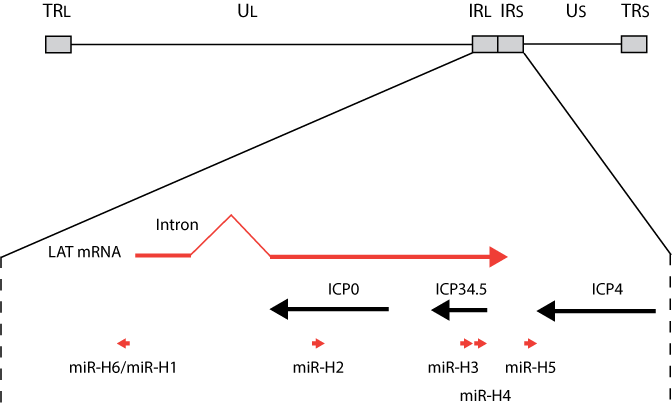
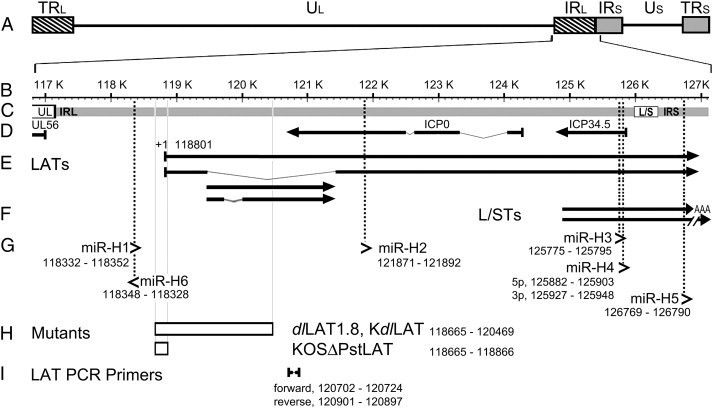
- Still transcription from viral
genome
- Latency associated
transcripts
- Overlap IE1 but on opposite
strand
- Minor
LAT
- Polyadenylated
- Localized to discrete intranuclear foci
- 8.3 kb
- Polyadenylated
- Major LAT
- Stable introns spliced from primary LAT transcript
- Contains two open reading frames
- 1.5 & 2 kb
- Stable introns spliced from primary LAT transcript
- Transcribed from a locus within the repeat regions flanking the ULR
- miRNAs by LAT locus
- Likely contributes to rapid turnover
- Implicated in
- Latent/lytic control
- Immune evasion
- Cell survival
- Latent/lytic control
- Raise coding capacity
- Nonimmunogenic
- 16 in
HSV1
- Within 8.3 LAT
- miRNA-H2
- Shown to reduce ICP0 abundance
- Shown to reduce ICP0 abundance
- miRNA-H3
- Shown to reduce ICP4
abundance
- Shown to reduce ICP4
abundance
- miRNA-H4
- miRNA-H5
- miRNA-H7
- miRNA-H8
- miRNA-H2
- Just upstream of start site
- miRNA-H1
- miRNA-H6
- Overlap
- Abundant during productive infection
- miRNA-H1
- 1-8 expressed during latency
- Within 8.3 LAT
- 18 in HSV 2
- miRNA-H2 shown to inhibit ICP0
- miRNA-H3 & -H4 down regulate neurovirulence factor expression
- miRNA-H2 shown to inhibit ICP0
- Likely contributes to rapid turnover
- Probably not translated into functional protein in vivo
- miRNA?
- miRNA?
- sRNAs
- Capable of inhibiting productive infection in culture
- sRNA2 weaker
- Down regulated ICP4 accumulation
- Did not affect RNA levels
- Down regulated ICP4 accumulation
- sRNA1 appears to mediate anti-apoptosis activity
- Capable of inhibiting productive infection in culture
- Not transcribed in all infected
- Dynamic expression?
- Dynamic expression?
- Overlap IE1 but on opposite
strand
- Latency associated
transcripts
- Establishment of latency
- Viruses w/o VP16 can't initiate lytic cycle, but can establish latent infection in vivo
- Default pathway?
- Diverges immediately upon infection
- Large load may be indicative of abortive lytic infection
- Large load may predispose to reactivation
- Large load may predispose to reactivation
- Potential for noncytolytic CD8 + T cell inhibition in HSV-1 replication
- Block in expression via IFN gamma secretion and Granzyme B
- Also likely to play role in reactivation control
- However, specific for immunodominant glycoprotein B epitote - not IE
- However, specific for immunodominant glycoprotein B epitote - not IE
- Block in expression via IFN gamma secretion and Granzyme B
- Large load may be indicative of abortive lytic infection
- Replication required to be effective
- Copies per cell variable
- # of input
genomes?
- Limited expression prior to latency?
- Efficiency at
periphery?
- # of input
genomes?
- Copies per cell variable
- Not mutually exclusive with lytic
infection?
- Failure of ICP0 expression and genome circularization first step to latency?
- Failure of ICP0 expression and genome circularization first step to latency?
- Viruses w/o VP16 can't initiate lytic cycle, but can establish latent infection in vivo
- Reactivation
- Triggers
- Immunosuppression
- Febrile
illness
- UV
exposure
- Stress
- Nerve damage/removal
- Removal of neurotropic
factor?
- Activation of cAMP and protein-kinase C-dependent second messenger pathways?
- Heat stressing and corticosteroid
treatment
- Immunosuppression
- Molecular Basis
- Activation of second messenger systems?
- Different from initial infection
- Nucleosomally associated rather than extruded
- Transcriptionally repressed
- No VP16
- Nucleosomally associated rather than extruded
- CD8+ T cells
- Recognize glycoprotein B
- Suppress reactivation?
- Suppress reactivation?
- Just respond to lytic transcript expression?
- Recognize glycoprotein B
- Activation of second messenger systems?
- In culture only, leads to rapid spread
- Triggers
- Present in neurons but not satellite
cells
- Treatment
- Acyclovir =
mainstay
- Converted to active form by viral TK and cellular
kinases
- Acyclovir
triphosphate
- Acyclovir
triphosphate
- Topically, orally,
intravenously
- Every four
hours
- Shortens
episodes
- Reduces
recurrences
- Incorporated into viral genome, acting as a chain terminator and inhibiting
replication
- Converted to active form by viral TK and cellular
kinases
- Alternates
- Valacyclovir
- Famicyclovir
- Penciclovir
- Cidoform
- Attacks viral DNA
polymerase
- Attacks viral DNA
polymerase
- Foscarnet
- Pyrophosphate
analogue
- Competitively binds DNA polymerase
- Prevents chain
elongation
- Prevents chain
elongation
- Pyrophosphate
analogue
- Valacyclovir
- Resistance rare except in
immunocompromised
- Future
- Interfere with latency
establishment?
- Eradicate latent
genomes
- Target
LATs?
- Target IE genes and
ICP0
- Target
LATs?
- Vaccination?
- Interfere with latency
establishment?
- Acyclovir =
mainstay
- Models
- Animal models
- Humans only natural host
- Mouse
- Infection of eye, flank or footpad
- Replication at local epithelial site
- Transport via axon to sensory neurons
- Transport via axon to sensory neurons
- Replication at local epithelial site
- Latent infection established but rarely reactivated
- Hypothermia
- CD8+ T cell depletion
- Skin abrasion
- Hypothermia
- Infection of eye, flank or footpad
- Rabbit eye
- Cornea
infected
- Latency established in trigeminal
ganglion
- Virus shed in
tears
- Virus shed in
tears
- Latency established in trigeminal
ganglion
- No spontaneous reactivation
- Cornea
infected
- Guinea pigs
- Reproduces clinical course of human infection but not amenable to detailed molecular study
- Reproduces clinical course of human infection but not amenable to detailed molecular study
- Humans only natural host
- In vitro
- Relies on antiviral drugs or replication defective
mutants
- Reactivation
triggers
- NGF
withdrawal
- Sensed by TrkA receptor
- Activates phosphalidylinositol 3-kinase (PI3-K) catalytic subunit
- Recruitment of 3-phosphoinositide-dependent protein kinase-1 (PDK1) to plasma membrane
- Phosphorylation of serine/threonine kinase Akt
- Recruitment of 3-phosphoinositide-dependent protein kinase-1 (PDK1) to plasma membrane
- Activates phosphalidylinositol 3-kinase (PI3-K) catalytic subunit
- Epidermal growth factor (EGF) and GDNF can signal through same pathway, but do not really maintain latency
- Glial cell line-derived neurotrophic factor-responsive K10 + C fiber neurons colabel with isolectin-B4
- Glial cell line-derived neurotrophic factor-responsive K10 + C fiber neurons colabel with isolectin-B4
- Responsive A5 + neurons largely calcitonin gene-related peptide-positive
- Sensed by TrkA receptor
- Histone deacetylase
inhibition
- Trichostatin A
- Trichostatin A
- ICP0
expression
- In sensory ganglia derived from
mice
- Heat
shock
- Treatment with
dexamethasone
- Heat
shock
- Forskolin
- Inducible cyclic AMP early repressor
- Capsaicin
- Capsase-3 activator C2-ceramide
- Protein kinase C activation by phorbol myristate acetate
- Transient hypothermia
- NGF
withdrawal
- Viral genome
circularized
- LAT expression and virus reactivation only in neuronal
systems
- Latency established using unnatural block
- Preferred neuron types reverse
- Relies on antiviral drugs or replication defective
mutants
- Animal models
- HSV
genome
- Linear, double-stranded, 152
kb
- Two long and two short regions
- Circularizes following nuclear entry
- Theta replication at 3 origins, then rolling circle
- Cocantemers cléaved into monomeric units
- Cocantemers cléaved into monomeric units
- Maintained as a circle during latency
- Assembled into nucleosomes
- Structure to mediate epigenetic control regulated by PTMs of histones
- Euchromatin-like modifications
- Acetylation of H3K9 and H3K14
- Enriched in lytic infection
- Enriched in lytic infection
- Acetylation of H3K9 and H3K14
- Heterochromatin-like modifications
- Dimethylation of H3K9
- Underrepresented
- Underrepresented
- Dimethylation of H3K9
- Enrichment of acetylated H3K9 and H3K14 at LAT promote and enhancer during latency
- Lytic genes enriched w/ methylated H3K27 during latency
- Euchromatin-like modifications
- Structure to mediate epigenetic control regulated by PTMs of histones
- Associated with reversible and nonreversible and nonreversible repressive chromatin modifications
- Assembled into nucleosomes
- Two long and two short regions
- Linear, double-stranded, 152
kb
- Sources Used:
- Lachmann, R. (2003). Herpes simplex virus latency. Expert Reviews in
Molecular Medicine, 5(29), 1-14. doi:10.1017/S1462399403006975
- Margolis, T., Imai, Y., Yang, L., Vallas, V., & Krause, P. (2007). Herpes simplex virus type 2 (HSV-2)
establishes latent infection in a different population of ganglionic neurons than HSV-1: Role of
latency-associated transcripts. Journal of Virology, 1872-1878. doi:10.1128/JVI.02110-06
- Ives AM, Bertke AS. 2017. Stress hormones epinephrine and corticosterone selectively modulate
herpes simplex virus 1 (HSV-1) and HSV-2 productive infections in adult sympathetic, but not
sensory, neurons. J Virol 91:e00582-17.
- Michael P. Nicoll, João T. Proença, Stacey Efstathiou; The molecular basis of herpes simplex virus
latency, FEMS Microbiology Reviews, Volume 36, Issue 3, 1 May 2012, Pages 684–705,
https://doi.org/10.1111/j.1574-6976.2011.00320.x
- Bertke AS, Patel A, Krause PR. 2007. Herpes simplex virus latency-associated transcript sequence
downstream of the promoter influences type-specific reactivation and viral neurotropism. J Virol
81:6605–6613. 10.1128/JVI.02701-06.
- Bertke AS, Ma A, Margolis MS, Margolis TP. 2013. Different mechanisms regulate productive herpes
simplex virus 1 (HSV-1) and HSV-2 infections in adult trigeminal neurons. J Virol 87:6512–6516.
10.1128/JVI.00383-13.
- Lachmann, R. (2003). Herpes simplex virus latency. Expert Reviews in
Molecular Medicine, 5(29), 1-14. doi:10.1017/S1462399403006975
Media attachments
Want to create your own Mind Maps for free with GoConqr? Learn more.