
Mind map
Financial Reporting & IFRS
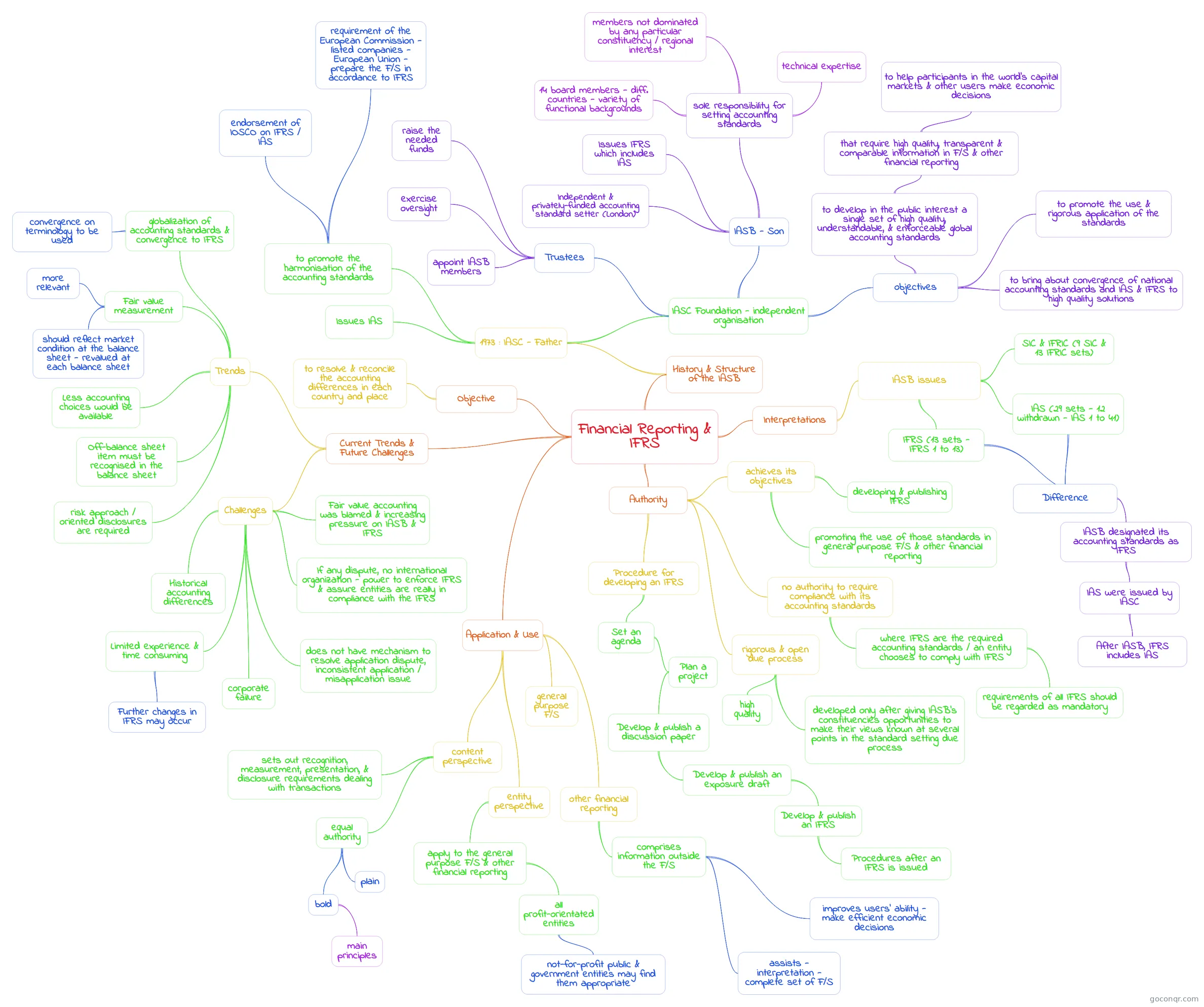
Mind map: Financial Reporting & IFRS
Map content
Financial Reporting & IFRS
History & Structure of the IASB
- 1973 : IASC - Father
- Issues IAS
- IASC Foundation - independent organisation
- Trustees
- appoint IASB members
- exercise oversight
- raise the needed funds
- objectives
- to bring about convergence of national accounting standards and IAS & IFRS to high quality solutions
- to promote the use & rigorous application of the standards
- to develop in the public interest a single set of high quality, understandable, & enforceable global accounting standards
- that require high quality, transparent & comparable information in F/S & other financial reporting
- to help participants in the world's capital markets & other users make economic decisions
- that require high quality, transparent & comparable information in F/S & other financial reporting
- IASB - Son
- Independent & privately-funded accounting standard setter (London)
- Issues IFRS which includes IAS
- sole responsibility for setting accounting standards
- 14 board members - diff. countries - variety of functional backgrounds
- members not dominated by any particular constituency / regional interest
- technical expertise
- Trustees
- to promote the harmonisation of the accounting standards
- requirement of the European Commission - listed companies - European Union - prepare the F/S in accordance to IFRS
- endorsement of IOSCO on IFRS / IAS
- 1973 : IASC - Father
Interpretations
- IASB issues
- IFRS (13 sets - IFRS 1 to 13)
- IAS (29 sets - 12 withdrawn - IAS 1 to 41)
- Difference
- IASB designated its accounting standards as IFRS
- IAS were issued by IASC
- After IASB, IFRS includes IAS
- IAS were issued by IASC
- IASB designated its accounting standards as IFRS
- Difference
- SIC & IFRIC (9 SIC & 13 IFRIC sets)
- IFRS (13 sets - IFRS 1 to 13)
- IASB issues
Objective
- to resolve & reconcile the accounting differences in each country and place
Current Trends & Future Challenges
- Trends
- globalization of accounting standards & convergence to IFRS
- convergence on terminology to be used
- Fair value measurement
- more relevant
- should reflect market condition at the balance sheet - revalued at each balance sheet
- Less accounting choices would be available
- Off-balance sheet item must be recognised in the balance sheet
- risk approach / oriented disclosures are required
- globalization of accounting standards & convergence to IFRS
- Challenges
- Historical accounting differences
- corporate failure
- Limited experience & time consuming
- Further changes in IFRS may occur
- does not have mechanism to resolve application dispute, inconsistent application / misapplication issue
- If any dispute, no international organization - power to enforce IFRS & assure entities are really in compliance with the IFRS
- Fair value accounting was blamed & increasing pressure on IASB & IFRS
- Trends
Application & Use
- general purpose F/S
- other financial reporting
- comprises information outside the F/S
- assists - interpretation - complete set of F/S
- improves users' ability - make efficient economic decisions
- comprises information outside the F/S
- content perspective
- sets out recognition, measurement, presentation, & disclosure requirements dealing with transactions
- equal authority
- bold
- main principles
- plain
- bold
- entity perspective
- apply to the general purpose F/S & other financial reporting
- all profit-orientated entities
- not-for-profit public & government entities may find them appropriate
- all profit-orientated entities
- apply to the general purpose F/S & other financial reporting
Authority
- achieves its objectives
- promoting the use of those standards in general purpose F/S & other financial reporting
- developing & publishing IFRS
- no authority to require compliance with its accounting standards
- where IFRS are the required accounting standards / an entity chooses to comply with IFRS
- requirements of all IFRS should be regarded as mandatory
- where IFRS are the required accounting standards / an entity chooses to comply with IFRS
- rigorous & open due process
- high quality
- developed only after giving IASB's constituencies opportunities to make their views known at several points in the standard setting due process
- Procedure for developing an IFRS
- Set an agenda
- Plan a project
- Develop & publish a discussion paper
- Develop & publish an exposure draft
- Develop & publish an IFRS
- Procedures after an IFRS is issued
- Develop & publish an IFRS
- Develop & publish an exposure draft
- Develop & publish a discussion paper
- Plan a project
- Set an agenda
- achieves its objectives
Information
- Description
- Mind Map on Financial Reporting & IFRS, created by Thiffany Martin on 13/10/2014.
- Created by
- Thiffany Martin
- Views
- 707
- Rating