
Mind map
Jerome Bruner
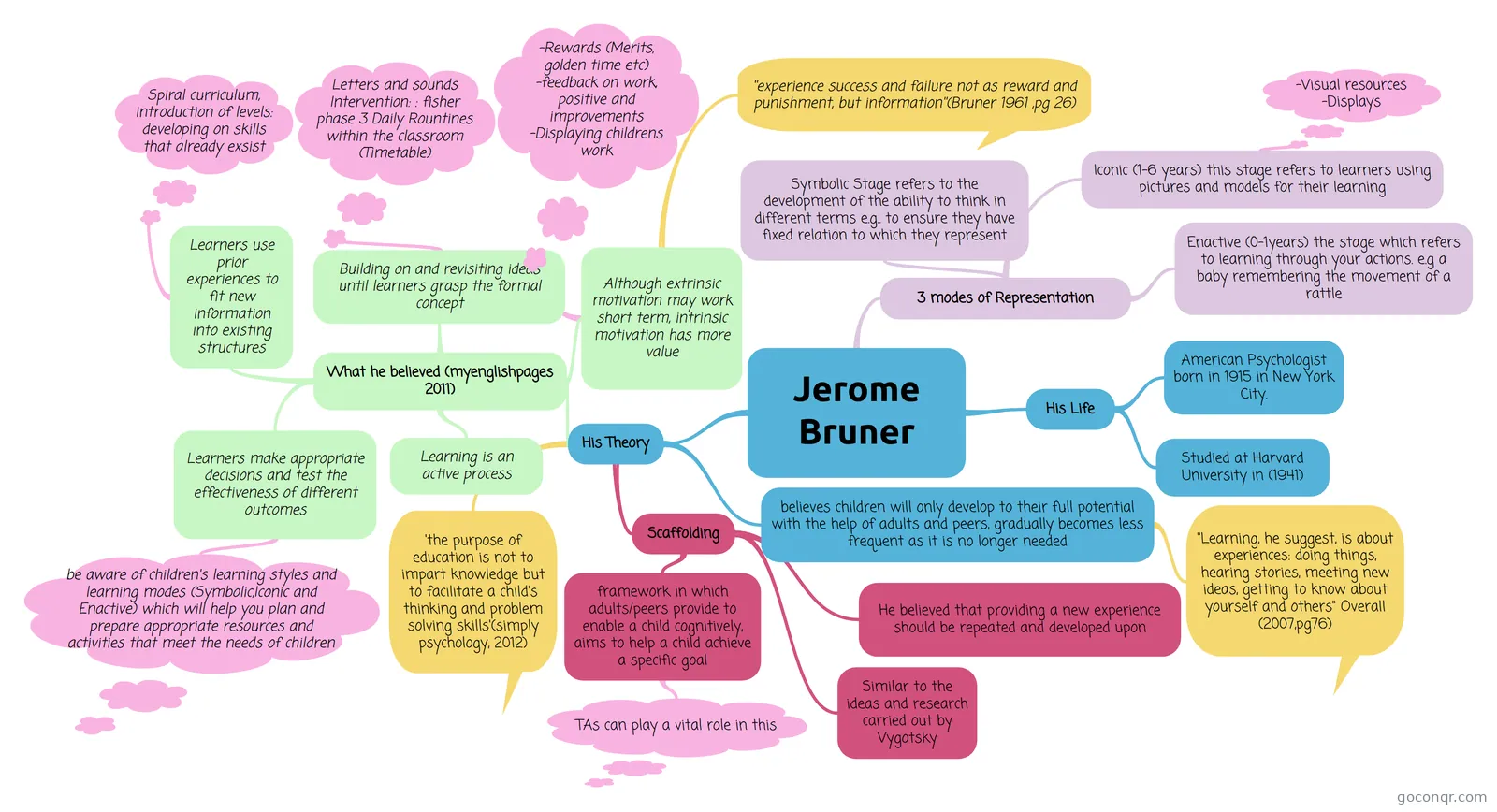
Mind map: Jerome Bruner
Map content
Jerome Bruner
His Life
- American Psychologist born in 1915 in New York City.
- Studied at Harvard University in (1941)
His Theory
- believes children will only develop to their full potential with the help of adults and peers, gradually becomes less frequent as it is no longer needed
- "Learning, he suggest, is about experiences: doing things, hearing stories, meeting new ideas, getting to know about yourself and others" Overall (2007,pg76)
- Scaffolding
- framework in which adults/peers provide to enable a child cognitively, aims to help a child achieve a specific goal
- TAs can play a vital role in this
- Similar to the ideas and research carried out by Vygotsky
- He believed that providing a new experience should be repeated and developed upon
- framework in which adults/peers provide to enable a child cognitively, aims to help a child achieve a specific goal
- What he believed (myenglishpages 2011)
- Learning is an active process
- Learners make appropriate decisions and test the effectiveness of different outcomes
- be aware of children's learning styles and learning modes (Symbolic,Iconic and Enactive) which will help you plan and prepare appropriate resources and activities that meet the needs of children
- Learners use prior experiences to fit new information into existing structures
- Spiral curriculum, introduction of levels: developing on skills that already exsist
- Building on and revisiting ideas until learners grasp the formal concept
- Letters and sounds Intervention: : fisher phase 3 Daily Rountines within the classroom (Timetable)
- Although extrinsic motivation may work short term, intrinsic motivation has more value
- -Rewards (Merits, golden time etc) -feedback on work, positive and improvements -Displaying childrens work
- ''experience success and failure not as reward and punishment, but information''(Bruner 1961 ,pg 26)
- 'the purpose of education is not to impart knowledge but to facilitate a child's thinking and problem solving skills'(simply psychology, 2012)
- believes children will only develop to their full potential with the help of adults and peers, gradually becomes less frequent as it is no longer needed
3 modes of Representation
- Enactive (0-1years) the stage which refers to learning through your actions. e.g a baby remembering the movement of a rattle
- Iconic (1-6 years) this stage refers to learners using pictures and models for their learning
- -Visual resources -Displays
- Symbolic Stage refers to the development of the ability to think in different terms e.g.. to ensure they have fixed relation to which they represent
Information
- Description
- Mind Map on Jerome Bruner, created by rileyzoe on 11/18/2014.
- Created by
- rileyzoe
- Views
- 376
- Rating