
1905240
Description

Mind Map by Marcus Danvers, updated more than 1 year ago

|
Created by Marcus Danvers
almost 11 years ago
|
|
(4) Affirmative Action
- Civil Rights Act L B J
- AA has it roots in the 1964 Civil Rights Act (LBJ)
- 70% approval at the time
- In the act it became illegal to segregate on the grounds of race
- It also became illegal to discriminate against employees on the grounds
of race (e.g. not hiring someone because they were African-American).
- Hubert H Humphrey: “there is nothing in [Title VII] that will give power to the
Commission to require hiring, firing, and promotion to meet a racial ‘quota.’ [. . .] Title
VII is designed to encourage the hiring on basis of ability and qualifications, not race or
religion.”
- AA has it roots in the 1964 Civil Rights Act (LBJ)
- Under Nixon
- “Philadelphia Order” Nixon Administration
- Required government contractors in Philadelphia to hire
minority workers, it was quicker extended to other cities
- Required government contractors in Philadelphia to hire
minority workers, it was quicker extended to other cities
- “We would not impose quotas, but would require federal contractors to show
'affirmative action' to meet the goals of increasing minority employment.” – Nixon
- “Philadelphia Order” Nixon Administration
- Affirmative action examples
- 1971 – Griggs v. Duke
Power Company
- Griggs V. Duke Power Company was a court case in December of
1970 and was ruled in favour of the prosecutor in March 1971.
- The case was arguing that Duke’s requirement of a high school
diploma and an IQ test was discriminating against African-Americans.
- It was found that Whites that had been working the jobs who
fulfilled neither requirement did it just as well as those who did.
- The Supreme Court ruled that under title VII of the Civil Rights Act that if the requirements were
impeding minorities, the business had to demonstrate that the tests were necessary for the job.
- They ruled that these tests were not necessary,
and Duke was found in violation of the Act.
- Griggs V. Duke Power Company was a court case in December of
1970 and was ruled in favour of the prosecutor in March 1971.
- 2003 - Hopwood
Vs Texas
- Started in 1992. Cheryl Hopwood attempted to sue University
of Texas Lawschool for not recruiting her as a student.
- She claimed that she had been discriminated against because she
was more qualified than most of the students who were recruited
- But she was white Originally the case ruled in favour of Hopwood. It
became illegal for Texas. To use race as a factor in recruiting students
- However in 2003 the decision was overuled and so now in
Texas race can now be used to decide on admission to colleges.
- "does not prohibit the law school's narrowly tailored use of race in admissions
decisions to further a compelling interest in obtaining the educational benefits
that flow from a diverse student body.“ Supreme court 2003
- The Hopwood case has
implications for
affirmative action:
- It redefined the purpose
of affirmative action from:
- Benefiting those who
historically had been
discriminated against
- Benefiting those who
historically had been
discriminated against
- To:
- Improving the diversity
of institutions
- Improving the diversity
of institutions
- It redefined the purpose
of affirmative action from:
- Started in 1992. Cheryl Hopwood attempted to sue University
of Texas Lawschool for not recruiting her as a student.
- 1971 – Griggs v. Duke
Power Company
- Clinton’s Affirmative
Action Review 1998
- “Let me be clear about what affirmative action must not mean and what I won’t allow it to be. It does not
mean – and I don’t favor – the unjustified preference of the unqualified over the qualified of any race or
gender. It doesn’t mean – and I don’t favor – numerical quotas. It doesn’t mean – and I don’t favor – rejection
or selection of any employee or student solely on the basis of race or gender without regard to merit…”
- “Let me be clear about what affirmative action must not mean and what I won’t allow it to be. It does not
mean – and I don’t favor – the unjustified preference of the unqualified over the qualified of any race or
gender. It doesn’t mean – and I don’t favor – numerical quotas. It doesn’t mean – and I don’t favor – rejection
or selection of any employee or student solely on the basis of race or gender without regard to merit…”
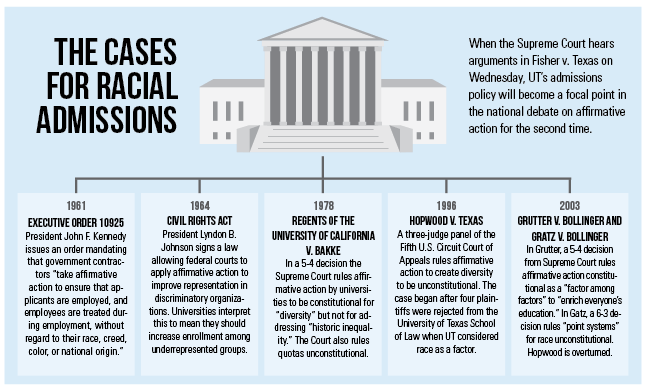
- The Cases For Racial Admissions
- What was the purpose of
afirmative action when it
was introduced in the 1960s
- To address the consequences of political polices that had
actively denied opportunity to generations of racial minorities
- To address the consequences of political polices that had
actively denied opportunity to generations of racial minorities
- Conservatives against
affirmative action
- The USA is highly competitive there are winners and losers
- It provides incentives for
people to achieve
- Under meritocracy
- It provides incentives for
people to achieve
- Past dicrimination not main reason - is is put down to
lifestyle choices (drugs alcohol) in minority communities
- The USA is highly competitive there are winners and losers
- What solutions do
conservatives suggest
to racial inequality
- Abolition of welfare that serves as disincentives
to self-reliance, including affirmative action.
- This would allow people to make the most of their own abilites
and the opportunities offered by a vibrant free-market economy
- The Republic party support this, partical
radical right-wing Tea Party movement
- Abolition of welfare that serves as disincentives
to self-reliance, including affirmative action.
- Moderates' views about
affirmative action
- No longer needed - significant minority groups
have benefited over the past 40 years
- They call for it to be reformed
- School and cultural reform - Texas 10% rule (top 10% of
all highschool grads get university payments
- School and cultural reform - Texas 10% rule (top 10% of
all highschool grads get university payments
- Democratic party Support a need for poverty
relief and racial anti-discrimination policies
- No longer needed - significant minority groups
have benefited over the past 40 years
- Left-wing view of
affirmative action
- It provids practical opportunities that have long
been denied because of slavery and segregation
- It can bring further benefits, like increasing the number
of people who are fully participating in society
- The Black community need government assistance
due to it typical having limited resources
- Political authorities have a responsibilty to provide resources
in deprived districts for a high-quality, rounded, curriculum
- It provids practical opportunities that have long
been denied because of slavery and segregation
- What do radicals mean
by "corrective justice"
- Genuine fairness can only
be achieved when
compensation is payed
- Payment for the accumulated effects of over
200 years of lost liberty and opportunity
- Payment for the accumulated effects of over
200 years of lost liberty and opportunity
- This would proved Black with the resources to implement
solutions to problems unique to their communities
- Genuine fairness can only
be achieved when
compensation is payed
- Counter-arguments of both sides
- Defenders of affirmative action
- Opponents down-play the impact of radical discrimination over a 200 year period by
making comparisons with other groups that have never suffered "hatred and injustice"
- (White are being discriminated against)
- (White are being discriminated against)
- Moderates opponents of affirmative action want to intro a new welfare programme, but
would they remain commited to their alternative form of affirmative action.
- Opponents primarily motived by racism
- Opponents down-play the impact of radical discrimination over a 200 year period by
making comparisons with other groups that have never suffered "hatred and injustice"
- Critics of affirmative action
- They object to an approach an approach that they see as undermining the
features of American society - open competition and limited government
- They object to an approach an approach that they see as undermining the
features of American society - open competition and limited government
- Defenders of affirmative action
Media attachments
Want to create your own Mind Maps for free with GoConqr? Learn more.