
21179604
Description

Mind Map by Khairil Mashud, updated more than 1 year ago

|
Created by Khairil Mashud
almost 6 years ago
|
|
Physics
'AS' & 'A'
Level:
Waves
- CAN BE
DESCRIBED BY
TERMS
- - Amplitude (A)
- The maximum displacement of any
point on the wave from its undisturbed
position is called the amplitude A.
- The maximum displacement of any
point on the wave from its undisturbed
position is called the amplitude A.
- - Wavelength (λ), λ= v/f
- The distance from any point on a
wave to the next exactly similar
point (e.g. crest to crest) is called
the wavelength λ
- The distance from any point on a
wave to the next exactly similar
point (e.g. crest to crest) is called
the wavelength λ
- - Frequency (f), f = v/λ
- The number of oscillations per unit time of
a point in a wave is called its frequency f.
- The number of oscillations per unit time of
a point in a wave is called its frequency f.
- - Wave Speed (v), v = f λ
- Speed with which energy is transmitted by a
wave
- Speed with which energy is transmitted by a
wave
- - Period (T), T = 1/f
- The time taken for one complete oscillation
of a point in a wave is called the period T.
- The time taken for one complete oscillation
of a point in a wave is called the period T.
- - Amplitude (A)
- CAN BE
REPRESENTED
BY
GRAPH
- DISPLACEMENT-DISTANCE
GRAPH
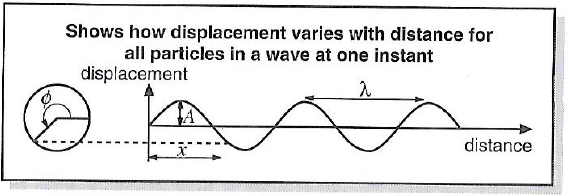
- SHOWS HOW DISPLACEMENT VARIES WITH DISTANCE
FOR ALL PARTICLES IN A WAVE AT ONE INSTANT
- SHOWS HOW DISPLACEMENT VARIES WITH DISTANCE
FOR ALL PARTICLES IN A WAVE AT ONE INSTANT
- DISPLACEMENT-TIME
GRAPH
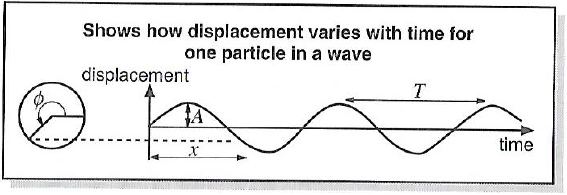
- SHOWS HOW DISPLACEMENT VARIES WITH TIME FOR
ONE PARTICLE IN A WAVE
- SHOWS HOW DISPLACEMENT VARIES WITH TIME FOR
ONE PARTICLE IN A WAVE
- DISPLACEMENT-DISTANCE
GRAPH
- ALL WAVES ARE CAUSED BY
SOME TYPE OF VIBRATION
- IN LONGITUDINAL WAVES, THE PARTICLES OF THE
MEDIUM VIBRATE PARALLEL TO THE DIRECTION OF
THE WAVE VELOCITY. E.g: SOUND WAVE
- ULTRASOUND IS ANY SOUND WAVE THAT HAS
A FREQUENCY ABOVE 20 kHz (20 000 Hz)
- Ultrasound transducers use
the piezo-electric effect (of a
crystal) to generate and
detect ultrasound waves
- Ultrasound transducers use
the piezo-electric effect (of a
crystal) to generate and
detect ultrasound waves
- ULTRASOUND IS ANY SOUND WAVE THAT HAS
A FREQUENCY ABOVE 20 kHz (20 000 Hz)
- IN TRANSVERSE WAVES, THE PARTICLES OF THE MEDIUM
VIBRATE AT RIGHT ANGLES TO THE DIRECTION OF THE
WAVE VELOCITY. E.g: Water & Electromagnetic Waves
- CAN BE POLARISED
- POLARISATION – CONFINE THE OSCILLATIONS OF THE
ELECTRIC VECTOR OF LIGHT WAVES TO ONE DIRECTION.
- POLARISATION – CONFINE THE OSCILLATIONS OF THE
ELECTRIC VECTOR OF LIGHT WAVES TO ONE DIRECTION.
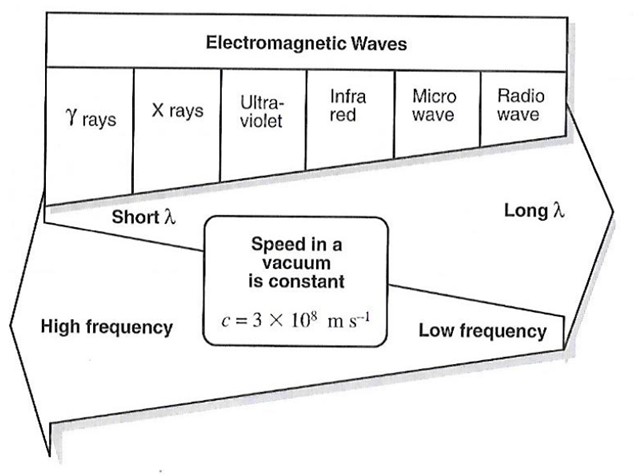
- ELECTROMAGNETIC WAVES
- CAN BE POLARISED
- IN LONGITUDINAL WAVES, THE PARTICLES OF THE
MEDIUM VIBRATE PARALLEL TO THE DIRECTION OF
THE WAVE VELOCITY. E.g: SOUND WAVE
- INTENSITY
- INTENSITY = POWER / AREA
- ALTERNATIVELY
- INTENSITY ∝ AMPLITUDE(Square)
- INTENSITY = (Constant).AMPLITUDE(Square)
- INTENSITY = 2.π(Square).f(Square).ƿ.v.A(Square)
- INTENSITY ∝ AMPLITUDE(Square)
- ALTERNATIVELY
- INTENSITY = POWER / AREA
- DOPPLER EFFECT
- (OR THE DOPPLER SHIFT) IS THE CHANGE
IN FREQUENCY OF A WAVE IN RELATION TO
AN OBSERVER WHO IS MOVING RELATIVE
TO THE WAVE SOURCE (OR VICE VERSA).
- SOURCE IS APPROACHING THE OBSERVER
- f(Observer) = [ f(source) v ] / [v - v(source) ]
- f(Observer) = [ f(source) v ] / [v - v(source) ]
- SOURCE IS MOVING
AWAY FROM THE
OBSERVER
- f(Observer) = [ f(source) v ] / [v + v(source) ]
- AS DISTANCE AWAY FROM THE SOURCE
INCREASE, THE INTENSITY DECREASES BECAUSE:
- (1) THE WAVE MAY SPREAD OUT & (2) THE WAVE
MAY BE ABSORBED OR SCATTERED
- (1) THE WAVE MAY SPREAD OUT & (2) THE WAVE
MAY BE ABSORBED OR SCATTERED
- f(Observer) = [ f(source) v ] / [v + v(source) ]
- SOURCE IS APPROACHING THE OBSERVER
- (OR THE DOPPLER SHIFT) IS THE CHANGE
IN FREQUENCY OF A WAVE IN RELATION TO
AN OBSERVER WHO IS MOVING RELATIVE
TO THE WAVE SOURCE (OR VICE VERSA).
Media attachments
Want to create your own Mind Maps for free with GoConqr? Learn more.