
Mind map
Critical Thinking Unit 1 (F501)
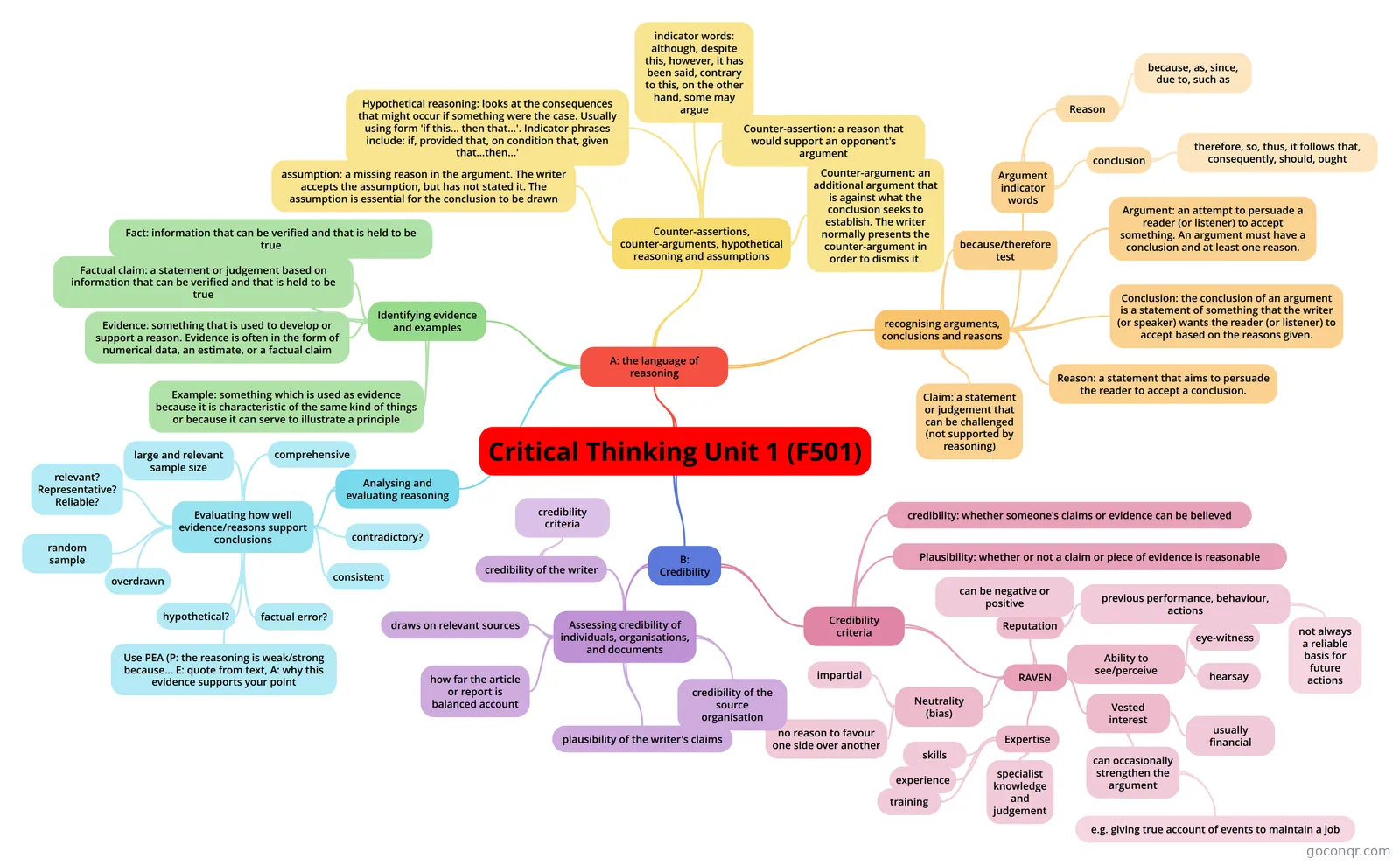
Mind map: Critical thinking unit 1
Map content
Critical Thinking Unit 1 (F501)
A: the language of reasoning
- recognising arguments, conclusions and reasons
- Argument: an attempt to persuade a reader (or listener) to accept something. An argument must have a conclusion and at least one reason.
- Conclusion: the conclusion of an argument is a statement of something that the writer (or speaker) wants the reader (or listener) to accept based on the reasons given.
- Reason: a statement that aims to persuade the reader to accept a conclusion.
- Claim: a statement or judgement that can be challenged (not supported by reasoning)
- Argument indicator words
- Reason
- because, as, since, due to, such as
- conclusion
- therefore, so, thus, it follows that, consequently, should, ought
- Reason
- because/therefore test
- Counter-assertions, counter-arguments, hypothetical reasoning and assumptions
- Counter-argument: an additional argument that is against what the conclusion seeks to establish. The writer normally presents the counter-argument in order to dismiss it.
- Counter-assertion: a reason that would support an opponent's argument
- indicator words: although, despite this, however, it has been said, contrary to this, on the other hand, some may argue
- Hypothetical reasoning: looks at the consequences that might occur if something were the case. Usually using form 'if this... then that...'. Indicator phrases include: if, provided that, on condition that, given that...then...'
- assumption: a missing reason in the argument. The writer accepts the assumption, but has not stated it. The assumption is essential for the conclusion to be drawn
- Identifying evidence and examples
- Fact: information that can be verified and that is held to be true
- Factual claim: a statement or judgement based on information that can be verified and that is held to be true
- Evidence: something that is used to develop or support a reason. Evidence is often in the form of numerical data, an estimate, or a factual claim
- Example: something which is used as evidence because it is characteristic of the same kind of things or because it can serve to illustrate a principle
- Analysing and evaluating reasoning
- Evaluating how well evidence/reasons support conclusions
- relevant? Representative? Reliable?
- comprehensive
- large and relevant sample size
- random sample
- Use PEA (P: the reasoning is weak/strong because... E: quote from text, A: why this evidence supports your point
- consistent
- factual error?
- hypothetical?
- overdrawn
- contradictory?
- Evaluating how well evidence/reasons support conclusions
- recognising arguments, conclusions and reasons
B: Credibility
- Credibility criteria
- credibility: whether someone's claims or evidence can be believed
- Plausibility: whether or not a claim or piece of evidence is reasonable
- RAVEN
- Reputation
- can be negative or positive
- previous performance, behaviour, actions
- not always a reliable basis for future actions
- Ability to see/perceive
- eye-witness
- hearsay
- Vested interest
- usually financial
- can occasionally strengthen the argument
- e.g. giving true account of events to maintain a job
- Expertise
- skills
- experience
- training
- specialist knowledge and judgement
- Neutrality (bias)
- impartial
- no reason to favour one side over another
- Reputation
- Assessing credibility of individuals, organisations, and documents
- credibility of the writer
- credibility criteria
- plausibility of the writer's claims
- how far the article or report is balanced account
- draws on relevant sources
- credibility of the source organisation
- credibility of the writer
- Credibility criteria
Information
- Description
- OCR AS level critical thinking unit 1 overview
- Created by
- jeacur
- Views
- 235
- Tags
- Rating