
Mind map
OCR Chemistry - F321 - Module 3
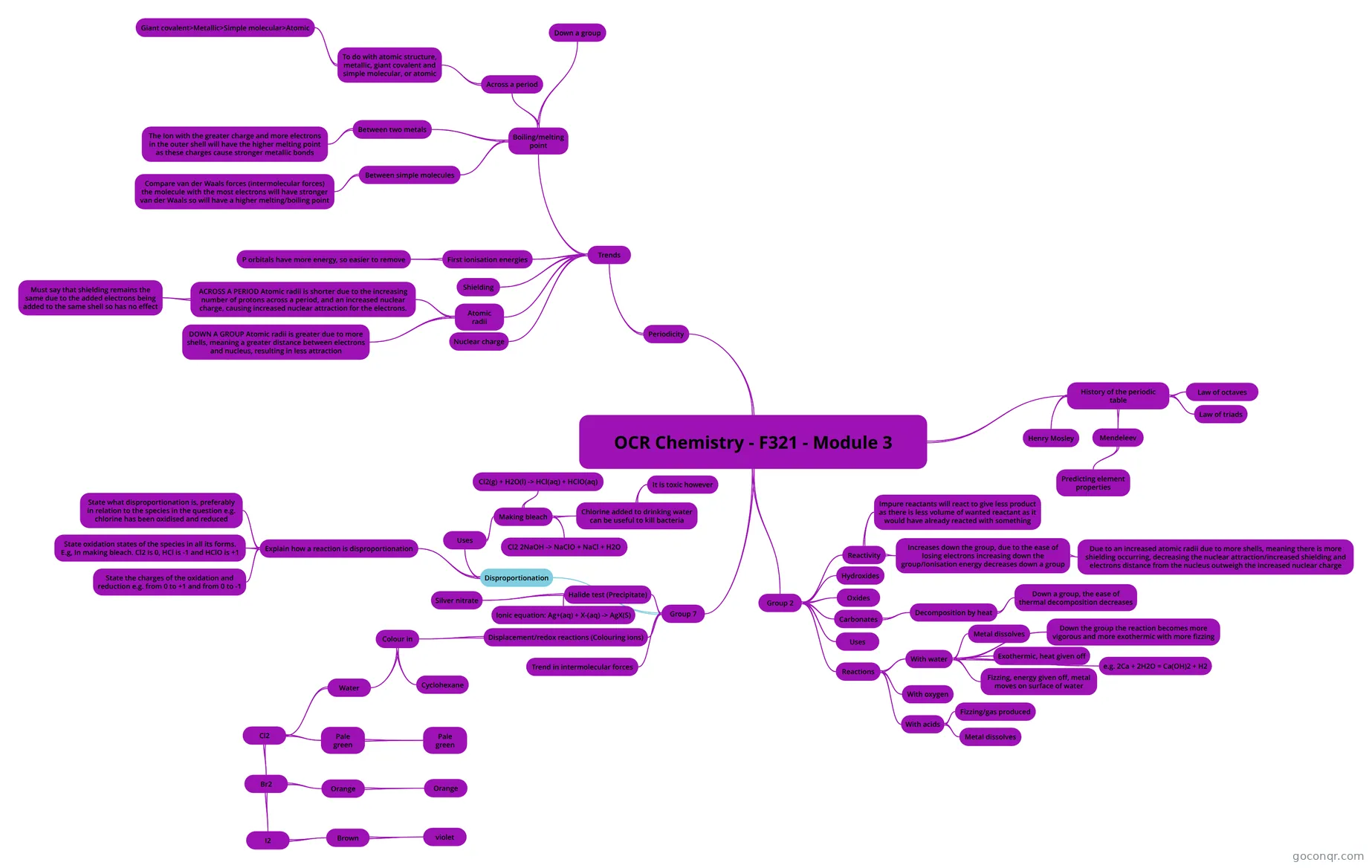
Mind map: OCR Chemistry F321 Module 3 periodic table
Map content
OCR Chemistry - F321 - Module 3
History of the periodic table
- Law of octaves
- If elements were listed in order of Relative atomic mass, every 8th element will have similar properties (noble gases were not discovered so today it will be every 9)
- Law of triads
- For every 3 elements in a group, the middle elements relative atomic mass will be an average of the 3
- Mendeleev
- Advantages of his table = properties could be predicted, showed order was not in mass.
- Disadvantages = isotopes not yet discovered, and neither noble gases
- Periodic laws: elements with similar properties have a similar weight or increase regularly. If arranged in order of mass, a periodicity of properties are apparent.
- Predicting element properties
- An unknown element but known place in periodic table can have its properties predicted as down a group the number of outermost electrons and electron structure is the same
- Henry Mosley
- elements were ordered in atomic number not atomic mass, this fixed problems with e.g Argon and potassium
- Law of octaves
Group 2
- Carbonates
- With acid CaCO3 + 2HCl = H2O + CO2 + CaCl2
- Decomposition by heat
- MgCO3 = MgO + CO2
- Down a group, the ease of thermal decomposition decreases
- Oxides
- MgO + 2HCl = MgCl2 + H2O (Neutralising acid soils)
- Hydroxides
- The use of a hydroxide is to neutralise acidic soils, however the correct amount needs to be used as any excess will raise the pH to be too high
- Ca(OH)2 + aq = Ca^2+ + 2OH^- (Neutralising acidic soils)
- Solubility and alkalinity increases down the group
- Milk of magnesia, Mg(HO)2, neutralises stomach acids
- Uses
- Neutralsing acidic soils (Hydroxides, mainly Ca(OH)2
- Reactions
- With water
- Down the group the reaction becomes more vigorous and more exothermic with more fizzing
- e.g. 2Ca + 2H2O = Ca(OH)2 + H2
- Fizzing, energy given off, metal moves on surface of water
- Exothermic, heat given off
- Metal dissolves
- With oxygen
- Forms an oxide 2Ca + O2 = 2CaO
- With acids
- Fizzing/gas produced
- Metal dissolves
- With water
- Reactivity
- Impure reactants will react to give less product as there is less volume of wanted reactant as it would have already reacted with something
- Increases down the group, due to the ease of losing electrons increasing down the group/Ionisation energy decreases down a group
- Due to an increased atomic radii due to more shells, meaning there is more shielding occurring, decreasing the nuclear attraction/increased shielding and electrons distance from the nucleus outweigh the increased nuclear charge
- Carbonates
Periodicity
- Trends
- First ionisation energies
- ACROSS A PERIOD Atomic radii (Explained in 'Atomic radii) is smaller across a period, so by electrons being closer to the nucleus, they'll require more energy to be removed due to electrons being attracted to nucleus.
- DOWN A GROUP First ionisation energies decrease due to nuclear radii increasing with more shells, so electrons are further away. Also shielding is stronger due to more inner shells repelling outer electrons. This is despite increased nuclear charge
- P orbitals have more energy, so easier to remove
- Boiling/melting point
- Between two metals
- The Ion with the greater charge and more electrons in the outer shell will have the higher melting point as these charges cause stronger metallic bonds
- Between simple molecules
- Compare van der Waals forces (intermolecular forces) the molecule with the most electrons will have stronger van der Waals so will have a higher melting/boiling point
- Across a period
- To do with atomic structure, metallic, giant covalent and simple molecular, or atomic
- Giant covalent>Metallic>Simple molecular>Atomic
- To do with atomic structure, metallic, giant covalent and simple molecular, or atomic
- Down a group
- Between two metals
- Atomic radii
- ACROSS A PERIOD Atomic radii is shorter due to the increasing number of protons across a period, and an increased nuclear charge, causing increased nuclear attraction for the electrons.
- Must say that shielding remains the same due to the added electrons being added to the same shell so has no effect
- DOWN A GROUP Atomic radii is greater due to more shells, meaning a greater distance between electrons and nucleus, resulting in less attraction
- ACROSS A PERIOD Atomic radii is shorter due to the increasing number of protons across a period, and an increased nuclear charge, causing increased nuclear attraction for the electrons.
- Shielding
- ACROSS A PERIOD Shielding is the same due to electrons being on same outermost shell
- DOWN A GROUP Shielding increases due to more inner shells repelling outermost electrons
- Nuclear charge
- ACROSS A PERIOD Nuclear charge increases due to increased proton number, causing a greater nuclear attraction (only an impacting factor across a period)
- DOWN A GROUP Nuclear charge increases, but has minimal impact on other trends due to increased atomic radii (so DESPITE this)
- First ionisation energies
- Trends
Group 7
- Reactions may need to be done in a well ventilated area as some of the halogens are toxic / radioactive further down the group
- Halide test (Precipitate)
- The reaction = AgNO3 + KX^- = AgX + KNO3 The K can also be a H or Na
- Chlorine = white Bromine = Cream Iodine = Yellow To ensure that the colours are correct, ammonia can be added to dissolve the precipitate, dilute will dissolve the Cl, concentrated will dissolve the Br and nothing will dissolve the I.
- Silver nitrate
- Metals in silver nitrate will allow silver to be deposited on the metal surface and the metal to be a nitrate
- Ionic equation: Ag+(aq) + X-(aq) -> AgX(S)
- Displacement/redox reactions (Colouring ions)
- The most reactive element (chlorine) will turn into the ions easier as it has a higher electron affinity because it is the smallest atom with little shielding acting on the the outermost electrons, it also has the shortest distance between the outermost electrons and the nucleus.
- Down a group the reactivity/oxidising power decreases down the group.
- The free molecule will determine the colour of the solution as the more reactive ion will be part of a molecule.
- Equation : Cl2 + 2Br- = 2Cl- + Br2
- Colour in
- Water
- Cl2
- Br2
- I2
- Brown
- violet
- Brown
- Orange
- Orange
- I2
- Pale green
- Pale green
- Br2
- Cl2
- Cyclohexane
- Water
- Trend in intermolecular forces
- Atoms get bigger down the group, more electrons, more protons, stronger charges lead to stronger van der Waals, which take more energy to break. Which means boiling point increases down the group.
- Reactivity decreases down the group as their oxidising power decreases down the group, die to larger radii, more shielding and they are less able to gain an electron in the p orbital to form a halide ion.
- Disproportionation
- Disproportionation is when the same element in a single reaction is both oxidised and reduced. Be sure to show the change in charges
- Uses
- Making bleach
- Chlorine added to drinking water can be useful to kill bacteria
- It is toxic however
- Cl2(g) + H2O(l) -> HCl(aq) + HClO(aq)
- Cl2 2NaOH -> NaClO + NaCl + H2O
- Conditions: room temperature and dilute sodium hydroxide
- Chlorine added to drinking water can be useful to kill bacteria
- Making bleach
- Explain how a reaction is disproportionation
- State what disproportionation is, preferably in relation to the species in the question e.g. chlorine has been oxidised and reduced
- State oxidation states of the species in all its forms. E.g, In making bleach. Cl2 is 0, HCl is -1 and HClO is +1
- State the charges of the oxidation and reduction e.g. from 0 to +1 and from 0 to -1
Information
- Description
- A-Level Chemistry (AS topics) Mind Map on OCR Chemistry - F321 - Module 3, created by jacob gray on 02/05/2015.
- Created by
- jacob gray
- Views
- 107
- Tags
- Rating