
2645189
Description

Mind Map by louwarrior95, updated more than 1 year ago
|
|
Created by louwarrior95
almost 11 years ago
|
|
The Spine
- Functions
- Support
- Attachment
- Surrounds Spinal Cord (Protection)
- Shock Absorbancy
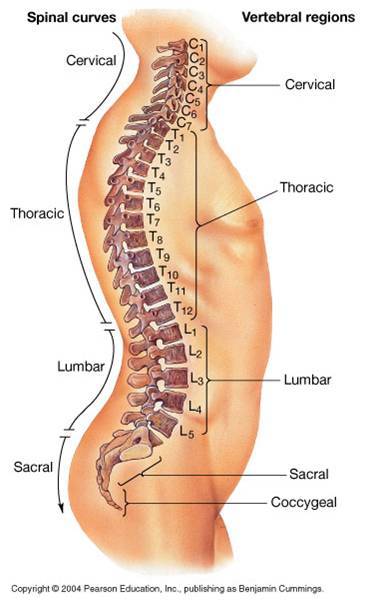
- Spinal Curves
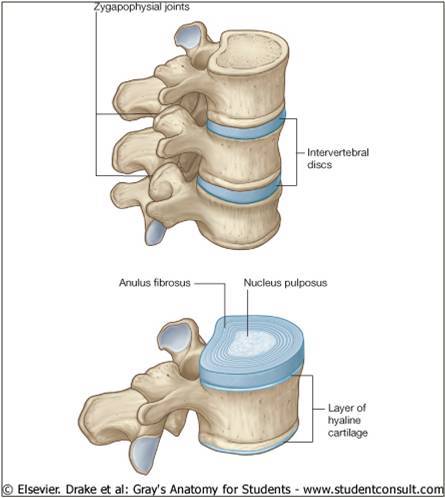
- Intervertebral discs
- Spinal Curves
- Flexibility
- Support
- Gross Structure
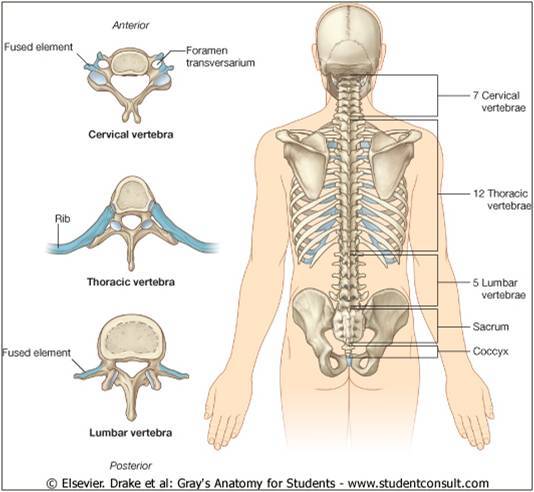
- 33 Bony Segments
- 24 Separate Vertebrae
- Vertebrae increase in size as you go down the
vertebral column
- Vertebrae increase in size as you go down the
vertebral column
- 9 Fused (Sacrum & Coccyx)
- 24 Separate Vertebrae
- Series of Ligaments & Muscles
- Approx' 1/4 of spinal length is made of
intervertebral discs
- Height variation
during the day
- Compression forces
- Height variation
during the day
- 33 Bony Segments
- Vertebrae
- Typical Vertebrae
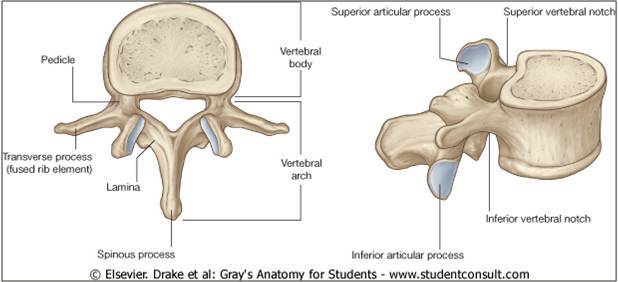
- Top Half is called the vertebral body
- The bottom half is called the vertebral arch
- It comes to a point called the Spinous
Process (the sticky out bit you can feel)
- The lengths of bone joining to
the point are called lamina
- On either side beneath the vertebral body are transverse processes
- It comes to a point called the Spinous
Process (the sticky out bit you can feel)
- Top Half is called the vertebral body
- IV Discs
- Inside - Nucleus
Pulposus
- Type 2 Collagen
- 70% Water
- 70% Water
- Type 2 Collagen
- Inside - Nucleus
Pulposus
- Typical Vertebrae
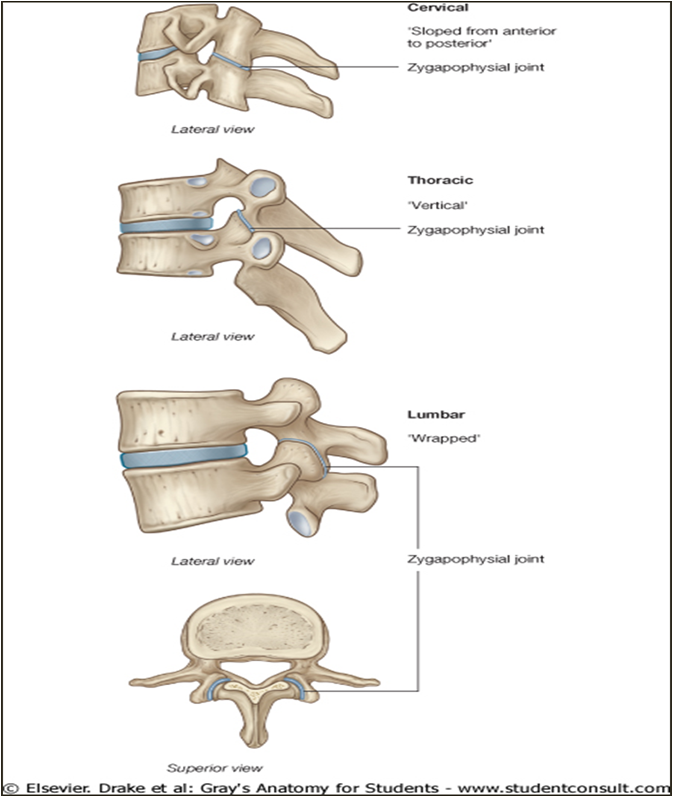
- Zygapophyseal/Facet Joints
- General Synovial Plane Joints
- At the Cervical
Spine all
movements occur
- At the thoracic Spine Project
almost vertical. Lateral Flexion
& Rotation occur
- At the Lumbar Spine
Flex/Extension & Lateral
Flexion occur
- General Synovial Plane Joints
- Ligaments
- Longitudinal
- Anterior
- Originates from the anterior
tubercle of the Atlas (C1) to Pelvic
Surface of S1
- 1/2 mm thick & get wider as it descends
- Superficial Across Several
Vertebra
- Originates from the anterior
tubercle of the Atlas (C1) to Pelvic
Surface of S1
- Posterior
- Originates from the
Posterior axis to S1
- Attaches to each disc
- Narrower as it desends
- Originates from the
Posterior axis to S1
- Anterior
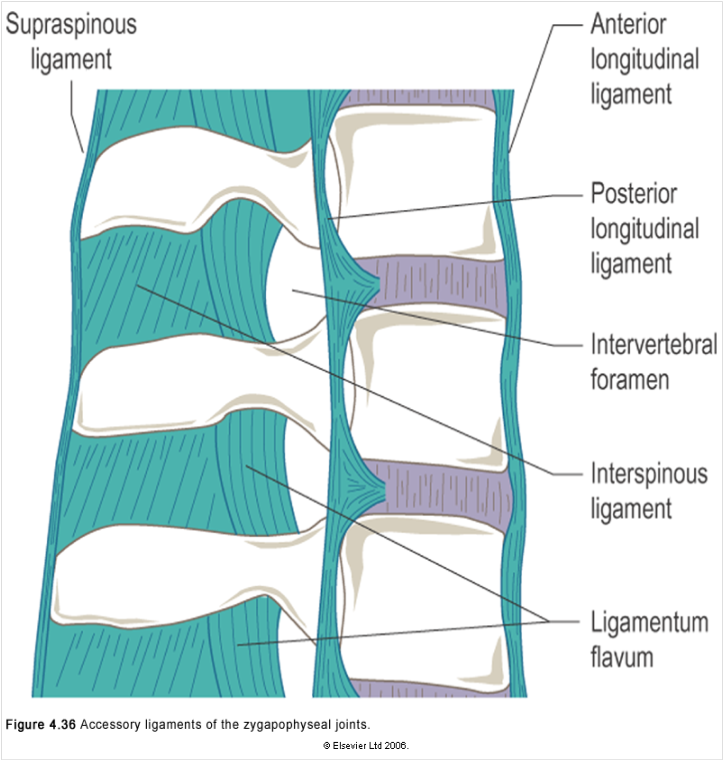
- Accesory
- Ligamentum Flavum
- Laminae of Vertebra
- C1/C2 to L4/L5
- Yellow, Elastic Tissue
- Laminae of Vertebra
- Supraspinous
- Over & connects Spinous
processes.
- Continous with
Interspinous ligament
- Interspinous
- Relatively weak bands. Stronger in
Lumbar Spine.
- Relatively weak bands. Stronger in
Lumbar Spine.
- Interspinous
- Over & connects Spinous
processes.
- Ligamentum Nuchae
- Spine of C7 to External Occipital
Protuberance
- Spine of C7 to External Occipital
Protuberance
- Intertransverse
- Adjacent to
Transverse
Processes
- More obvious in Lumbar spine
- More obvious in Lumbar spine
- Adjacent to
Transverse
Processes
- Ligamentum Flavum
- Longitudinal
Media attachments
Want to create your own Mind Maps for free with GoConqr? Learn more.