
28965978
Description

Mind Map by Said Alsaied, updated more than 1 year ago

|
Created by Said Alsaied
over 5 years ago
|
|
Sciatica
- Vertebral Column
- curvatures
- cervical
- thoracic
- lumbar
- sacral
- coccygeal
- cervical
- intervertebral discs
- outer layer called Annulus fibrosis
- parallel collagen bundles
- parallel collagen bundles
- Avascular
- Inner layer nucleus pulposus
- soft gelatinous material
- soft gelatinous material
- outer layer called Annulus fibrosis
- joints
- Zygapo-physeal
- joints between the inferior articular process of superior vertebrae and the superior articular
process of inferior vertebrae
- joints between the inferior articular process of superior vertebrae and the superior articular
process of inferior vertebrae
- Atlanto-occipital
- Articulation between C1 and skull
- Articulation between C1 and skull
- Atlanto-Axial
- Articulation between the atlas (C1 and the Axis (C2)
- Articulation between the atlas (C1 and the Axis (C2)
- Zygapo-physeal
- ligaments
- weak ligament join adjacent spinous processes
- strong cord- like ligament join spinous processes
- Weak posterior ligament starts from C2
- Connect adjacent transverse processes consist of few scattered fibers except in lumbar region its
membranous
- weak ligament join adjacent spinous processes
- curvatures
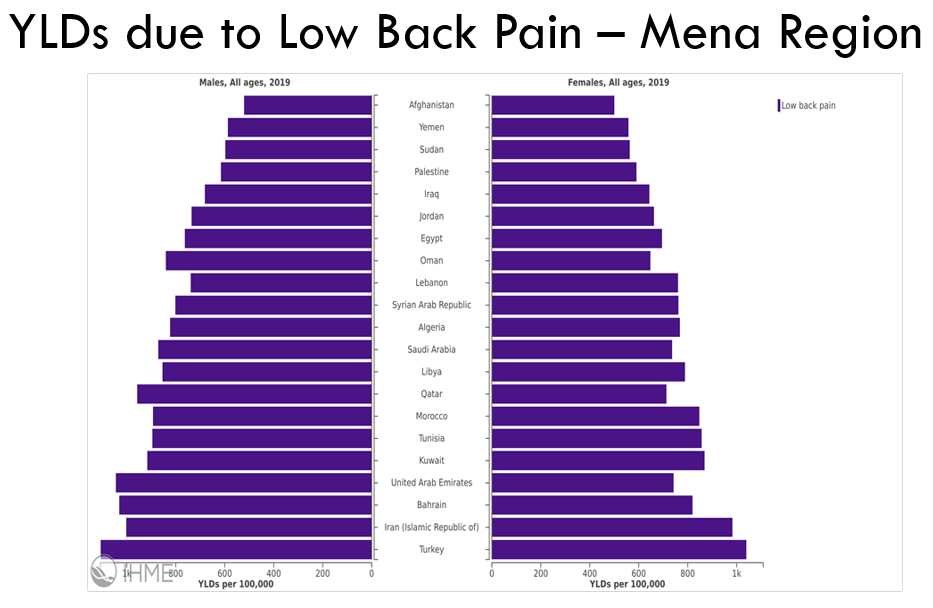
- lower back pain
- causes
- Scoliosis
- Spondylosis
- Spinal Stenosis
- Osteoporosis
- Spine Osteoarthritis
- Bulging and Ruptured Disc
- Muscle Strain & Ligament Sprain
- Scoliosis
- physical examination
- looking
- Symmetry of shoulder height / scapulae/ posterior ribs and iliac crest
- Skin for any discoloration/ swelling and scars
- Muscle (around the joint ) for atrophy
- Bones for any deformity (scoliosis, kyphosis, lordosis and ankylosing spondylitis ) that cause loss of
normal curvature
- Symmetry of shoulder height / scapulae/ posterior ribs and iliac crest
- palpating
- Skin --> the cervical, thoraco-lumbar and sacral vertebrae
- Muscles --> for tenderness and atrophy
- Bones surface landmarks --> start from base of skull down to spinous prominence of L4 for
tenderness, swellings and deformities
- joints
- Skin --> the cervical, thoraco-lumbar and sacral vertebrae
- movements
- only asctive
- special tests
- Straight leg raising (Supine)
- Femoral nerve Stretch test (Prone)
- Schober's test
- Straight leg raising (Supine)
- only asctive
- looking
- epidemiology
- causes
- Electromyography (EMG)
- meaning
- Recording the electrical current from the cell membranes of the muscle fibers
- Recording the electrical current from the cell membranes of the muscle fibers
- uses tiny devices called electrodes to translate these signals into graphs
- electrical activity picked up by the electrodes is then displayed on an oscilloscope
- other uses
- Carpal tunnel syndrome
- Polymyositis
- Myasthenia gravis
- Carpal tunnel syndrome
- meaning
- pain that travels along the path of the sciatic nerve, which branches from the lower back through the
hips and buttocks and down to one leg (it typically affects only one side of the body)
- Sciatic Nerve
- basic facts
- longest and widest nerve in the entire human body
- Originates from nerve roots L4-S3 of the lumbosacral plexus
- can be considered as two individual nerves bundled together in the same connective tissue sheath –
the tibial and common fibular nerves
- longest and widest nerve in the entire human body
- motor distributions
- Semitendinosus
- Biceps femoris (long head)
- Biceps femoris (short head)
- Semimembranosus
- Hamstring portion of the adductor magnus
- indirectly innervates (via its terminal branches) all the muscles of the leg and foot
- Semitendinosus
- sensory distributions
- No direct sensory functions
- Indirectly innervates (via its terminal branches – tibial nerve and common fibular nerve) the skin of
the lateral leg, heel, and both the dorsal and plantar surfaces of the foot
- No direct sensory functions
- radicular pain
- definition
- the pain that occurs and radiates from one or more spinal nerve roots
- the pain that occurs and radiates from one or more spinal nerve roots
- causes
- Nerve root injury
- foraminal stenosis
- Herniated Discs
- Nerve root injury
- treatments
- Epidural injection
- Acupuncture
- yoga
- Epidural injection
- types
- lumbar radiculopathy
- cervical radiculopathy
- thoracic radiculopathy
- lumbar radiculopathy
- definition
- basic facts
- causes
- Herniated or slipped disk
- Degenerative disk disease
- Cauda equina syndrome
- Tumors in the lumbar spinal canal that compress the sciatic nerve.
- Trauma injury to the lumbar spine or sciatic nerve
- Herniated or slipped disk
- symptoms
- Moderate to severe pain, Numbness or weakness in lower back, buttock and down your leg
- Pain that worsens with movement, or loss of movement
- Pins and needles
- Loss of bowel and bladder control
- Moderate to severe pain, Numbness or weakness in lower back, buttock and down your leg
- treatment techniques
- medications
- Anti-inflammatories
- Muscle relaxants
- Narcotics
- Anti-inflammatories
- Chiropractor
- Surgery
- Back braces
- medications
Media attachments










Want to create your own Mind Maps for free with GoConqr? Learn more.