
29758093
Description

Mind Map by JOSE MADRID, updated more than 1 year ago

|
Created by JOSE MADRID
almost 5 years ago
|
|
Mutations
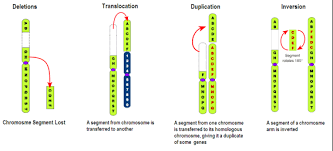
- Chromosomal Mutations
- A mutation involving a long segment of DNA.
These mutations can involve deletions,
insertions, or inversions of sections of DNA.
In some cases, deleted sections may attach
to other chromosomes, disrupting both the
chromosomes that loses the DNA and the
one that gains it. Also referred to as a
chromosomal rearrangement.
- A mutation involving a long segment of DNA.
These mutations can involve deletions,
insertions, or inversions of sections of DNA.
In some cases, deleted sections may attach
to other chromosomes, disrupting both the
chromosomes that loses the DNA and the
one that gains it. Also referred to as a
chromosomal rearrangement.
- Gene Mutations
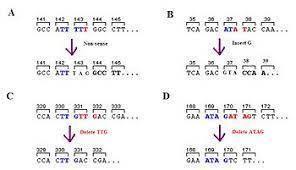
- Frameshift Mutation
- A frameshift mutation is a type of mutation involving the
insertion or deletion of a nucleotide in which the number
of deleted base pairs is not divisible by three. "Divisible by
three" is important because the cell reads a gene in groups
of three bases. Each group of three bases corresponds to
one of 20 different amino acids used to build a protein. If a
mutation disrupts this reading frame, then the entire DNA
sequence following the mutation will be read incorrectly.
- A frameshift mutation is a type of mutation involving the
insertion or deletion of a nucleotide in which the number
of deleted base pairs is not divisible by three. "Divisible by
three" is important because the cell reads a gene in groups
of three bases. Each group of three bases corresponds to
one of 20 different amino acids used to build a protein. If a
mutation disrupts this reading frame, then the entire DNA
sequence following the mutation will be read incorrectly.
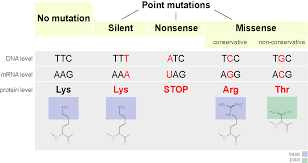
- Point Mutation
- A point mutation is when a single base pair is altered. Point
mutations can have one of three effects. First, the base substitution
can be a silent mutation where the altered codon corresponds to the
same amino acid. Second, the base substitution can be a missense
mutation where the altered codon corresponds to a different amino
acid. Or third, the base substitution can be a nonsense mutation
where the altered codon corresponds to a stop signal.
- A point mutation is when a single base pair is altered. Point
mutations can have one of three effects. First, the base substitution
can be a silent mutation where the altered codon corresponds to the
same amino acid. Second, the base substitution can be a missense
mutation where the altered codon corresponds to a different amino
acid. Or third, the base substitution can be a nonsense mutation
where the altered codon corresponds to a stop signal.
- Frameshift Mutation
- Factors that cause Mutations
- Replication Errors
- Examples
- Mutations, DNA polymerase proofreading,
Mismatch Repair, etc.
- Mutations, DNA polymerase proofreading,
Mismatch Repair, etc.
- Examples
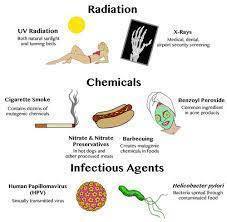
- Mutagens
- Examples
- Radioactive substances, x-rays,
ultraviolet radiation, heat and
radiation.
- Radioactive substances, x-rays,
ultraviolet radiation, heat and
radiation.
- Examples
- Replication Errors
Media attachments
Want to create your own Mind Maps for free with GoConqr? Learn more.