
Mind map
Theories of Motivation
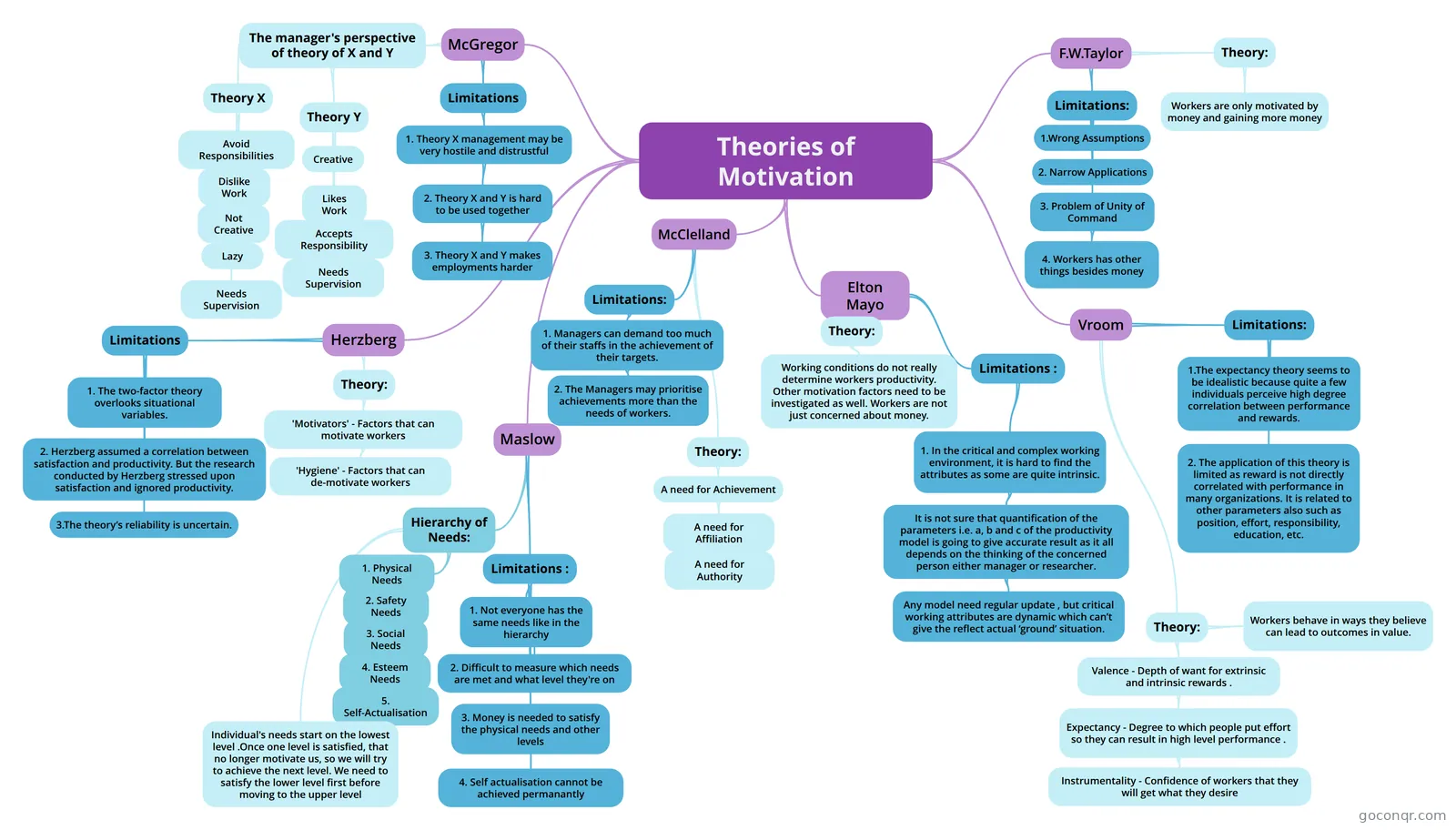
Mind map: Theories of motivation
Map content
Theories of Motivation
F.W.Taylor
- Limitations:
- 1.Wrong Assumptions
- 2. Narrow Applications
- 3. Problem of Unity of Command
- 4. Workers has other things besides money
- Theory:
- Workers are only motivated by money and gaining more money
- Limitations:
Elton Mayo
- Limitations :
- 1. In the critical and complex working environment, it is hard to find the attributes as some are quite intrinsic.
- It is not sure that quantification of the parameters i.e. a, b and c of the productivity model is going to give accurate result as it all depends on the thinking of the concerned person either manager or researcher.
- Any model need regular update , but critical working attributes are dynamic which can’t give the reflect actual ‘ground’ situation.
- It is not sure that quantification of the parameters i.e. a, b and c of the productivity model is going to give accurate result as it all depends on the thinking of the concerned person either manager or researcher.
- 1. In the critical and complex working environment, it is hard to find the attributes as some are quite intrinsic.
- Theory:
- Working conditions do not really determine workers productivity. Other motivation factors need to be investigated as well. Workers are not just concerned about money.
- Limitations :
Maslow
- Limitations :
- 1. Not everyone has the same needs like in the hierarchy
- 2. Difficult to measure which needs are met and what level they're on
- 3. Money is needed to satisfy the physical needs and other levels
- 4. Self actualisation cannot be achieved permanantly
- Hierarchy of Needs:
- 1. Physical Needs
- 2. Safety Needs
- 3. Social Needs
- 4. Esteem Needs
- 5. Self-Actualisation
- 4. Esteem Needs
- 3. Social Needs
- 2. Safety Needs
- Individual's needs start on the lowest level .Once one level is satisfied, that no longer motivate us, so we will try to achieve the next level. We need to satisfy the lower level first before moving to the upper level
- 1. Physical Needs
- Limitations :
Herzberg
- Limitations
- 1. The two-factor theory overlooks situational variables.
- 2. Herzberg assumed a correlation between satisfaction and productivity. But the research conducted by Herzberg stressed upon satisfaction and ignored productivity.
- 3.The theory’s reliability is uncertain.
- Theory:
- 'Motivators' - Factors that can motivate workers
- 'Hygiene' - Factors that can de-motivate workers
- 'Motivators' - Factors that can motivate workers
- Limitations
McClelland
- Limitations:
- 1. Managers can demand too much of their staffs in the achievement of their targets.
- 2. The Managers may prioritise achievements more than the needs of workers.
- 1. Managers can demand too much of their staffs in the achievement of their targets.
- Theory:
- A need for Achievement
- A need for Affiliation
- A need for Authority
- A need for Affiliation
- A need for Achievement
- Limitations:
Vroom
- Limitations:
- 1.The expectancy theory seems to be idealistic because quite a few individuals perceive high degree correlation between performance and rewards.
- 2. The application of this theory is limited as reward is not directly correlated with performance in many organizations. It is related to other parameters also such as position, effort, responsibility, education, etc.
- Theory:
- Workers behave in ways they believe can lead to outcomes in value.
- Valence - Depth of want for extrinsic and intrinsic rewards .
- Expectancy - Degree to which people put effort so they can result in high level performance .
- Instrumentality - Confidence of workers that they will get what they desire
- Expectancy - Degree to which people put effort so they can result in high level performance .
- Limitations:
McGregor
- The manager's perspective of theory of X and Y
- Theory X
- Dislike Work
- Avoid Responsibilities
- Not Creative
- Lazy
- Needs Supervision
- Theory Y
- Likes Work
- Creative
- Accepts Responsibility
- Needs Supervision
- Theory X
- Limitations
- 1. Theory X management may be very hostile and distrustful
- 2. Theory X and Y is hard to be used together
- 3. Theory X and Y makes employments harder
- 2. Theory X and Y is hard to be used together
- 1. Theory X management may be very hostile and distrustful
- The manager's perspective of theory of X and Y