
38110647
Description

Mind Map by María Fernanda Montes de Oca Manríquez, updated more than 1 year ago

|
Created by María Fernanda Montes de Oca Manríquez
over 3 years ago
|
|
Multiple states
models
- Section 8.1: In this chapter, we formulate
the survival model as an example of a
multiple state model. Then we introduce
several other multiple state models which
are useful
- Section 8.2: Examples of multiple state models. Multiple
state models are one of the most exciting development,
there are a natural tool for many important areas of
practical interest to actuaries. They also simplify and
provide a sound foundation for some traditional
actuarial techniques.
- Section 8.2.1: We have modeled the uncertainty over the duration of and
individual’s future lifetime by regarding the future lifetime as a random variable
Tx, for an individual currently aged x, with a given cumulative distribution function
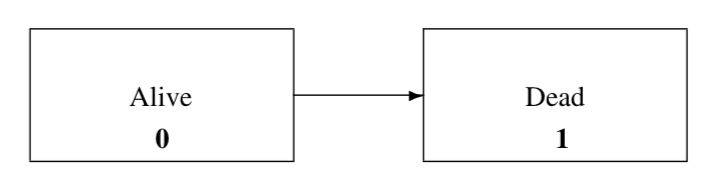
- We can represent this model diagrammatically. Our
individual is in one of two states ‘Alive’ and ‘Death’. For
convenience we label these states ‘0’ and ‘1’ respectively.
Transition form state 0 to state 1 is allowed, as indicated by
the direction of the arrow, but transitions in the opposite
direction cannot occur. This is an example of a multiple state
model with two states.
- We can represent this model diagrammatically. Our
individual is in one of two states ‘Alive’ and ‘Death’. For
convenience we label these states ‘0’ and ‘1’ respectively.
Transition form state 0 to state 1 is allowed, as indicated by
the direction of the arrow, but transitions in the opposite
direction cannot occur. This is an example of a multiple state
model with two states.
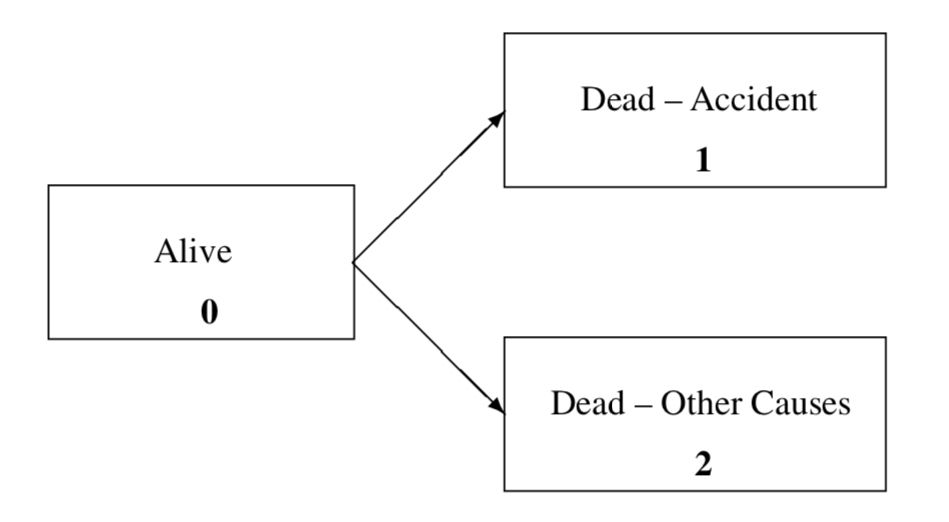
- Section 8.2.2: Term insurance with increased benefit on accidental death. This
model has three states and we can define a continuous time stochastic process
where Y(t) takes one of the three values 0, 1 and 2. This model starts by being
alive, that is, starts in state 0 and at some future time, dies.
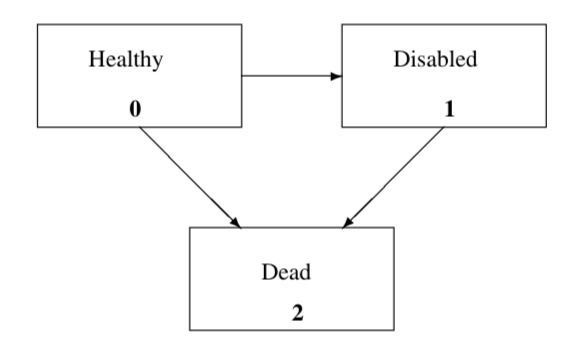
- Section 8.2.3: The permanent disability model. The
next image shows a model appropriate for a policy
which provides the benefits: 1. annuity while
permanently disabled, 2. a lump sum on becoming
permanently disabled, 3. a lump sum on death
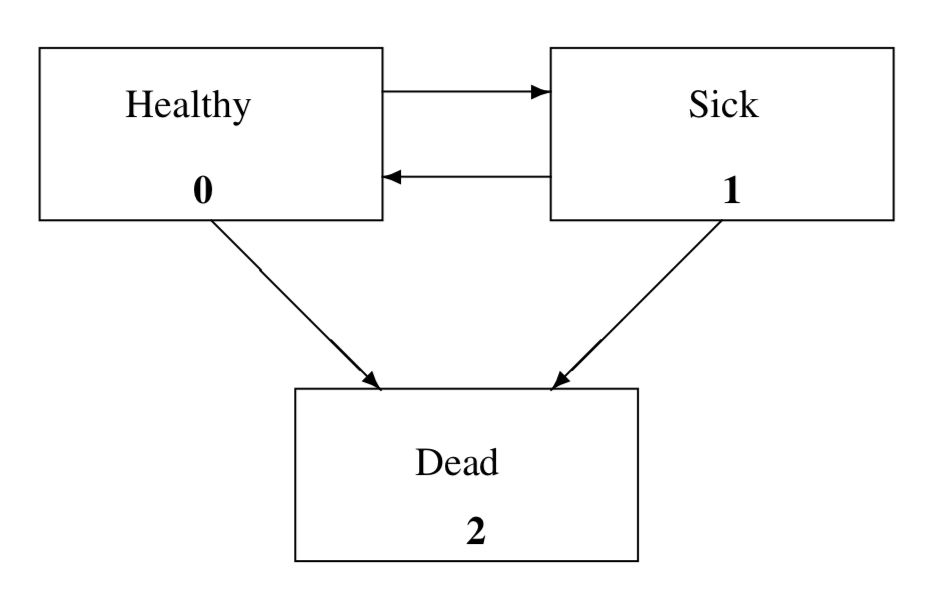
- Section 8.2.4: The disability income insurance model. Disability
income insurance pays a benefit during periods of sickness;
the benefit ceases on recovery. The next image shows an
appropriate model for a policy which provides an annuity while
the person is sick with premiums payable while the person is
healthy either when the person is becoming sick or dying.
- This model illustrates an important general feature of
multiple state models which was not present for models.
In terms of our interpretation of the model, this means
that several periods of sickness could occur before death,
with healthy periods in between.
- This model illustrates an important general feature of
multiple state models which was not present for models.
In terms of our interpretation of the model, this means
that several periods of sickness could occur before death,
with healthy periods in between.
Media attachments
Want to create your own Mind Maps for free with GoConqr? Learn more.