
39014704
Description

Mind Map by Ginna Paola Vargas, updated more than 1 year ago

|
Created by Ginna Paola Vargas
about 2 years ago
|
|
Logistics and the Logistics System
(Logistics Network)
- LOGISTICS
- Definition
- Is that part of the Supply Chain
process that plans, implements and
controls the efficient and effective
forward and reverse flow
- Handles the storage of
goods, services, and
related information from
the point of origin to the
point of consumption
- In order to meet customers' requirements
- In order to meet customers' requirements
- Handles the storage of
goods, services, and
related information from
the point of origin to the
point of consumption
- Is that part of the Supply Chain
process that plans, implements and
controls the efficient and effective
forward and reverse flow
- Logistics Classification
- By its content
- Pure Logistics
- Applied Logistics
- High-level
logistics
- Operational
Logistics
- Industrial,
commercial,
agricultural, military,
educational, IT,
hospital
- Industrial,
commercial,
agricultural, military,
educational, IT,
hospital
- High-level
logistics
- Pure Logistics
- By its function
- Procurement
Logistics
- Production
Logistics
- Distribution
Logistics
- Procurement
Logistics
- By its content
- Logistics functions
- supplying
- It refers to the
management of the
efficient procurement
and delivery of
materials, products, or
resources needed to
maintain a company's
operations
- It refers to the
management of the
efficient procurement
and delivery of
materials, products, or
resources needed to
maintain a company's
operations
- Storage
- It refers to the process
of receiving, storing,
and managing
products, raw
materials, or inputs at
a designated location
- It includes activities
such as: reception,
classification, stowage,
unloading, inventory
control, among others
- It includes activities
such as: reception,
classification, stowage,
unloading, inventory
control, among others
- It refers to the process
of receiving, storing,
and managing
products, raw
materials, or inputs at
a designated location
- Production
- It refers to the stage in the
supply chain where
products are manufactured
or assembled from raw
materials or components
- It involves the
planning,
management, and
control of the
manufacture of
products to meet
demand
- It involves the
planning,
management, and
control of the
manufacture of
products to meet
demand
- It refers to the stage in the
supply chain where
products are manufactured
or assembled from raw
materials or components
- Distribution
- It refers to the process in which
finished products or goods are
delivered from the point of
production or storage to end
customers
- It includes order
management,
warehousing and
transportation, as
well as order
receiving,
customer and
product invoicing.
- It includes order
management,
warehousing and
transportation, as
well as order
receiving,
customer and
product invoicing.
- It refers to the process in which
finished products or goods are
delivered from the point of
production or storage to end
customers
- Transport
- It refers to the physical
movement of products, goods,
or resources from a point of
origin to a point of destination
- It refers to the physical
movement of products, goods,
or resources from a point of
origin to a point of destination
- supplying
- Logistical characteristics
- Logistics requires the
integration of different
areas of a company
- It involves the
coordination of
activities and resources
in order to carry out
operations efficiently
- It must adapt to the
changes and needs of the
market
- It seeks to minimize the costs and
times of transportation, storage
and distribution
- It seeks to satisfy the needs and
requirements of customers,
guaranteeing the delivery of
products in a timely manner
- It seeks to satisfy the needs and
requirements of customers,
guaranteeing the delivery of
products in a timely manner
- It seeks to minimize the costs and
times of transportation, storage
and distribution
- It must adapt to the
changes and needs of the
market
- It involves the
coordination of
activities and resources
in order to carry out
operations efficiently
- Logistics requires the
integration of different
areas of a company
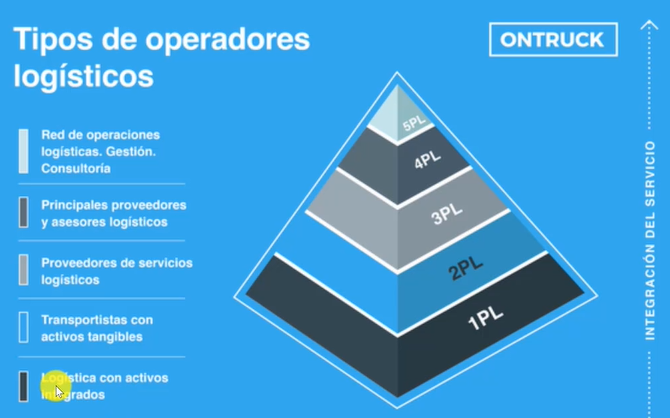
- Types of Logistics Operators
- 1 PL transport
- Logistics with
Integrated Assets
- Logistics with
Integrated Assets
- 2 PL transport or storage
- Carriers with
tangible assets
- Carriers with
tangible assets
- 3 PL Transport, storage and
logistics services
- Logistics
Service
Providers
- Logistics
Service
Providers
- 4 PL Supply Chain
Management (Management
of Different 3 PL) and IT
Integration
- Main Logistics
Suppliers and
Advisors
- Main Logistics
Suppliers and
Advisors
- 5 PL Supplier network management and
optimization, management of various
supply chains, integration of technology
and innovation
- Logistics Operations
Network. Management.
Consulting
- Logistics Operations
Network. Management.
Consulting
- 1 PL transport
- Definition
- Logistics system
(network logistics)
- Definition
- It refers to a set of
interconnected activities that
manage the flow of products,
information, and resources
throughout a supply chain
- With the aim of ensuring
efficient distribution and
meeting customer
needs
- This system covers from the
procurement of raw materials
to the final delivery of
products
- It involves aspects such
as transportation,
storage, inventory
management, and
planning
- It involves aspects such
as transportation,
storage, inventory
management, and
planning
- This system covers from the
procurement of raw materials
to the final delivery of
products
- With the aim of ensuring
efficient distribution and
meeting customer
needs
- It refers to a set of
interconnected activities that
manage the flow of products,
information, and resources
throughout a supply chain
- Objectives of the
logistics system
- Improved customer service
- Reduction of the Logistics Cycle
- Reduction in the cost of the logistics system
- Reduction in the cost of the logistics system
- Reduction of the Logistics Cycle
- Improved customer service
- The development of the
Logistics System involves
- 1. Conceive the company
functioning in integration
with its environment
- 2. Conceive of the enterprise as
a harmonious network of nodes
that begins in thethrough the
company, the suppliers, and
concludes and restarts in the
customer
- 3. Make timely decisions
based on system criteria
- 4. Systematic elimination of
waste, i.e. everything that
does not contribute value to
the product
- 5. Move from the philosophy of
selling products to the customer
to that of satisfying a customer
need, i.e. a philosophy of service
- 6. Integrate the criteria
and interests of
customers and
suppliers into decisions
- 7. Structure a flexible organization
that allows a high capacity to react
with competitive costs
- 8. Move from function
management to
process management
- 9. Adopt a total quality
management policy.
- 10. Consider the informational,
financial and material flows that
occur in the company as a single
flow
- 10. Consider the informational,
financial and material flows that
occur in the company as a single
flow
- 9. Adopt a total quality
management policy.
- 8. Move from function
management to
process management
- 7. Structure a flexible organization
that allows a high capacity to react
with competitive costs
- 6. Integrate the criteria
and interests of
customers and
suppliers into decisions
- 5. Move from the philosophy of
selling products to the customer
to that of satisfying a customer
need, i.e. a philosophy of service
- 4. Systematic elimination of
waste, i.e. everything that
does not contribute value to
the product
- 3. Make timely decisions
based on system criteria
- 2. Conceive of the enterprise as
a harmonious network of nodes
that begins in thethrough the
company, the suppliers, and
concludes and restarts in the
customer
- 1. Conceive the company
functioning in integration
with its environment
- Definition
- References
- Trujillo, J. (2020) Supply Chain Configuration [OVI].
- Pinzón, B. (2005). Logistics. Presentation. http://hdl.handle.net/10596/5682
- Prepared by: Ginna Paola Vargas
- Trujillo, J. (2020) Supply Chain Configuration [OVI].
Media attachments



Want to create your own Mind Maps for free with GoConqr? Learn more.