
4315495
Description

Mind Map by Andrew Cooper, updated more than 1 year ago

|
Created by Andrew Cooper
almost 10 years ago
|
|
Chapter 9: Intelligence & Psychological Testing
- Testing
- Testing Laws
- Reliability
Annotations:
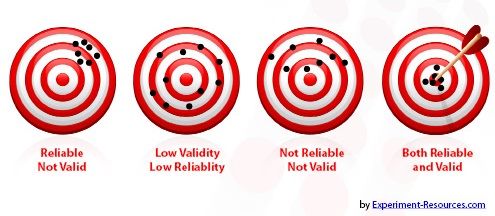
- Reliability is the degree to which an assessment tool produces stable and consistent results. Test-retest reliability is a measure of reliabilityobtained by administering the same test twice over a period of time to a group of individuals.
- Validity
Annotations:
- In the fields of psychological testing and educational testing, “Validity refers to the degree to which evidence and theory support the interpretations of test scores entailed by proposed uses of tests.”
- Content
Annotations:
- In psychometrics, content validity (also known as logical validity) refers to the extent to which a measure represents all facets of a given social construct.
- Criterion-related
Annotations:
- In psychometrics, criterion or concrete validity is the extent to which a measure is related to an outcome. Criterion validity is often divided into concurrent and predictive validity. Concurrent validity refers to a comparison between the measure in question and an outcome assessed at the same time.
- Construct
Annotations:
- Construct validity is “the degree to which a test measures what it claims, or purports, to be measuring.”
- Standardization
Annotations:
- While different types of tests and assessments may be “standardized” in this way, the term is primarily associated with large-scale tests administered to sizeable populations of students, such as a multiple-choice test given to all the eighth-grade public-school students in a particular state.
- Reliability
- Types
- Achievment
Annotations:
- An achievement test is a test of developed skill or knowledge. The most common type of achievement test is a standardized testdeveloped to measure skills and knowledge learned in a given grade level, usually through planned instruction, such as training or classroom instruction.
- Intelligence
Annotations:
- The intelligence test is a group of different questions, whose purpose is to determine the level of intelligence of the tested person. The average IQ is 100.
- Aptitude
Annotations:
- a test designed to determine a person's ability in a particular skill or field of knowledge.
- Personality
Annotations:
- A personality test is a questionnaire or other standardized instrument designed to reveal aspects of an individual's character or psychologicalmakeup.
- Achievment
- Testing Laws
- Intelligence
- IQ
- Old
Annotations:
- Ancient IQ tests
- Stanford-Binet
Annotations:
- The Stanford–Binet Intelligence Scale is an individually administered intelligence test that was revised from the original Binet-Simon Scale by Lewis M. Terman, a psychologist at Stanford University. The Stanford–Binet Intelligence Scale is now in its Fifth Edition.
- Mental Age
Annotations:
- Mental age is a concept related to intelligence. It looks at how a specific child, at a specific age—usually today, now—performs intellectually, compared to average intellectual performance for that physical age, measured in years.
- Chronological Age
Annotations:
- The actual age of a person
- Wechsler
Annotations:
- Creator of IQ tests most known for The WAIS-R, a revised form of the WAIS, was released in 1981 and consisted of six verbal and five performance subtests. The verbaltests were: Information, Comprehension, Arithmetic, Digit Span, Similarities, and Vocabulary.
- New
Annotations:
- Modern IQ tests
- Bell Curve (Normal Distribution)
Annotations:
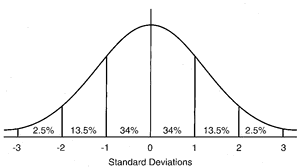
- About 68% of values drawn from a normal distribution are within one standard deviation σ away from the mean; about 95% of the values lie within two standard deviations; and about 99.7% are within three standard deviations. This fact is known as the 68-95-99.7 (empirical) rule, or the 3-sigma rule.
- Extremes
- Giftedness
Annotations:
- Intellectual giftedness is an intellectual ability significantly higher than average. It is a characteristic of children, variously defined, that motivates differences in school programming.
- Disability
Annotations:
- Intellectual disability is a disability characterized by significant limitations in both intellectual functioning and in adaptive behavior, which covers many everyday social and practical skills. This disabilityoriginates before the age of 18.
- Giftedness
- Old
- Types
- Sternberg's triarchic theory
Annotations:
- The triarchic theory of intelligence was formulated by Robert J. Sternberg, a prominent figure in the research of human intelligence. The theory by itself was groundbreaking in that it was among the first to go against the psychometric approach to intelligence and take a more cognitive approach.
- Gardner's eight
Annotations:
- Linguistic intelligence ("word smart") Logical-mathematical intelligence ("number/reasoning smart") Spatial intelligence ("picture smart")Bodily-Kinesthetic intelligence ("body smart")Musical intelligence ("music smart")Interpersonal intelligence ("people smart")Intrapersonal intelligence ("self smart")Naturalist intelligence ("nature smart")
- Emotional
Annotations:
- Emotional intelligence (EI) or emotional quotient (EQ) is the ability of individuals to recognize their own and other people's emotions, to discriminate between different feelings and label them appropriately, and to use emotional information to guide thinking and behavior.
- Sternberg's triarchic theory
- Creativity
Annotations:
- A type of knowledge that does not necessarily fall within the realm of intelligence. Original ideas and concepts.
- IQ
Media attachments


Want to create your own Mind Maps for free with GoConqr? Learn more.