
Mind map
cranial nerves
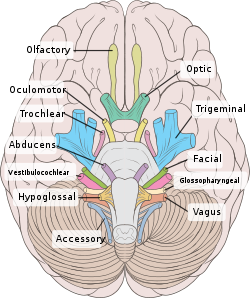
Map content
cranial nerves
CN I: olfactory
- (S) function: smell
- origin: olfactory receptor neurons in olfactory mucosa
- location: cribriform plate of ethmoid bone
- origin: olfactory receptor neurons in olfactory mucosa
- (S) function: smell
CN II: optic
- (S) function: vision
- origin: retinal ganglion cells
- location: optic canal
- origin: retinal ganglion cells
- (S) function: vision
CN III: occulomtor
- (M) function: most eye movements, pupillary constriction
- origin: midbrain (anterior aspect)
- location: superior orbital fissure
- origin: midbrain (anterior aspect)
- (M) function: most eye movements, pupillary constriction
CN IV: trochlear
- (M) function: superior oblique (depresseseye and rotates laterally)
- origin: midbrain (dorsal/ posterior aspect)
- location: superior orbital fissure
- origin: midbrain (dorsal/ posterior aspect)
- (M) function: superior oblique (depresseseye and rotates laterally)
CN V- trigeminal
- (S+M) function: sensation from face, muscles of mastication
- V1: opthalmic
- (S) function: sensation from forehead, nose
- origin: pons
- location: superior orbital fissure
- origin: pons
- (S) function: sensation from forehead, nose
- V2: maxillary
- (S) function: sensation from cheeks, upper lip
- origin: pons
- location: foramen rotundum
- origin: pons
- (S) function: sensation from cheeks, upper lip
- V3: mandibular
- (S+M) function: sensation from chin, jaw, mouth, muscles of mastication
- origin: pons
- location: foramen ovale
- origin: pons
- (S+M) function: sensation from chin, jaw, mouth, muscles of mastication
- V1: opthalmic
- (S+M) function: sensation from face, muscles of mastication
CN VI: abducens
- (M) function: lateral rectus (abducts the eye)
- origin: pons (nuclei underlying floor of 4th ventricle)
- location: superior orbital fissure
- origin: pons (nuclei underlying floor of 4th ventricle)
- (M) function: lateral rectus (abducts the eye)
CN VIII: vestibulocochlear
- (S) function: proprieception; acoustic branch: hearing, vestibular branch: equilibrium
- origin: CB pontine angle, lateral to CN VII
- location: internal acoustic canal
- origin: CB pontine angle, lateral to CN VII
- (S) function: proprieception; acoustic branch: hearing, vestibular branch: equilibrium
CN IX: glossopharyngeal
- (S+M) function: taste (posterior 1/3 of tongue), sensation from tonsils, senses carotid BP from carotid arteries and sinus, stylopharyngeus (swallowing, larynx, pharynx), parotid gland secretion (salivary gland back of mouth)
- origin: medulla
- location: jugular foramen
- origin: medulla
- (S+M) function: taste (posterior 1/3 of tongue), sensation from tonsils, senses carotid BP from carotid arteries and sinus, stylopharyngeus (swallowing, larynx, pharynx), parotid gland secretion (salivary gland back of mouth)
CN VII: facial
- (S+M) function: taste (anterior 2/3 of tongue), muscles of facial expression, lacrimal + salivary gland secretion
- origin: pons (CB pontine angle) above olive, medial to CN VIII
- location: runs through acoustic canal, then through facial canal, exiting at stylomastoid foramen
- origin: pons (CB pontine angle) above olive, medial to CN VIII
- (S+M) function: taste (anterior 2/3 of tongue), muscles of facial expression, lacrimal + salivary gland secretion
CN X: vagus
- (S+M) function: taste (epiglottis), sensation from meninges, pharynx, senses aortic BP at aortic arch, muscles in pharynx and larynx, parasympathetic (ie rest and digest) fibres to heart, lungs, digestive tract
- origin: medulla (posterolateral sulcus)
- location: jugular foramen
- origin: medulla (posterolateral sulcus)
- (S+M) function: taste (epiglottis), sensation from meninges, pharynx, senses aortic BP at aortic arch, muscles in pharynx and larynx, parasympathetic (ie rest and digest) fibres to heart, lungs, digestive tract
CN XI: (spinal) accessory
- (M) function: trapezius and sternocleidomastoid (shrug and head movements)
- origin: cranial and spinal roots
- location: jugular foramen
- origin: cranial and spinal roots
- (M) function: trapezius and sternocleidomastoid (shrug and head movements)
CN XII: hypoglossal
- (M) function: tongue muscles (speech articulation and swallowing/bolus formation)
- origin: medulla
- location: hypoglossal canal
- origin: medulla
- (M) function: tongue muscles (speech articulation and swallowing/bolus formation)
Images and files in the map
Information
- Description
- Mind Map on cranial nerves, created by Danielle Morley on 11/01/2014.
- Created by
- Danielle Morley
- Views
- 75
- Rating