
Mind map
Cloud
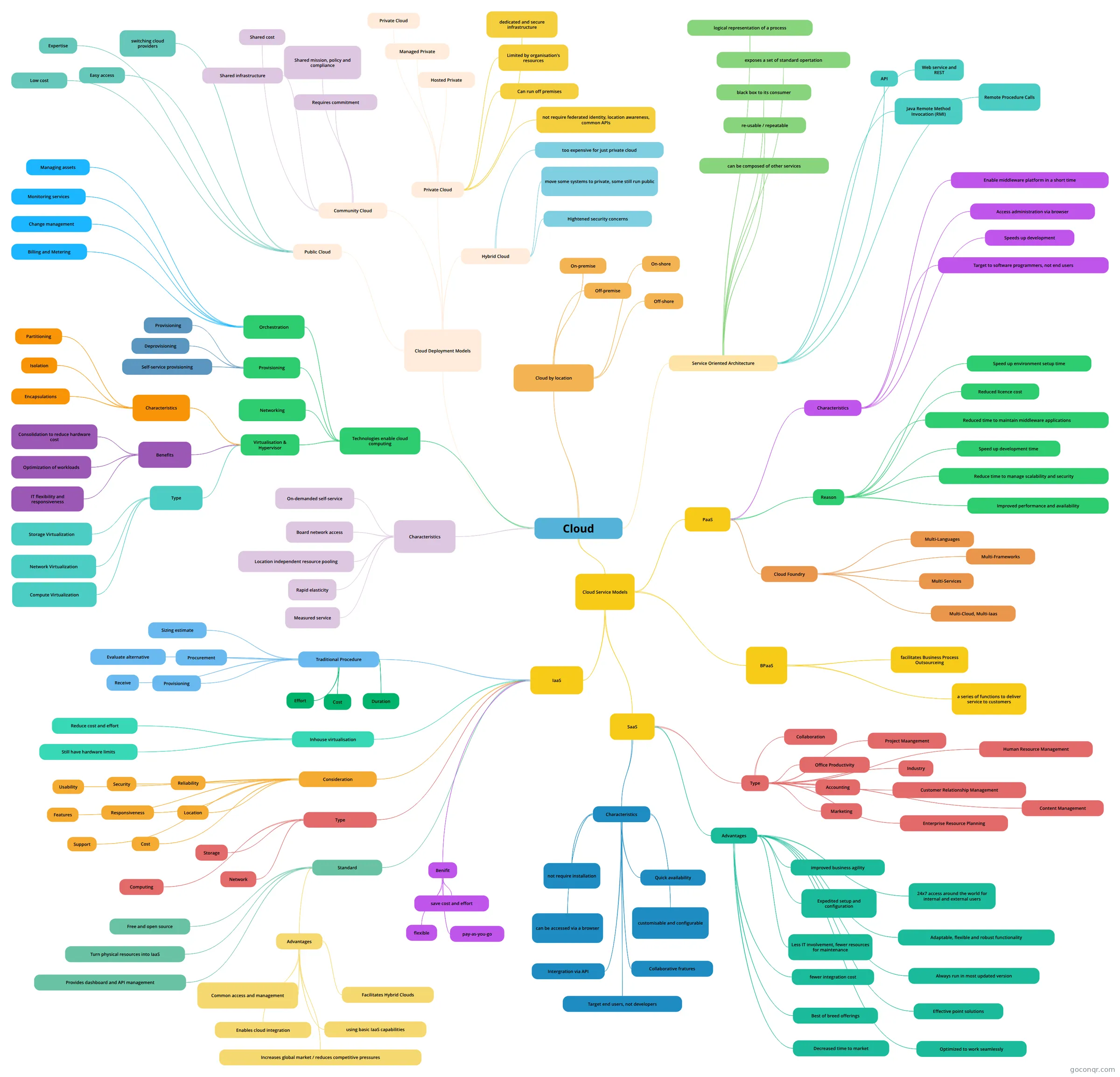
Mind map: Cloud computing concepts and models
Map content
Cloud
Characteristics
- On-demanded self-service
- Board network access
- Location independent resource pooling
- Rapid elasticity
- Measured service
Technologies enable cloud computing
- Orchestration
- automated coordination and management of IT resoources are management issue that need to be deal with
- Managing assets
- Monitoring services
- Change management
- Billing and Metering
- Provisioning
- Process of making computing resources available to users
- Provisioning
- Deprovisioning
- Self-service provisioning
- Networking
- Neede for high-speed network
- Virtualisation & Hypervisor
- Hypervision allow muti-operation system in same machine, which allow virtualisation
- Characteristics
- Partitioning
- Isolation
- Encapsulations
- Benefits
- Consolidation to reduce hardware cost
- Optimization of workloads
- IT flexibility and responsiveness
- Type
- Storage Virtualization
- Network Virtualization
- Compute Virtualization
- Orchestration
Cloud Service Models
- Must enable Multitenancy
- IaaS
- computer, storage and networking as a service
- Traditional Procedure
- Sizing estimate
- Evaluate alternative
- Procurement
- Receive
- Provisioning
- Effort
- 100 - 200 person-hour
- Duration
- 6-9 months
- Cost
- cost vary greatly
- Inhouse virtualisation
- Reduce cost and effort
- Still have hardware limits
- Type
- Computing
- extra server, stand up instance of virtual machine on the cloud, can specify computer configuration
- Storage
- extra storage on the cloud, can specify database parameters such as Data Center, size, data redundancy options and format
- Network
- when need to manage netwok and IP address, virtual private network, can specify IP address range, subnets configuration, route table, network gateway, network security
- Computing
- Benifit
- save cost and effort
- pay-as-you-go
- flexible
- Consideration
- Reliability
- Security
- Usability
- Features
- Responsiveness
- Location
- Support
- Cost
- Standard
- Free and open source
- Turn physical resources into IaaS
- Provides dashboard and API management
- Advantages
- Common access and management
- Facilitates Hybrid Clouds
- Enables cloud integration
- using basic IaaS capabilities
- Increases global market / reduces competitive pressures
- PaaS
- provide middleware and development tools
- Characteristics
- Enable middleware platform in a short time
- enables middleware platform to be deployed in a short time without the need to provision hardware or software
- Access administration via browser
- Speeds up development
- speed up when use with API providing services
- Target to software programmers, not end users
- Enable middleware platform in a short time
- Reason
- Speed up environment setup time
- can use pre-built platform and server rather then setup all by oneself
- Reduced licence cost
- not necessary to have full licence for all software
- Reduced time to maintain middleware applications
- cons - lose some control over middleware versions, depending on vendor
- Speed up development time
- use of API
- Reduce time to manage scalability and security
- Improved performance and availability
- Speed up environment setup time
- Cloud Foundry
- Multi-Languages
- Multi-Frameworks
- Multi-Services
- Multi-Cloud, Multi-Iaas
- SaaS
- software application
- Characteristics
- not require installation
- can be accessed via a browser
- Quick availability
- customisable and configurable
- Intergration via API
- Collaborative fratures
- Target end users, not developers
- Advantages
- improved business agility
- Less IT involvement, fewer resources for maintenance
- fewer integration cost
- Best of breed offerings
- Decreased time to market
- 24x7 access around the world for internal and external users
- Always run in most updated version
- Effective point solutions
- Optimized to work seamlessly
- Expedited setup and configuration
- Adaptable, flexible and robust functionality
- Type
- Collaboration
- Office Productivity
- Accounting
- Marketing
- Project Maangement
- Industry
- Customer Relationship Management
- Enterprise Resource Planning
- Human Resource Management
- Content Management
- BPaaS
- specialised type of SaaS that cover the entire business process
- facilitates Business Process Outsourceing
- a series of functions to deliver service to customers
Cloud Deployment Models
- Public Cloud
- Low cost
- Expertise
- Easy access
- switching cloud providers
- Community Cloud
- shared private cloud
- Shared infrastructure
- Shared cost
- Shared mission, policy and compliance
- Requires commitment
- Private Cloud
- dedicated and secure infrastructure
- Limited by organisation's resources
- Can run off premises
- not require federated identity, location awareness, common APIs
- Managed Private
- located in organization's own data center, operated and managed by external vendor
- Hosted Private
- resides in vendor's data center, operated and managed by vendor, owned by organisation
- Private Cloud
- organisation owns and operates
- Hybrid Cloud
- too expensive for just private cloud
- move some systems to private, some still run public
- Hightened security concerns
- Public Cloud
Cloud by location
- On-premise
- Off-premise
- On-shore
- Off-shore
Service Oriented Architecture
- Distributed computing
- logical representation of a process
- exposes a set of standard opertation
- black box to its consumer
- re-usable / repeatable
- can be composed of other services
- API
- Web service and REST
- Remote Procedure Calls
- Java Remote Method Invocation (RMI)