
543122
Description

Mind Map by goldengirl987, updated more than 1 year ago

|
Created by goldengirl987
almost 12 years ago
|
|
Propaganda Model
- Cultural
Phenomenom
- A cultural phenomenon is also known as the bandwagon effect. It
describes the behaviour where individuals are likely to believe and
do things just because other individuals do as well for example,
elections.
- Elections
- Size, Ownership and Profit Orientation
- Barzilian Elections 2010 - Lula (ex- president) and Dilma (current president)
combined to increase the profit and size of her campaign using his ideas in the
hope of persuading the public that the bigger the party is, the more political
action they can address. The impact of this convergence was shown through the
media in a positive light and therefore that they are the ones who should be
running the country.
- Barzilian Elections 2010 - Lula (ex- president) and Dilma (current president)
combined to increase the profit and size of her campaign using his ideas in the
hope of persuading the public that the bigger the party is, the more political
action they can address. The impact of this convergence was shown through the
media in a positive light and therefore that they are the ones who should be
running the country.
- Advertising
- Negative Advertising: In any election campain, negative advertising is a
strategy used by many parties to compromize the other with sometimes
false acusations or hidden information This has been evident with Ed
Miliband, and how the Mass Media creates a stereotypical, and even
comical representation of him, manipulates audiences to feel swayed to a
different political party, and may want to support Liberal Democrats or
the Conservatives, all because of a negative representation..
- Negative Advertising: In any election campain, negative advertising is a
strategy used by many parties to compromize the other with sometimes
false acusations or hidden information This has been evident with Ed
Miliband, and how the Mass Media creates a stereotypical, and even
comical representation of him, manipulates audiences to feel swayed to a
different political party, and may want to support Liberal Democrats or
the Conservatives, all because of a negative representation..
- Anti - Communism/ Fear
- This has been highlighted
predominantly in the USA, the people
running to be President project an
image to the public that the country is
in a constant state of threats e.g.
terrorism, and that these people
running for President are the ones
who can prevent this.
- This has been highlighted
predominantly in the USA, the people
running to be President project an
image to the public that the country is
in a constant state of threats e.g.
terrorism, and that these people
running for President are the ones
who can prevent this.
- Sourcing
- Owners of big transnational conglomerates, such as
Rupert Murdoch (year) as a dominate producer of
source which have affected past general elections.It has
made evident that there is a parallel relationship between
the party the Sun newspaper has backs up and the winner
of the general election. The sourcing of information the
mass media uses is key, e.g., interviews with past
winners can influence reader's choice.
- Owners of big transnational conglomerates, such as
Rupert Murdoch (year) as a dominate producer of
source which have affected past general elections.It has
made evident that there is a parallel relationship between
the party the Sun newspaper has backs up and the winner
of the general election. The sourcing of information the
mass media uses is key, e.g., interviews with past
winners can influence reader's choice.
- Flak
- In 2012 Obama's eligibility was challenged by numerous
lawsuits in states like Ohio, North Carolina, Hawaii and
many others. For example in June 2012, Sibley filed a
lawsuit saying that Obama was unable to run for president
of the USA, as he was not born there
- In 2012 Obama's eligibility was challenged by numerous
lawsuits in states like Ohio, North Carolina, Hawaii and
many others. For example in June 2012, Sibley filed a
lawsuit saying that Obama was unable to run for president
of the USA, as he was not born there
- Size, Ownership and Profit Orientation
- A cultural phenomenon is also known as the bandwagon effect. It
describes the behaviour where individuals are likely to believe and
do things just because other individuals do as well for example,
elections.
- Theory background
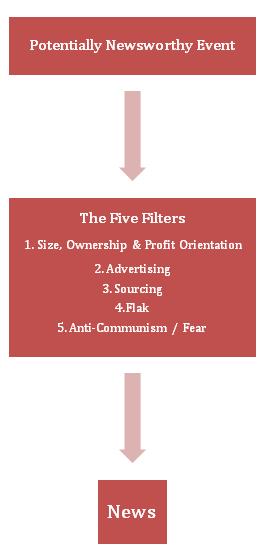
- Herman and Chomsky’s model is based on the notion that the
content of news media is determined only once this content
has passed through a series of five ‘filters’, a screening process
wherein those potential news stories that fail to comply with
the demands of any of the filters are essentially ‘filtered out’ of
the news media – receiving little or no coverage. Herman and
Chomsky view these filters as being fundamentally bound to
the power dynamics that take place around the media industry
so that they ultimately amount to little more than a propaganda
campaign that serves to protect or further the interests of the
groups that hold the greatest power in this field.
- Herman and Chomsky’s model is based on the notion that the
content of news media is determined only once this content
has passed through a series of five ‘filters’, a screening process
wherein those potential news stories that fail to comply with
the demands of any of the filters are essentially ‘filtered out’ of
the news media – receiving little or no coverage. Herman and
Chomsky view these filters as being fundamentally bound to
the power dynamics that take place around the media industry
so that they ultimately amount to little more than a propaganda
campaign that serves to protect or further the interests of the
groups that hold the greatest power in this field.
- Uses
- New corporations use the filters to
determin what is newsworthy based on the
factors that affect them, socially. politically
and economically
- New corporations use the filters to
determin what is newsworthy based on the
factors that affect them, socially. politically
and economically
- Filters
- Sourcing
- It is essential for News Media to have an ever-constant
supply of stories to release; consequently, many news media
organisations tend to rely on particular sources they can turn
to recurrently for information on events and stories that they
can expect to have a strong degree of credibility. This can be
accomplished when turning to sources that have a
pre-established presence of authority that is recognised by
the general public (such as judicial, political, or government
bodies as well as large, well-known corporations or
institutions).
- Through this, media professionals can appear to legitimise
their work / stories and strengthen their claim at objectivity
in citing so-called ‘official’ sources that the public would
assume to be reliable and credible, rather than having to go
through the potentially problematic and even costly process
of thoroughly verifying and cross-checking the information
they received from less well-respected or less
well-recognised sources.
- However, this can lead to these allegedly ‘official’ sources
holding a significant amount of influence over the news media
through the information they supply. Furthermore, media
professionals may feel hesitant to release information that may
challenge that of their ‘official’ sources and their interests due to
their own reliance on these sources to continue obtaining stories
in the future.
- However, this can lead to these allegedly ‘official’ sources
holding a significant amount of influence over the news media
through the information they supply. Furthermore, media
professionals may feel hesitant to release information that may
challenge that of their ‘official’ sources and their interests due to
their own reliance on these sources to continue obtaining stories
in the future.
- Through this, media professionals can appear to legitimise
their work / stories and strengthen their claim at objectivity
in citing so-called ‘official’ sources that the public would
assume to be reliable and credible, rather than having to go
through the potentially problematic and even costly process
of thoroughly verifying and cross-checking the information
they received from less well-respected or less
well-recognised sources.
- It is essential for News Media to have an ever-constant
supply of stories to release; consequently, many news media
organisations tend to rely on particular sources they can turn
to recurrently for information on events and stories that they
can expect to have a strong degree of credibility. This can be
accomplished when turning to sources that have a
pre-established presence of authority that is recognised by
the general public (such as judicial, political, or government
bodies as well as large, well-known corporations or
institutions).
- Flak
- Referring to the negative responses a media article/program/statement may
receive, the success of ‘flak’ is particularly linked to questions of power. In
this sense, the more powerful the organization, the greater gravity the flak
they produce can have for the ‘offending’ media organisation (such as
potentially expensive lawsuits).
- Thus, media industries may tend have
become conditioned to avoid certain topics
that could otherwise result in provoking
powerful companies or political bodies to
resort to flak.
- Thus, media industries may tend have
become conditioned to avoid certain topics
that could otherwise result in provoking
powerful companies or political bodies to
resort to flak.
- Referring to the negative responses a media article/program/statement may
receive, the success of ‘flak’ is particularly linked to questions of power. In
this sense, the more powerful the organization, the greater gravity the flak
they produce can have for the ‘offending’ media organisation (such as
potentially expensive lawsuits).
- Anti- Communism/ Fear
- The original premise of this filter considered how
Western media was influenced by the West’s Cold War
conflict against communist nations (principally the
USSR) and communist ideology in itself. The effects of
this conflict included promoting a strongly
anti-communist stance in news media, which
contributed to harshly dissuading any internal
communist movement from arising.
- Presently (after the decline of communism), this filter has been
reconceived as ‘fear’, now more generally considering how news media
may tend to work to harbour sentiments of fear within their public to thus
unite them in fervent opposition against a common enemy (such as
terrorists).
- Presently (after the decline of communism), this filter has been
reconceived as ‘fear’, now more generally considering how news media
may tend to work to harbour sentiments of fear within their public to thus
unite them in fervent opposition against a common enemy (such as
terrorists).
- The original premise of this filter considered how
Western media was influenced by the West’s Cold War
conflict against communist nations (principally the
USSR) and communist ideology in itself. The effects of
this conflict included promoting a strongly
anti-communist stance in news media, which
contributed to harshly dissuading any internal
communist movement from arising.
- Advertising
- Another group whose interests
may influence or take
precedence over what is
considered newsworthy is that
of advertisers. As such,
advertising revenue tends to
serve as the primary source of
income for news media outlets
such as newspapers,
magazines, television
programs, etc.
- To this effect, media content may be
tailored in such a way that it can appeal to
advertisers’ interests (such as what type of
audience it is popularly received by and
what style of content or views it may
present) and thus attract their sponsorship.
- Additionally, media professionals may be dissuaded from
releasing content that may offend or in any way alienate
their sponsoring advertisers.
- Additionally, media professionals may be dissuaded from
releasing content that may offend or in any way alienate
their sponsoring advertisers.
- To this effect, media content may be
tailored in such a way that it can appeal to
advertisers’ interests (such as what type of
audience it is popularly received by and
what style of content or views it may
present) and thus attract their sponsorship.
- Another group whose interests
may influence or take
precedence over what is
considered newsworthy is that
of advertisers. As such,
advertising revenue tends to
serve as the primary source of
income for news media outlets
such as newspapers,
magazines, television
programs, etc.
- Size, Ownership & Profit
Oreintation
- It is important to appreciate
that the news media form
and function as an industry –
an industry with high-value
stock market stakes that
make it very attractive for
powerful corporation
investments.
- Moreover, despite the
exponential growth of the media
over time, power over the
industry is concentrated into
only around 29 large media
corporations.
- Thus, this filter deals with how the content of news media may
be affected by the market motivations or particular interests of
the corporation that manages it or, more specifically the
owners and directors of the companies themselves.
- Thus, this filter deals with how the content of news media may
be affected by the market motivations or particular interests of
the corporation that manages it or, more specifically the
owners and directors of the companies themselves.
- Moreover, despite the
exponential growth of the media
over time, power over the
industry is concentrated into
only around 29 large media
corporations.
- It is important to appreciate
that the news media form
and function as an industry –
an industry with high-value
stock market stakes that
make it very attractive for
powerful corporation
investments.
- Sourcing
Media attachments
Want to create your own Mind Maps for free with GoConqr? Learn more.