Zulu rules

Description

Scheduled for deletion Mind Map on Zulu rules, created by Jethro Broughton on 18/10/2016.
Jethro Broughton
Mind Map by Jethro Broughton, updated more than 1 year ago
Jethro Broughton
Created by Jethro Broughton about 9 years ago
7
1

Resource summary

Zulu rules
  1. commands
    1. Ordinary verbs
      1. eg. Linda! - Wait!
      2. When speaking to one person or people
        1. Drop the first vowel of the person/s being addressed
          1. eg. Ngena mfundi! - Enter Student!
          2. In plural the verb suffixes a -ni
            1. eg. Ngenani bafundi! - Enter Students!
          3. Monosyllabic verbs
            1. prefix a yi-
              1. eg. Yidla Bafundi! - Eat Students!
            2. Negatives
              1. Negative consists of musa and uku- to the verb
                1. Plural: the musa takes the -ni suffix
                  1. eg. Musani ukudlala ibhola, bantwana! - Don't play soccer, children!
                  2. eg. Musa ukudlala ibhola, mtwana! - Don't play soccer, child!
                    1. If the verb starts with a, e, i, u the verb must take an ukw- prefix
                      1. If the verb starts with o the verb must take an uk- prefix
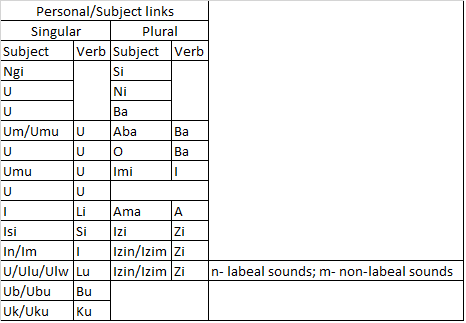
                  3. Subject links
                    1. Prefixes
                    2. questions
                      1. Who = -bani
                        1. How= -njani
                          1. What= -ni
                            1. For what/Why = -elani
                              1. Where = -phi/kuphi
                                1. With who = nobani
                                  1. When = nini
                                    1. hey = na
                                      1. by means of what/about what = ngani
                                      2. infinitive
                                        1. the verb prefixes uku-
                                          1. if the verb starts with an a/e the uku changes to ukw-
                                            1. if the verb starts with an o the uku changes to uk-
                                          2. locatives
                                            1. City or Town
                                              1. if the location ends with a ...... it takes a .......
                                                1. a = -eni
                                                  1. e = -eni
                                                    1. i = -ini
                                                      1. o = -weni
                                                        1. u = -wini
                                                        2. the initial vowel becomes an e
                                                        3. place / property = a kwa- prefix in front of the place / property
                                                          1. personal noun = a k- prefix in front of the personal noun
                                                            1. to or from a personal noun: a k- prefix gets added
                                                              1. group 11 and 14 prefix an o-
                                                              2. Na and Nga
                                                                1. Na = and/ with/ even/ too/ also and can be used to show possession
                                                                  1. Na + a = Na; Na + e = Ne; Na + i = Ne; Na + o = No; Na + u = No
                                                                    1. Possession = Subject link + Na + Thing possessed
                                                                    2. Nga = with or by means of / modes of transport (by) / time reference (at/ on/ in) / about and can (only used with verbs)
                                                                      1. Nga + a = Nga; Nga + e = Nge; Nga + i = Nge; Nga + o = Ngo; Nga + u = Ngo
                                                                      2. Possessives
                                                                        1. Special cases
                                                                          1. ulu- + a- = lw-
                                                                            1. a + u = w-
                                                                              1. a + i = y-
                                                                                1. a + a = a-
                                                                                2. personal pronouns
                                                                                  1. Noun class prefix + a + -mi (my)/ -kho (your)/ -khe (his/hers)
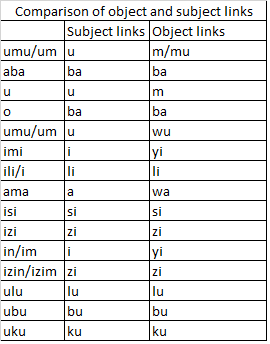
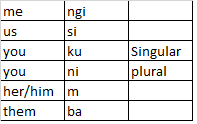
                                                                                3. Object links
                                                                                  1. Uya + object link + verb
                                                                                    1. Exceptions
                                                                                      1. Weak links: U = -m-/-mu-; u = -wu-; i = -yi-; a = -wa-
                                                                                    2. Negatives
                                                                                      1. The verb takes an a- prefix
                                                                                        1. Present = -i
                                                                                          1. Future = -a
                                                                                            1. Past = -anga
                                                                                            2. if the verb has a vowel at the start the verbs vowel take presidence
                                                                                              1. for the umu/um and u classes the prefix is aka-
                                                                                                1. a + u = awu for class 3
                                                                                                2. Tenses
                                                                                                  1. Past
                                                                                                    1. verb takes -e (object after verb) or -ile (no object after verb) as a suffix
                                                                                                    2. Present
                                                                                                      1. ya- is used when there is no object in the sentence
                                                                                                      2. Future
                                                                                                        1. verb link + zo + verb stem
                                                                                                          1. when there is no subject= -zok- / -zoku-
                                                                                                        2. Polite requests
                                                                                                          1. requesting an object
                                                                                                            1. Ngicela ..... object
                                                                                                            2. requesting to do something yourself
                                                                                                              1. Ngicela ..... uku- + verb
                                                                                                              2. requesting that someone else do something
                                                                                                                1. Ngicela ..... u-/ni- + verb + -e
                                                                                                                2. Negative
                                                                                                                  1. Singular= U + nga + verb + i
                                                                                                                    1. Plural= Ni + nga + verb + i
                                                                                                                  Show full summary Hide full summary

                                                                                                                  Similar