
7504926
Description

Mind Map by Anthony Rath, updated more than 1 year ago

|
Created by Anthony Rath
almost 9 years ago
|
|
Unit 2 - Particles and
radiation
- Constituents of the atom
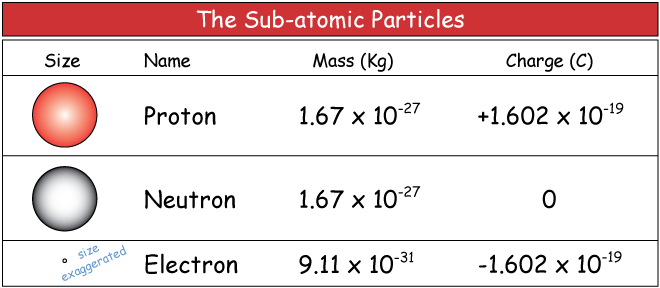
- Charge & Masses
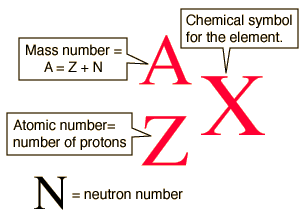
- AXZ Notation
- DEFINITION OF AN ISOTOPE
- Each of two or more
forms of the same
element that contain
equal numbers of
protons but different
numbers of neutrons.
- Each of two or more
forms of the same
element that contain
equal numbers of
protons but different
numbers of neutrons.
- Charge & Masses
- Stable and unstable nuclei
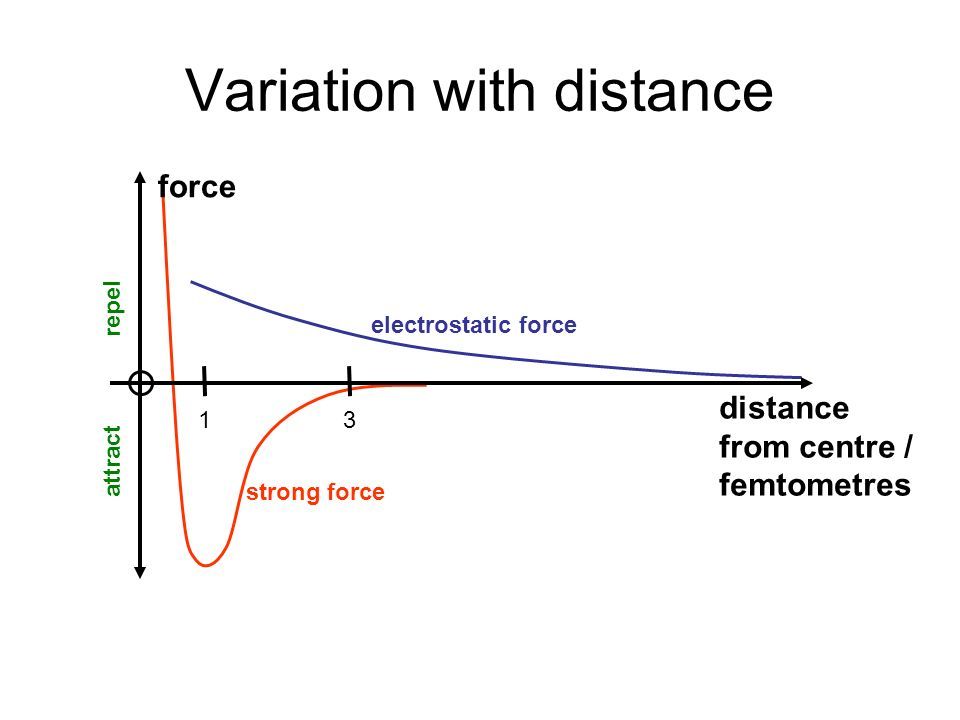
- STRONG NUCLEAR FORCE
- The strong nuclear force; its role in
keeping the nucleus stable;
short-range attraction up to
approximately 3 fm, very-short range
repulsion closer than approximately
0.5 fm.
- The strong nuclear force; its role in
keeping the nucleus stable;
short-range attraction up to
approximately 3 fm, very-short range
repulsion closer than approximately
0.5 fm.
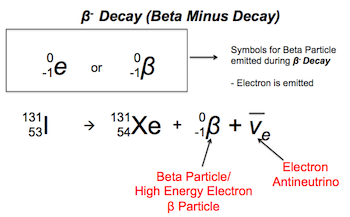
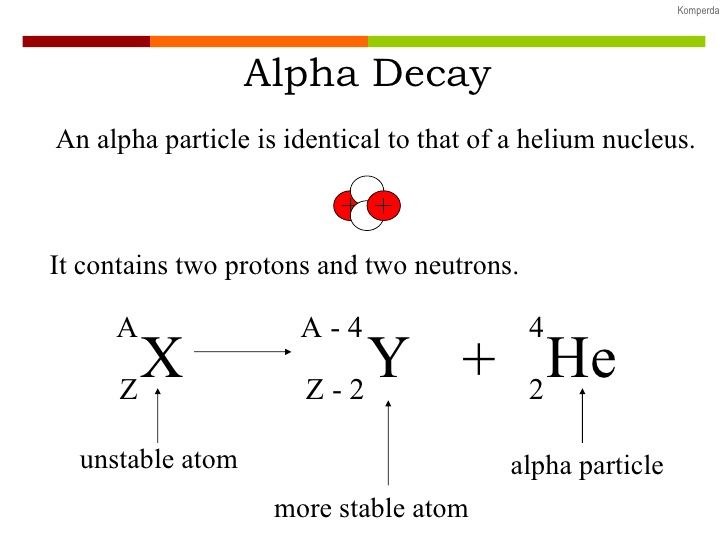
- ALPHA AND BETA
DECAY
- Unstable nuclei;
alpha and beta
decay
- The existence of
the neutrino was
hypothesised to
account for
conservation of
energy in beta
decay
- Unstable nuclei;
alpha and beta
decay
- STRONG NUCLEAR FORCE
- Particle interactions
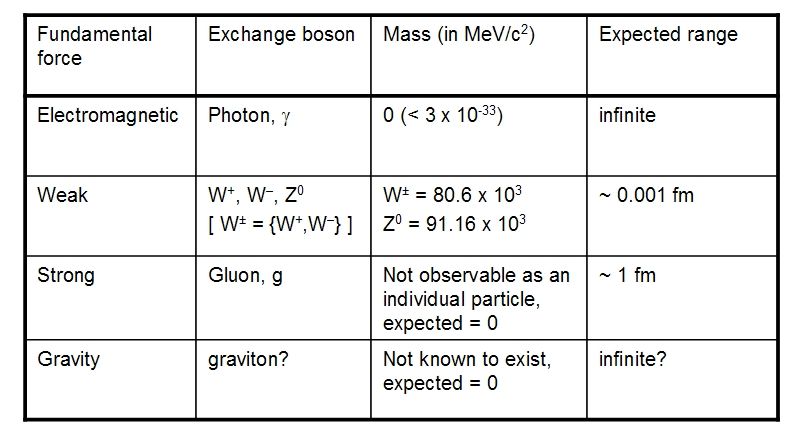
- FUNDAMENTAL INTERACTIONS
- Four fundamental
interactions: gravity,
electromagnetic, weak
nuclear, strong
nuclear. (The strong
nuclear force may be
referred to as the
strong interaction.)
- Exchange
Particles
- The weak interaction is
limited to β− and β+ decay,
electron capture and
electron–proton collisions; W+
and W− as the exchange
particles.
- Four fundamental
interactions: gravity,
electromagnetic, weak
nuclear, strong
nuclear. (The strong
nuclear force may be
referred to as the
strong interaction.)
- FUNDAMENTAL INTERACTIONS
- Particles, antiparticles and photons
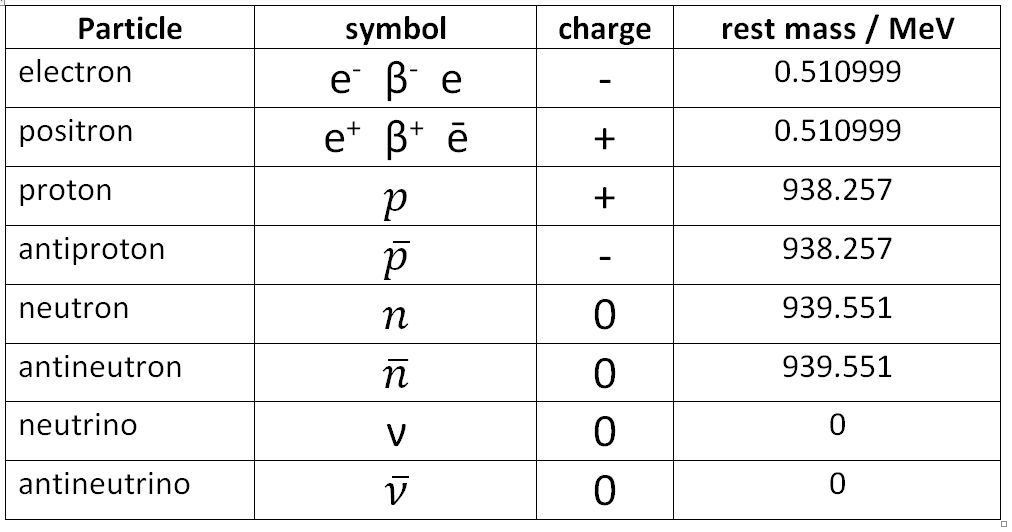
- For every type of
particle, there is a
corresponding
antiparticle.
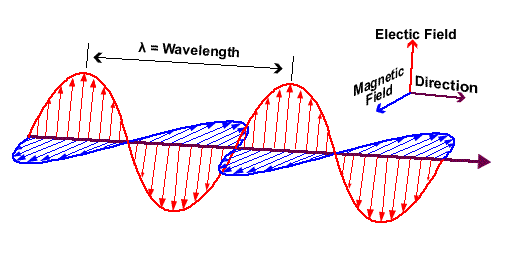
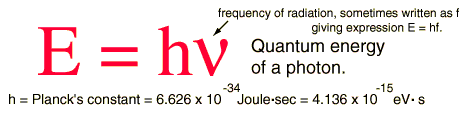
- Photon model of electromagnetic radiation
- Planck's constant
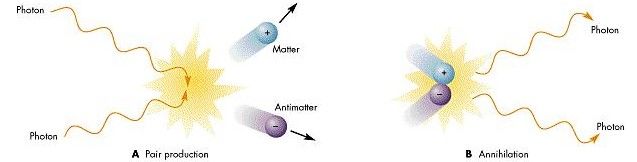
- Annihilation and pair production
- Particle Table
- For every type of
particle, there is a
corresponding
antiparticle.
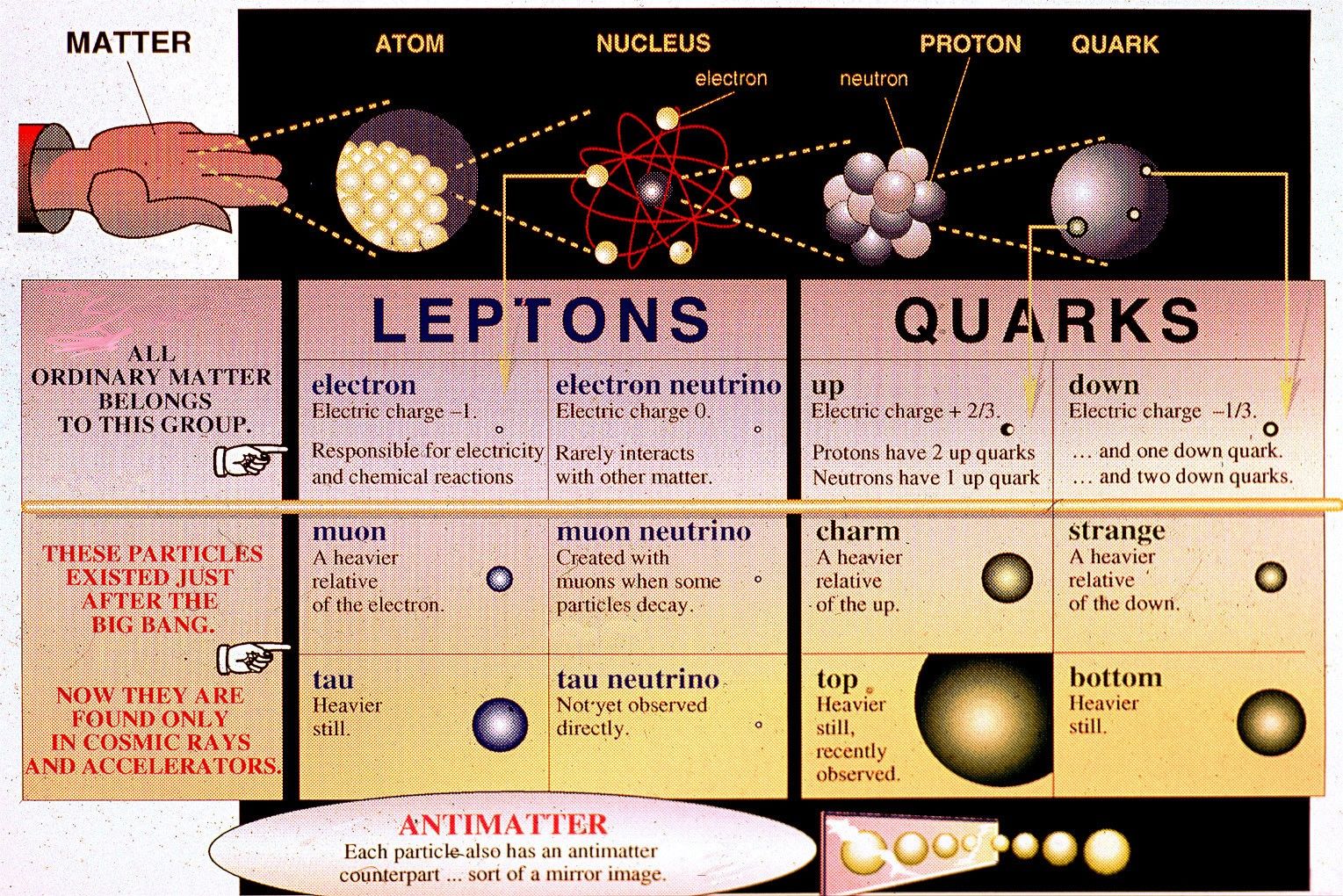
- Classification of particles
- Muons and tau
particles decay
into electrons.
- Conservation of
strangeness in
strong
interactions, but
not guaranteed in weak
interactions
- Strangeness
can change by
0, +1 or -1 in
weak
interactions.
- Strangeness
can change by
0, +1 or -1 in
weak
interactions.
- The pion is the
exchange particle
of the strong
nuclear force.
- Kaon+
Decay
- The decay of a
kaon ( K+ ) into
three pions (2 π+ ,
1 π− ) is a process
that involves both
weak and strong
interactions.
- Weak interactions :
The strange
antiquark ( s ) of the
kaon transmutes into
an up antiquark ( u )
by the emission of a
W+ boson; the W+
boson subsequently
decays into a down
antiquark ( d ) and an
up quark ( u )
- Strong
interactions : An
up quark ( u )
emits a gluon ( g )
which decays into
a down quark ( d )
and a down
antiquark ( d ).
- The decay of a
kaon ( K+ ) into
three pions (2 π+ ,
1 π− ) is a process
that involves both
weak and strong
interactions.
- All baryons eventually
decay into a proton
(The only stable
baryon).
- CONSERVATION LAWS
- Baryon No, Lepton
No & Charge must
always be
conserved!
- Baryon No, Lepton
No & Charge must
always be
conserved!
- Muons and tau
particles decay
into electrons.
- Quarks & Antiquarks
- Neutron Decay
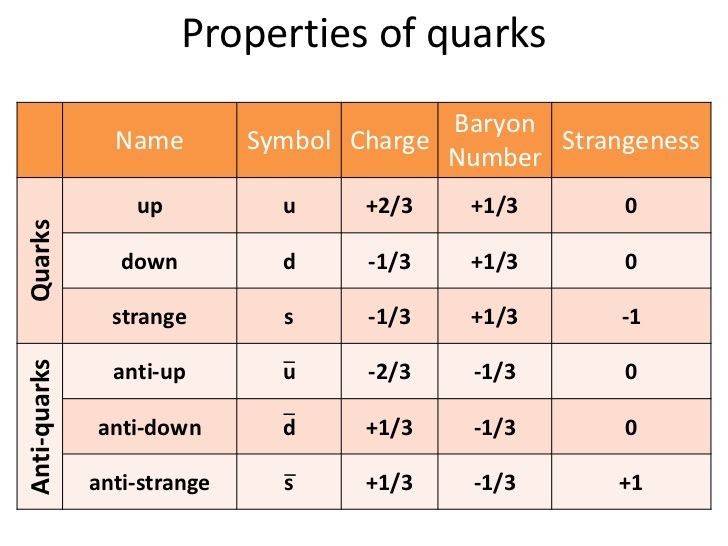
- Quark
Properties
- Neutron Decay
Media attachments


Want to create your own Mind Maps for free with GoConqr? Learn more.