
Mind map
Reason and Experience
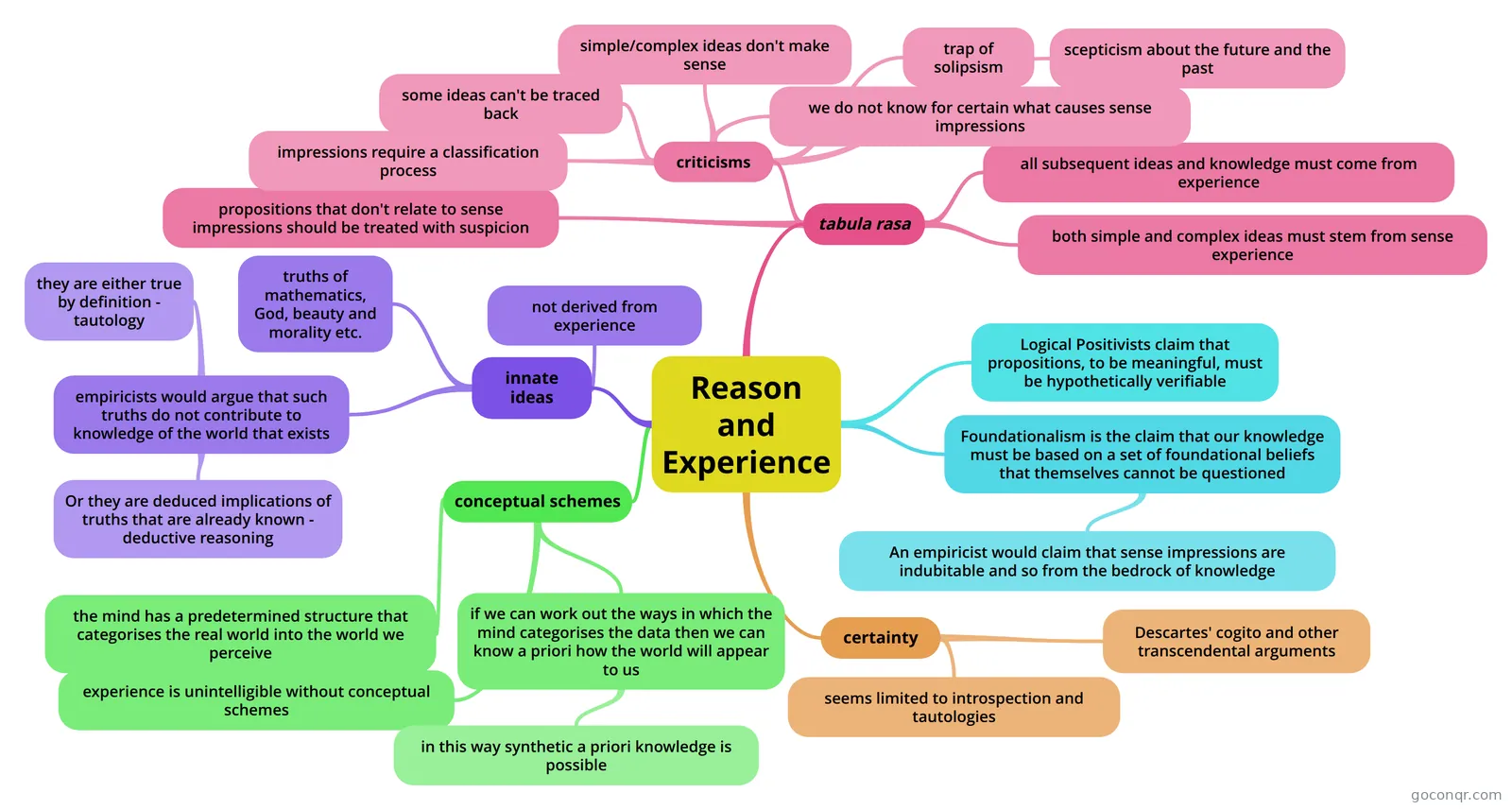
Mind map: Reason and experience
Map content
Reason and Experience
tabula rasa
- all subsequent ideas and knowledge must come from experience
- both simple and complex ideas must stem from sense experience
- propositions that don't relate to sense impressions should be treated with suspicion
- criticisms
- some ideas can't be traced back
- we do not know for certain what causes sense impressions
- impressions require a classification process
- simple/complex ideas don't make sense
- trap of solipsism
- scepticism about the future and the past
Logical Positivists claim that propositions, to be meaningful, must be hypothetically verifiable
Foundationalism is the claim that our knowledge must be based on a set of foundational beliefs that themselves cannot be questioned
- An empiricist would claim that sense impressions are indubitable and so from the bedrock of knowledge
innate ideas
- not derived from experience
- truths of mathematics, God, beauty and morality etc.
- empiricists would argue that such truths do not contribute to knowledge of the world that exists
- they are either true by definition - tautology
- Or they are deduced implications of truths that are already known - deductive reasoning
certainty
- seems limited to introspection and tautologies
- Descartes' cogito and other transcendental arguments
conceptual schemes
- the mind has a predetermined structure that categorises the real world into the world we perceive
- experience is unintelligible without conceptual schemes
- if we can work out the ways in which the mind categorises the data then we can know a priori how the world will appear to us
- in this way synthetic a priori knowledge is possible
Information
- Description
- A-Level Philosophy (Reason and Experience) Mind Map on Reason and Experience, created by lucy-hook on 11/05/2013.
- Created by
- lucy-hook
- Views
- 144
- Tags
- Rating