
Description
|
|
Created by Erika Cobb
over 6 years ago
|
|
Page 1
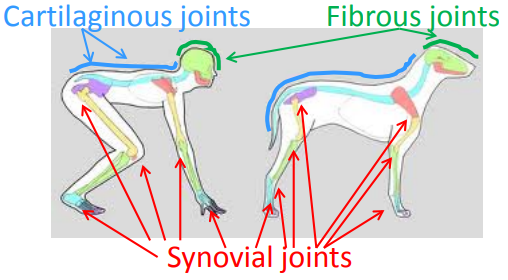
3 Main types of joints: Fibrous Joints: (Synarthrosis) Cartilaginous Joints: (Amphiarthrosis) Synovial Joints: (Diarthrosis)
Page 2
Fibrous Joints: (Synarthrosis) Mainly in skull No articular cartilage, no mobility 2 types: Suture (ossified) and Syndesmosis (not ossified)
Page 3
Cartilaginous Joints Join bones of axial skeleton to other bones No articular cavity, moderate mobility 2 types: Synchondrosis (ossified) and Symphisis (not ossified)
Page 4
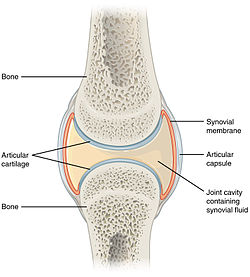
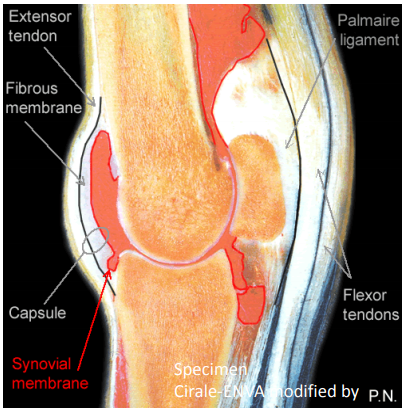
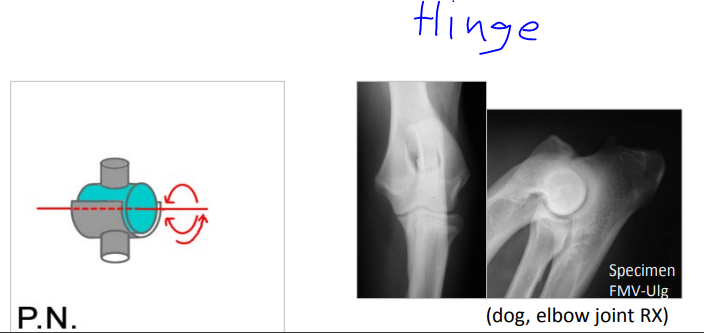
Synovial Joints Articulation of other bones Joint cavity, joint capsule, synovial fluid, articular cartilage, mobility Appendicular skeleton, vertebrae (articular processes), temporo-mandibular Simplification shown in second diagram Types: Simple: 2 bones, eg. scapulo-humeral joint Compound: more than 2 bones, eg. Stifle (femoro-tibio-patellar joint) Spheroid: (ball and socket) 3 axis of movement, eg. coxofemoral joint, shoulder (scapulo-humeral) joint Sellar or saddle: 2 axis of movement, eg. carpus in horse, cervical vertebrae in birds Plane: translation only, eg. costotransverse joint (rib and vertebrae), sacro-iliac joint Condylar: 1 axis of movement (i.e. femoro-tibial joint, temporomandibular joint) Hinge: special form of condylar joint with 1 axis of movement (i.e. elbow joint, cruro-tarsal joint, metacarpophalangeal joint) For protection and maintanence Peri-articular tendons (muscle to bone) Ligaments (bone to bone) Fibrous Membrane (outer layer of the synovial joint capsule) Synovial Membrane (inner layer of the synovial joint capsule) Synovial fluid production (cartilage feeding, joint immunity, joint lubrication)
Page 5
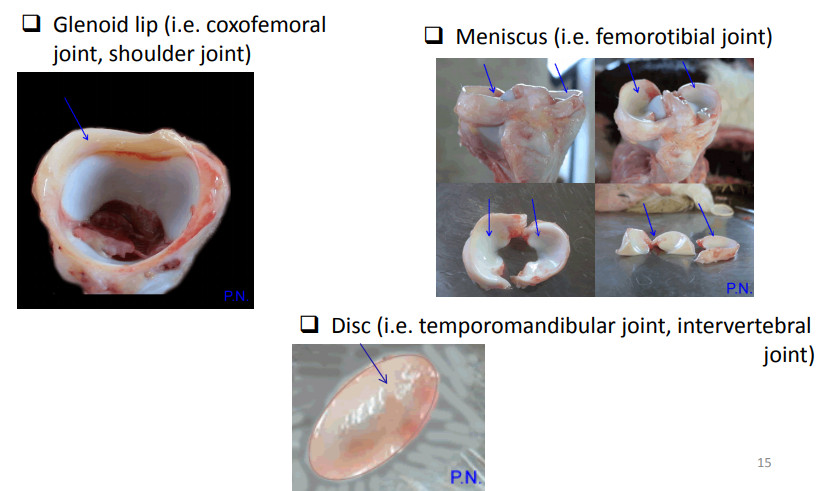
Pressure of Contact: Pressure of contact=applied force/surface area (pressure=force/area) Structures to help with pressure: Glenoid lip Meniscus Disc
Page 6
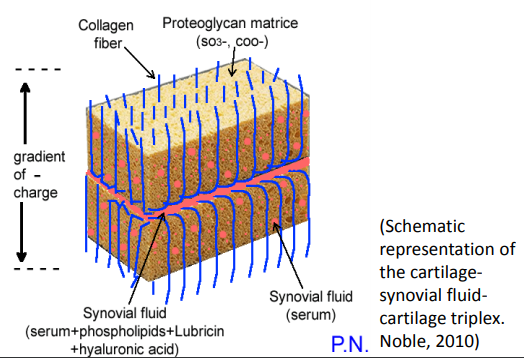
For Minimal Friction: Triplex cartilage-synovial fluid-cartilage The cartilage (proteoglycan matrice+collagen fiber + chondrocytes) is like a sponge the synovial fluid (serum + phospholipids + lubricin + hyaluronic acid + seric proteins) is like a viscous solution. The synovial joint is considered as a perfect tribological system because: The friction coefficient is minimal (0.001-0.05) and the wear is minimal. Lubrication Modes: Self-pressurized hydrostatic lubrication: Joint compression => Synovial fluid escapes from cartilage => Cartilage electrical imbalance increases and retains water => Cartilage hydrostatic pressure increases => Fluid load support increases => Friction coefficient decreases. Boundary lubrication: => Joint compression => Boundary lubricants (phospholipids, lubricin) have a protective role for articular surfaces while hyaluronic acid with escaped water is transformed in gel, increasing viscosity
Page 7
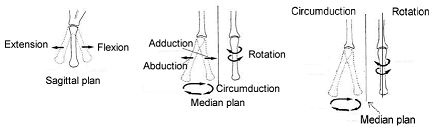
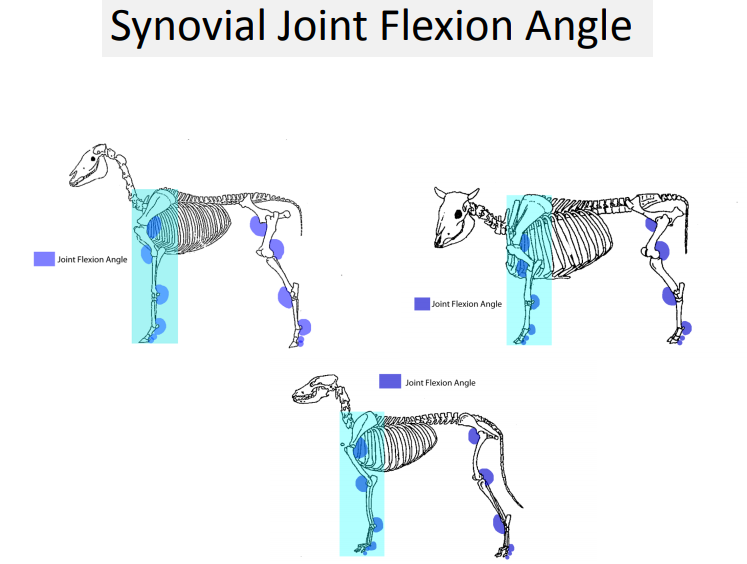
Movement Types: Flexion (joint is closed in the sagittal plane) Extension (joint is opened in the sagittal plane) Abduction (segment is pushed away from the median plane) Adduction (segment is moved closer to the median plane) Rotation (segment rotates around segmental axis) Pronation is a medial rotation of the antebrachial segment whereas Supination is a lateral rotation of the antebrachial segment Circumduction (segment describes a conicle revolution)
Want to create your own Notes for free with GoConqr? Learn more.