
Description


Page 1
Electric Potential and Potential Difference
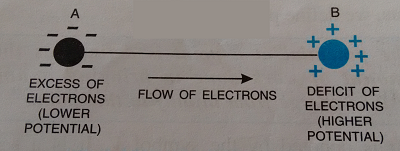
Electric Potential (symbol: V) If two charged conductors are placed in contact with each other the direction of the flow of electrons is determined by a quantity called the electric potential of the conductor. The electric potential depends mainly on the concentration of charges on the conductor (and also it's shape and size). Consider two conductors, one is A with an more electrons than protons and therefore negatively charged, and the second is B with less electrons than protons and therefore positively charged. When A and B are placed in contact with each other (or joined by a metallic wire) electrons will flow from A, which has more electrons, to B, which has less electrons so that eventually both A and B have the same number of excess electrons, or in other words have the same charge.The conductor A with an excess of electrons is said to be at a negative (or lower) potential while the conductor B with a deficit of electrons is said to be at a positive (or higher) potential. Electrons flow from the conductor at lower potential to the conductor at the higher potential.For electrons to flow between two conductors, there has to be a potential difference between them. The SI unit for measuring potential and potential difference is the volt (V). The potential difference between two points is measured using a device called a voltmeter.
END OF NOTE
Want to create your own Notes for free with GoConqr? Learn more.