


Page 1
Work
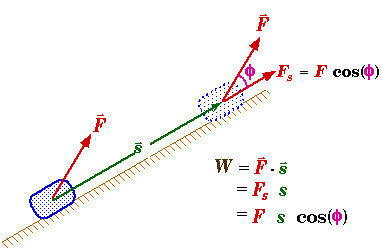
work is equal to the component of the force in the direction of the displacement multiplied by the displacement if F║ and s are in the same direction (0º positive and the object speeds up if F║ is in the opposite direction of s (90ºnegative and the object slows down if F is ┴ to s, then work is zero and the object maintains the same speed because of Newton's 3rd Law, when one body does negative work on a second body, the second body does an equal amount of positive work on the first body
Kinetic Energy
\(K=\frac {1} {2}mv^2\)
\(W=\vec{F} \cdot \vec{d}=Fdcos\theta\)
depends only on mass and speed, not direction of motion can never be negative the K of a particle is equal to the total work that the particle can do in the process of being brought to rest
Work-Energy Theorem
\(W_{tot}=K_{2}-K_{1}=\Delta K\)
Work and Energy with Varying Forces
\(W= \int_{x_{1}}^{x_{2}}F_{x}dx\)
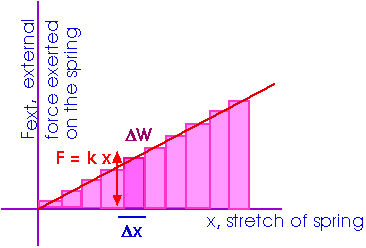
area under the force curve
Springs
\(F=kx\)\(W=\int_{0}^{x} kxdx=\frac {1} {2} kx^2 \)
Power
\(P=\frac {W}{t} = \vec {F} \cdot \vec{v}\)
Gravitational Potential Energy
\(U_{grav}=mgh\)\(W_{grav}=-\Delta U_{grav}\)
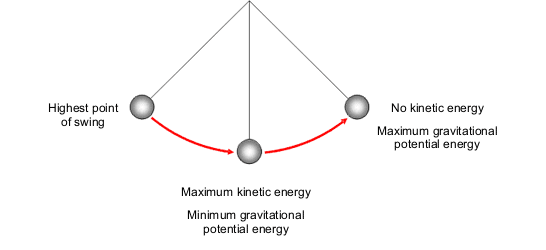
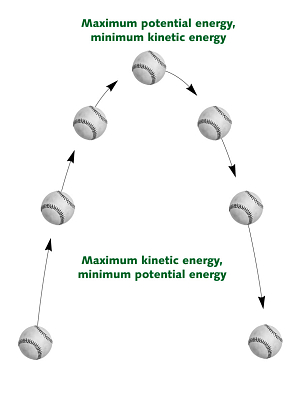
when an object is moving downwards, gravity does positive work on it and its U decreases when an object is moving upwards, gravity does negative work on it and its U increases
Conservation of Mechanical Energy
i
if only gravity does work, then:\(K_{i} + U_{i}=K_{f}+U_{f}= \)\(\frac {1}{2}mv_{i}^{2} +mgh_{i}=\frac {1}{2}mv_{2}^{2}+mgh_{f} \)
:
:
General Case:\(K_{i} + U_{i}+W_{other}=K_{f}+U_{f} \)
Elastic Potential Energy
\(U_{spring}=\frac{1}{2}kx^2\)
Conservative Forces
Nonconservative Forces
allow for two-way conversion between kinetic and potential energies gravitational force and spring force are both conservative forces work done by a conservative force is independent of the path of the body and depends only on the start and end pts when start point and end point are the same, the total work = zero
lost kinetic energy cannot be recovered by reversing the motion; mechanical energy is not conserved when a body slides up a ramp and then slides down to its starting point, friction does negative work in both directions and the system loses mechanical energy air resistance is another kind of nonconservative force
Law of Conservation of Energy
\(\Delta K+\Delta U+\Delta U_{internal}=0\)
F
Force and Potential Energy
\(F_x(x)=-\frac {dU(x)} {dx}\)
A conservative force always acts to push the system toward lower potential energy
In
In three dimensions,\(\vec {F}=-(\frac{\partial U}{\partial x}\hat{i}+\frac{\partial U}{\partial y}\hat{j}+\frac {\partial U}{\partial z}\hat{k})=-\vec{\bigtriangledown}U\), where \(\vec{\bigtriangledown}U\) is the gradient of U
Energy
Energy Diagrams
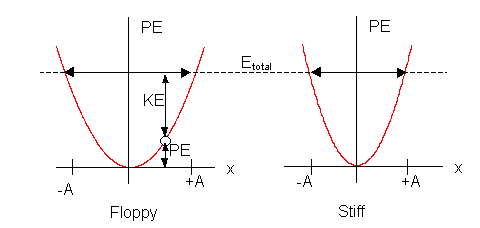
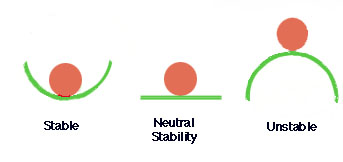
At each point, the force \(F_x\) is equal to the negative of the slope of the U(x) curve -A and A are turning points When a particle is at x=0, the slope and therefore the force are zero, so this is an equilibrium position When x is positive, the slope of U(x) is positive and the force is negative, directed toward the origin When x is negative, the slope of U(x) is negative and the force is positive, directed toward the origin Any minimum in a potential-energy curve is a stable-equilibrium position Any maximum in a potential-energy curve is an unstable-equilibrium position
Momentum
\[\vec {p} = m\vec {v}\]
momentum is a vector quantity with the same direction as the particle's velocity
\[\sum \vec {F}=\frac{d\vec{p}}{dt}\]
The net force acting on a particle equals the time rate of change of momentum of the particle
Impulse-Momentum Theorem
For a constant net force, \[\vec {J} = \sum \vec {F} \Delta t \]Impulse is a vector quantity; its direction is the same as the net force \(\sum \vec {F}\)\[\vec {J} = \vec{p_2}-\vec{p_1}\]The change in momentum of a particle during a time interval equals the impulse of the net force that acts on the particle during that interval
General definition of impulse (can use for varying forces):\[\vec {J}=\int_{t_1}^{t_2} \sum \vec{F}dt\]Also, we can define an average net force \(\vec{F_{av}}\) such that even when \(\sum \vec{F}\) is not constant, the impulse is given by:\[\vec{J}=\vec{F_{av}}(t_2 -t_1)\]
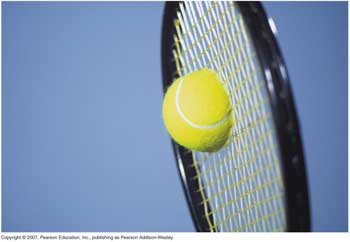

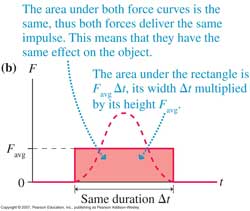
A large force acting for a short time can have the same impulse as a smaller force acting for a longer time if the areas under the force-time curves are the same
Momentum vs. Kinetic Energy
Impulse-Momentum Thm. depends on the time over which the net force acts Work-Energy Thm. depends on the distance over which the net force acts
Conservation of Momentum
Conservation o
Ch 6
Ch 7
Ch 8
Want to create your own Notes for free with GoConqr? Learn more.