
Notas
Unit 4: Plant Anatomy

Conteúdo das notas (3)
Página 1
Basic Plant Cell
Cell is smallest unit which exhibits life characteristics
Features unique to plant cells are cell wall, chloroplasts, plasmodesmata, large central vacuole
Cell wall surrounds cell on outside of the plasma membrane
Made of cellulose which gives shape, protection, strength
Porous, containing channels called plasmodesmata that enable transport and communication between neighboring cells
Plasma membrane regulates specialized movement of substances in and out of cells
Cytoplasmic membrane surrounding a large central vacuole is called a tonoplast
Vacuoles are membrane-ground sacs involved in plant cell growth and storage of water, enzymes, pigments, ions, and waste proucts
Plastids are membrane-bound organelles responsible for photosynthesis, storage of products like starch, and molecule synthesis
Chloroplasts are site of phosynthesis, absorbing sunlight using green pigment, chlorophyll, and converting it into chemical energy or glucose
Sometimes convert to chromoplasts (such as when fruit ripens) which synthesize and store other pigments giving plants distinctive colors
Amyloplasts are responsible for storing glucose molecules produced during photosynthesis by linking them together in long chains of starch
Nucleus is genetic control center of cell that contains chromosomes and is surrounded by nuclear envelope
Mitochondria generate most of cell's chemical energy ATP
Osmosis and Turgor Pressure
Diffusion is movement of particles from high to low concentration
Osmosis - water molecules cross semi-permeaeble membranes moving from more dilute to more concentrated
Hypotonic solutions have lower concentration of solutes relative to cell
Hypertonic solutions have higher concentration of solutes compared to cell
Isotonic solutions contain the same relative solute concentration as the cell
Turgor pressure enables plant to hold itself upright against gravity
Allows plants to swell instead of burst with water intake
Plant cells with correct internal water pressure are said to be turgid
Plants with too little internal water are said to be flaccid or plasmolysed
Loss of water from a plant cell is called plasmolysis
Página 2
Plant Organ Anatomy
Tissue systems
Meristematic & permanent tissue
Primary growth (length) and secondary growth (width) occur from addition of new tissue via mitotic cell division
All plants have primary cell walls which are flexible and can expand as the cell grows
Some plants have secondary cell walls which contain lignin, are inflexible, and provide structural support
Meristematic tissue cells are totipotent (are able to differentiate into the entire variety of mature cell types) and are undifferentiated or incompletely differentiated
Miotic cell division occurs here
Apical, lateral, or intercalary
Once formed, continue as meristematic or become permanent tissue
Small cells with thin walls and dense cytoplasm with small vacuoles
Large, dense nuclei contain chromatin and is located centrally
Meristems can form from other injured cells & aid wound healing
Apical meristems or primary meristems give rise to primary plant body
located at tips of stems and roots enabling plant to extend in length
plant shoot system originates here as leaf and bud primordia, more complex than SAM
Lateral meristems are secondary meristems because they're responsible for secondary growth or increase in girth and thickness in a maturing plant
Not all plants exhibit secondary growth
Intercalary meristems occur at base of leaf blades and at nodes
Enables a leaf blade to increase in length from the base
Permanent tissue cells are no longer actively dividing but are differentiated into cells with distinct functions
ground, epidermal, and vascular
May be living or dead, thin or thick-walled
Meristems produce cells that differentiate or specialize and become permanent to take on specific roles and can no longer divide
Dermal tissues cover and protect plant
Outermost covering
Water regulation, protection, gas exchange
Epidermis is a single layer of cells covering and protecting underlying tissue
Bark is a tough, waterproof outer layer of cork cells that protect woody plants from damage
Epidermal cells are the most numerous and least differentiated of the cells in the epidermis with thin walls, no chloroplasts, and alive at maturity. They secrete a waxy cuticle
The following features have specialized guard cells
Stomata are openings through which the uptake of carbon dioxide and release of oxygen and water vapor can occur on the epidermis of aerial ports of plant
the guard cells on each stoma or pore shrink and swell to control exchange and water loss
They have chloroplasts, are the only epidermal cells capable of photosynthesis
Trichomes are hair-like structures on surface of leaves and stems that develop from epidermal cells
reduce loss of water from shoot system by decreasing flow of air over plant surface
Can increase solar reflectance to protect against UV & overheating
Glandular trichomes can store & exude compounds that defend against herbivory
Root hairs are tiny hair-like extensions of root epidermis that absorb water and mineral nutrients in the soil
Increase root surface to access most amount of soil
Vascular tissue transports water, minerals, sugars to different parts
Consists of xylem and phloem - long distance transport
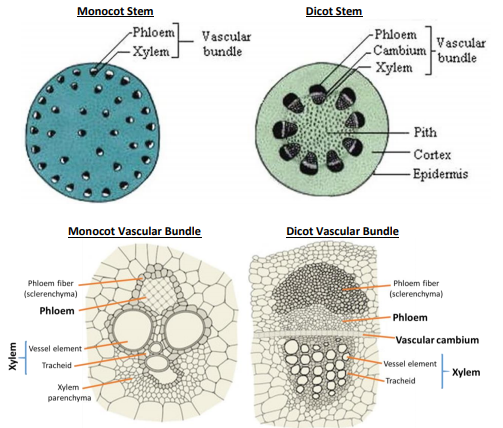
Lie adjacent to each other and are arranged in distinct strands called vascular bundles which run up and down the stem
The vascular bundle includes the phloem and xylem strands, meristematic tissue called vascular cambium sandwiched in between that creates new vascular tissue allowing secondary growth
Xylem conducts water and minerals from roots to leaves via transpiration (loss of water from stomata of plant)
Composed of tracheids, vessel elements, xylem parenchyma, and xylem fibers
Tracheids and vessel elements are dead at maturity & have thick cell wells of lignin, joined end to end to form hollow tube for water flow
pits in side of walls allow water to move from one cell to another
In growing tissue, lignified part of cell wall is in rings or helix allowing extension
In nonexpanding parts, cell wall forms as netlike or pitted structure for mechanical support
Xylem parenchyma are the only living cells in xylem involved in storage
Xylem fibers are sclerenchyma cells in between vessels and tracheids for mechanical support
Phloem tissue are composed of companion cells, sieve tube elements, phloem parenchyma, phloem slerenchyma
Living at maturity
Conduct dissolved sugars and organic molecules in process called translocation that transports products of photosynthesis to parts where energy is needed or stores
Sieve tubes are main conducting channels of phloem and contain cytoplasm but no nucleus
Companion cells are special type of parenchyma cell found alongside sieve tubes that provide energy used during translocation
Sieve tubes & companion cells not lignified
Pholem Parenchyma - storage
Phloem Sclerenchyma - mechanical support
Ground tissue serves as site for photosynthesis, provides a supporting matrix for vascular tissue, and helps store water and sugars
Derived from ground meristem tissue and makes up most of plant body
Metabolism, support and defense
Three types mainly differing on wall structure
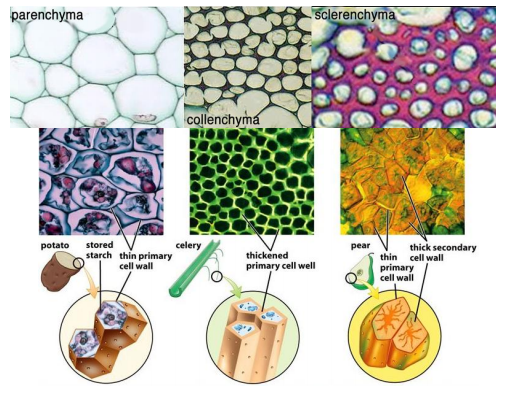
Ground Parenchyma cells are living cells making up bulk of soft internal tissue, commonly called pith
Thin, flexible cell walls
Large water filled vacuoles
Storage and metabolism
May contain sugars, organic acids, defense compounds, and starch
Ground Collenchyma are living cells that are long and narrow with unevenly thick extensible cell walls composed of cellulose and pectin
Found in strands or sheets beneath epidermis (young stems, petioles, leaf veins)
Provide flexible support to actively growing regions
Sclerenchyma cells take over role of mechanical support when growth is complete
Ground Sclerenchyma cells are typically dead, providing structural support and protection to non-growing regions
Cell walls are hard and rigid due to deposition of lignin
Classified as sclereids or fibers based on shape
Fibers are elongated with tapering ends and often occur in bundles
contribute more than half the volume of woody tissue and are found in all stems & leaves that are hard and tough
Sclereids are shorter with more abundant and elaborate pitting
Found in structures like seed coats, walnut shells, peach pits
Página 3
Tissue Arrangements
Stems
Epidermis of stem has distinct cuticle exuded by aerial dermal cells
Vascular bundles arranged throughout
Monocots have scattered vascular bundles without meristematic vascular cambium
Dicots have vascular bundles arranged in a ring with distinct line of vascular cambium seperating xylem from phloem
Outer ground tissue of dicot stem is the cortex, inner tissue is pith
Roots
Epidermis of a root will vary from epidermis of shoots because it won't have cuticle since it needs to absorb soil water
Cortex is composed of parenchyma cells loosely packed for aeration
Storage of extra sugar as starch
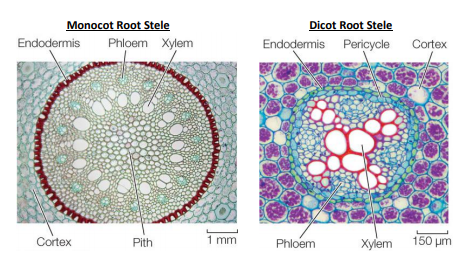
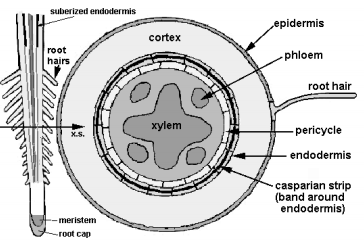
Endodermis is innermost layer of cortex with tightly packed cells with waterproof band known as Casparian strip that regulates flow of water into xylem
Pericycle is a layer of cells just within the endodermis containing meristematic cells where lateral roots emerge from
Stele is the cluster of vascular tissue at the center of the root
In dicots, will appear as an X
In monocots, will form a ring around pith (parenchyma cells similar to the cortex)
Leaves
Epidermis of leaves will have distinct cuticle as well as an upper and lower epidermal layer
Stomata mostly on underside of the leaf to protect from dust and debris and keep sheltered from direct light so water loss is limited
Dicot leaves appear different from monocots in that they have distinct palisade and spongy mesophyll (middle leaf) cells
Palisade cells will be rectangular, filled with chloroplasts, occur just below the upper epidermis
Main photosynthesizers in leaf
Spongy cells are smaller and irregular occuring closest to lower epidermis, large air pockets ensure space for gas exchange
Monocot leaves have regularly occurring vascular bundles that can be seen in cross section due to parallel venation
Reticulate venation of dicots means a cross section will only capture a few veins perfectly across so their vascular bundles will appear more irregular and scattered
Informações
- Descrição
- Notas sobre Unit 4: Plant Anatomy, criado por Sophia Wright em 21-09-2019.
- Criado por
- Sophia Wright
- Visualizações
- 1.411
- Avaliação